


TL;DR
- Written for university students, engineering freshers, and technology learners who want to understand drone swarm applications across key industries without prior background in robotics or aerospace.
- A drone swarm is not simply a group of drones flying together – it is a coordinated, autonomous system where each drone makes independent decisions based on shared data and programmed rules, much like birds in a murmuration.
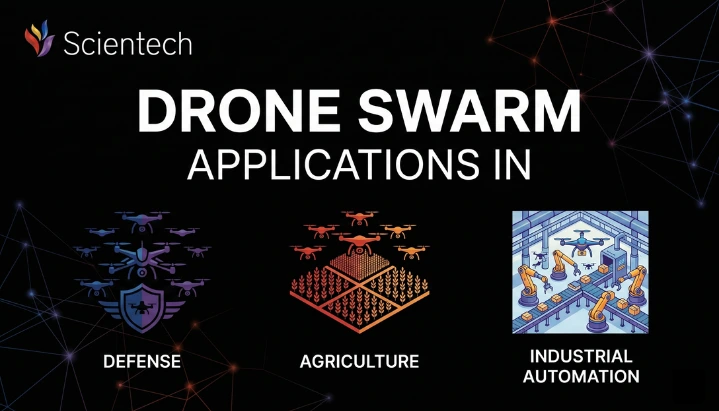
- Drone swarm applications span three major sectors: defense (surveillance, precision strike, electronic warfare), agriculture (crop monitoring, spraying, seeding), and industrial automation (infrastructure inspection, warehouse inventory, logistics).
- The technology behind a swarm drone system relies on AI, distributed algorithms, local sensing, and mesh communication – not a single control center managing every unit.
- Understanding drone swarms today prepares students for careers in robotics, AI systems, aerospace engineering, and autonomous vehicle development, all of which are projected to grow significantly through 2030.
Envision a flock of starlings flying through the air. A thousand birds take turns redirecting their course, creating smooth, undulating movements that don’t follow a conductor, have no leader, and don’t collide with one another. Each bird continuously adjusts its movement based on the behavior of nearby birds. Each bird simply responds to its nearby neighbours, and the resulting collective behaviour appears almost intelligent.
A drone swarm is built on a similar principle.
A group of drones that can collaborate and work together like ants, bees or birds is called a Drone Swarm. Unlike natural systems, engineered drone swarms are designed to achieve specific objectives. Each drone in the swarm is equipped with sensors, communication ability and rules that are hard coded in the drone’s onboard computer that enables them to react to their environment as well as other drones in real time.
It’s not science fiction. Drone swarms are already being deployed in military operations, agricultural environments, and industrial settings around the world. This is an exciting area for those interested in gaining an understanding of what technology is today, and where it will take them in the future, in the many fastest growing career areas of engineering and AI.
In this blog, you will learn the meaning of drone swarms, the technology’s mechanics, and the areas where swarm drone systems are having the greatest impact.
Also read,
- Drone Technology in Disaster Management: How UAVs Are Transforming
- Drone Delivery: Future of Last Mile Logistics Explained
- Practical Projects Engineering Students Can Build Using AI Learning Platforms
What Is a Drone Swarm?
It’s crucial to know the difference between a drone swarm and a bunch of drones flying around before exploring real-world applications.
A drone swarm is a group of unmanned aerial vehicles (UAVs) that operate collaboratively while making distributed decisions autonomously. These drones can communicate with one another, share sensor data, and make coordinated decisions with limited human intervention.
Consider it in this way. Ten people controlling ten drones each with its controller from afar is indeed remote operation at scale! On the other hand, a drone swarm coordinates itself autonomously. Drones themselves coordinate. They convey information about where they are, divide up jobs, avoid a collision, and adapt to changes in circumstances without any human needing to oversee them individually.
It has some important features: decentralized decision making, where each drone individually makes a decision based on some pre-programmed rules, local conditions and actions of other drones. No central controller is required for local coordination, although many real-world swarm systems still operate under mission-level supervision, centralized planning, or human oversight.
Three Levels of Swarm Coordination
There are three levels of drone swarms, from most simple to most complex: coordinated (swarms that move together with simple awareness of the environment and collision avoidance), cooperative (swarms that divide and coordinate tasks to accomplish objectives more efficiently than individual drones operating independently), and collaborative (swarms in which different types of drones coordinate dynamically and adapt their roles to achieve complex mission objectives).
This progression matters. A coordinated swarm is relatively simple. Cooperative swarms share tasks, while collaborative swarms involve multiple drone types dynamically working together toward complex objectives.
How a Swarm Drone System Actually Works
The implementation of drone swarms can involve sophisticated computer algorithms, local sensing and communication systems to coordinate multiple drones for a given task.
The drones use GPS to locate themselves, internal sensors to take in their surroundings, and wireless communication methods to share data with other drones. Drones share only the information necessary for coordination through radio frequencies, Wi-Fi, or other wireless technologies.
It’s ironic that one of the good things about effective swarms is that they try to limit the amount of communication or tolerate poor communication with low bandwidth, intermittent connections and lossy links. Coordination does not require flooding of data but only local sensing and occasional updates. Excessive communication can create network congestion, so effective swarm systems rely on efficient information sharing.
Swarms are resilient with this design philosophy. In the event of a drone failure, the remaining drones can continue operating. Depending on the swarm architecture, local rules may allow the swarm to continue limited operations even when communications are degraded or partially jammed.
Drone Swarm Applications in Defense
Drone swarm systems have long been a key concern in the military realm, and were one of the first areas to gain strategic importance. The reasons are simple: swarms are scalable, redundant and cost-effective compared to traditional manned systems.
Surveillance and Reconnaissance
A single surveillance drone can cover only a limited area. A swarm of drones can cover significantly larger areas than a single drone, depending on swarm size, flight endurance, and mission requirements, and feed information into a common intelligence picture. Distributed sensing is enabled by drone swarms, enabling real-time monitoring over large operational theaters with precise data and detection of anomalies.
This is especially useful in the field of border surveillance, maritime domain awareness and disaster zone assessment where timely and comprehensive coverage are essential.
Precision Strike and Saturation Attacks
In many advanced swarm concepts, drones may have different roles and capabilities. Some are used for intelligence, tracking or electronic warfare, while others are used for direct engagement.
The advantage of Swarms is that they can overload traditional air defense systems. In a contested battlefield environment, dozens or hundreds of drones can launch at once, outflanking the ability of traditional defense systems that are optimized for tracking and eliminating individual drones.
This is no longer a theoretical concept. In January 2025, NewSpace Research and Technologies reportedly received a contract related to swarm drone capabilities for the Indian Army. HAL has also participated in various autonomous drone and swarm-related research initiatives. India’s move in this area reflects the importance of swarm capability in the modern military doctrines of the world.
Electronic Warfare and Decoy Operations
In addition to physical strikes, drone swarms can be utilised to help confuse enemy radar and defence systems. Specialized drones equipped for GPS jamming or radar deception can mislead enemy targeting systems, while dedicated counter-drone platforms may support both hard-kill and soft-kill defense operations.
Strategic logics are obvious: the defenders may need to deploy disproportionately expensive defensive systems to counter a large swarm, so they are being forced to pick up the bill for the attackers.
Drone Swarm Applications in Agriculture
The shift from defense to agriculture might seem unexpected, but the same properties that make drone swarms effective in warfare, namely scale, autonomy, and coordinated sensing, make them equally powerful in farming.
India, with over 140 million hectares of agricultural land, could benefit significantly from this technology, particularly in regions facing labor constraints and large-scale farming challenges.
Crop Monitoring and Health Assessment
Swarms of drones are more effective and faster than individual drones for agriculture. Drone swarms can provide real-time insights, field-level monitoring, flexibility, and automation. They can simultaneously survey crops, analyze plant health, and support precision agriculture operations, in contrast with manned systems or satellites.
Consider the scale of the challenge. In a 500-acre field, manually inspecting every row for signs of disease, pests, or nutrient deficiencies is impractical. Aerial surveys using a swarm of agricultural drones with multispectral camera systems can help to create health maps of a whole field in a matter of hours and help to find patches of disease in time to stop it from spreading.
Precision Spraying and Seeding
Drone swarms can be used to plant seeds, survey large tracts of land for disease, and deliver crop treatments with greater precision than many ground-based systems. Swarms can also be used in conditions where fields are uneven, are flooded with water, or are not accessible to tractors, but can adapt to conditions as they occur.
Using drone swarms, limitations such as low payload capacity can be distributed across multiple drones, improving operational efficiency. Multiple drones can cover larger areas simultaneously, improving operational efficiency.
Cost Efficiency Over Time
The business case for using agricultural drone swarms is growing. Over time, drone swarms can reduce operational costs in suitable large-scale deployments, primarily through labor savings and more efficient resource utilization.
Today’s barrier is initial hardware and software investment. While component costs continue to decline and regulatory frameworks continue to mature, agriculture is widely considered one of the most promising sectors for large-scale swarm drone adoption.
Drone Swarm Applications in Industrial Automation
Beyond defense and agriculture, swarm drone systems are finding critical roles in industrial environments where physical inspection and monitoring are expensive, slow, and dangerous for human workers.
Infrastructure Inspection
In the industrial sector, drone swarms are used for infrastructure inspections of bridges, pipelines, and power facilities, delivering accurate data and identifying potential issues.
Consider a long-distance oil pipeline running through remote terrain. Traditional inspections often require helicopters, ground personnel, and significant time investment. A swarm drone system can inspect long sections of a pipeline and identify potential leaks, corrosion, or maintenance issues. By combining thermal imaging and automated analysis, inspections can often be completed faster and more cost-effectively than traditional methods.
There are opportunities like power grids, telecom towers, wind turbines and large industrial plants, but the opportunities are not only in inspection but also in frequency. Swarms allow for continuous monitoring to be economical so that predictive maintenance is possible, not reactive repair.
Warehouse and Inventory Management
Early forms of multi-drone coordination are already being tested in commercial warehouse operations. Companies such as ZenaDrone are testing multi-drone systems for warehouse inventory management, using coordinated drones to capture real-time data on shelving, stock levels, and inventory movement. These are not GPS-based systems, but instead use visual markers or LiDAR mapping and are only currently used in warehouses, but they show how distributed coordination can help to cut down on manual work and speed up logistics operations.
In an eCommerce warehouse with thousands of SKUs, drone-based inventory scanning helps cut down on human error and can speed up stock take to a whole new level.
Emergency Response and Disaster Management
Another high impact application is emergency management. Drone swarms can help search for missing persons and supply emergency aid and assistance in times of natural disasters.
The ability to provide aerial support to wildfires, such as aerial surveys in order to assess damages, locate access points and support firefighting operations through aerial monitoring, hotspot detection, and improved situational awareness with little human input, is also an application that could be achieved with the help of an aerial drone swarm.
Swarm drone deployments could be invaluable during future flood-response missions in regions such as Himachal Pradesh or during cyclone-response operations along the Indian coast.
Challenges Facing Swarm Drone Technology
No technology discussion is complete without addressing limitations. For students and professionals evaluating this field, challenges are as instructive as capabilities.
Regulatory frameworks remain underdeveloped. Most aviation authorities, including India’s DGCA, are still building rules for autonomous multi-drone operations, particularly in civilian airspace.
Cybersecurity risks are significant. A hacker could redirect a drone swarm for malicious purposes, raising genuine concerns over safety, cybersecurity, and privacy.
Software maturity is a bottleneck. Operational readiness depends heavily on software maturity and regulatory approval. While much of the required hardware already exists, software maturity and certification frameworks continue to evolve and have yet to fully match the industry’s ambitions.
Cost at scale remains a challenge in agriculture particularly, though this is improving steadily as component prices fall and manufacturing volumes rise.
Future of Drone Swarm Systems
The long-term direction of this technology appears promising. Swarms will shrink, and get smarter, less expensive, and more independent. As AI capabilities improve, swarm systems are expected to handle more decision-making autonomously while humans retain supervisory control.
The future of conflict may include cooperation between air, ground, and sea drones to create an all-encompassing and automated military ecosystem.
Agriculture is widely viewed as one of the most promising large-scale markets for swarm technology, where fleets of small UAVs could complement or partially replace traditional spraying and monitoring equipment as regulations mature.
The way forward for industrial automation is paved with regulatory clearance and cost savings, which are both moving well. Pilots are already underway to an extent in sectors such as logistics, construction, and energy infrastructure.
Engineers, computer scientists, robotics specialists, and AI professionals entering the workforce today are joining a field where drone swarm technology will remain a major focus of innovation, deployment, and policy discussion for at least the next decade.
Conclusion
Drone swarms are one of the most significant combinations of AI, robotics, and autonomous systems in the last few decades. It started as a concept based on biological behaviour and has grown into operational technology used by militaries, fielded on farms and trialled in industrial facilities across the world.
At a fundamental level, drone swarms represent collective machine intelligence. A swarm of drones is not necessarily “brilliant,” but the system is.
The main lessons to be learned for university students and technology learners are simple:
In a swarm drone system, coordinated decision-making across multiple drones often produces better results than relying on a single drone operating independently. There are currently several drone swarm applications in the field, including in defense, agriculture and industrial automation, each bringing their own unique technical and regulatory challenges. India is also part of this technological race and there are development programs in military and agricultural systems at home. The prerequisites for this sector are the skills of AI and machine learning, embedded systems, wireless communication, control theory, and autonomous vehicle design.
The drone swarm field is closely connected to some of the world’s most active areas of research, innovation, and investment, if you are a student seeking to create a career in technology. Learn the fundamentals of autonomous systems, explore open-source UAV simulation platforms such as PX4 and Gazebo, and follow the latest swarm robotics developments from organizations such as DRDO, HAL, and research groups across the IITs.
For aspiring engineers and technologists, drone swarms represent only the beginning of a much broader autonomous systems revolution.
FAQs
A drone swarm refers to a group of unmanned aerial vehicles that operate together autonomously, coordinating their movements and tasks through AI, sensors, and wireless communication rather than individual human control. Each drone follows shared rules and local data to function as part of a unified system.
In separately controlled drone operations, each unit requires a dedicated operator and operates independently. In a swarm drone system, drones communicate with each other and coordinate as a collective, requiring far less human intervention. The swarm adapts dynamically to mission changes, failures, or obstacles without direct operator input for each unit.
Most active real-world drone swarm applications include military surveillance, border monitoring, precision agriculture (crop spraying and field monitoring), infrastructure inspection in the energy sector, and warehouse inventory management. Emergency response and wildfire management are emerging applications receiving significant research attention.
Yes. In January 2025, NewSpace Research and Technologies was reported to have secured a contract related to swarm drone capabilities for the Indian Army. HAL has also participated in autonomous drone and swarm-related initiatives. This reflects India’s growing focus on indigenous autonomous defense technology.
Key areas include artificial intelligence and machine learning (for autonomous decision-making), embedded systems programming, wireless communication protocols, control systems engineering, and computer vision. Familiarity with simulation environments like Gazebo, ROS (Robot Operating System), and drone firmware platforms such as PX4 provides a strong practical foundation.
Primary challenges are regulatory approval for autonomous multi-drone flights in civilian airspace, cybersecurity vulnerabilities that could allow malicious actors to intercept or redirect swarms, high initial deployment costs particularly in agriculture, and software complexity required to coordinate large numbers of drones reliably across varied environments.

