

TL;DR
- This blog is for engineering students, university freshers, and technology learners who want to understand what an autonomous drone is and how AI is transforming UAV technology from the ground up.
- Traditional drones need a human to control every movement, but autonomous drones use AI to see, think, and fly on their own making them far more powerful and versatile.
- Intelligence behind an autonomous drone comes from three layered technologies: computer vision for perception, machine learning for decision-making, and real-time onboard processing for execution.
- India is rapidly building its own autonomous drone ecosystem, supported by hundreds of drone startups, government initiatives, and increasing adoption across agriculture, logistics, infrastructure, and defence.
- If you are an engineering student today, skills in AI, embedded systems, robotics, and UAV systems position you directly for one of fastest-growing career tracks in both India and global technology markets.
Imagine a drone flying into a flood-affected area, mapping the region, locating trapped victims, and sending their coordinates to rescue teams without a pilot actively controlling it. No manual navigation. No real-time remote guidance. The drone makes decisions independently based on the conditions it encounters.
This is no longer a science-fiction concept. Autonomous drones are already being deployed today across industries, although many people are still unaware of the scale of their impact.
Autonomous drones are one of the most exciting technologies for engineering students to explore today. They combine AI, robotics, aerospace engineering, embedded systems, and computer science, creating significant opportunities across multiple industries.
This blog will take you through what exactly an autonomous drone is, how artificial intelligence is making it work, what it’s being used for, how India is getting in on the game and what that means for you as a student or early career.
Also Read,
- Drone Technology in Disaster Management: How UAVs Are Transforming Emergency Response
- Drone Delivery in Last Mile Logistics: Future, Benefits & Challenges
- Practical Projects Engineering Students Can Build Using AI Learning Platforms
What Is an Autonomous Drone?
The concept of an autonomous drone begins with that of an ordinary drone. A standard UAV (Unmanned Aerial Vehicle) is a flying machine that is controlled by a person on the ground. A person on the ground directs the drone up, down, left, right. The drone is not doing anything but executing those commands.
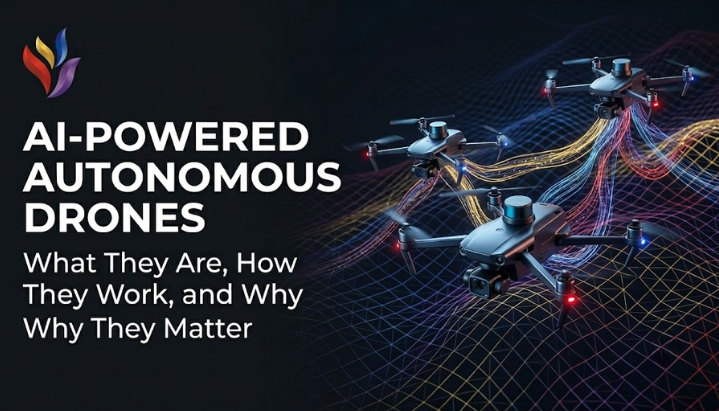
But an autonomous drone is a different beast. It can take off, fly around, avoid obstacles, accomplish a mission, and land all on its own through its interpretation of environment and decision making.
An easy rule of thumb: A common drone is like a puppet and humans are pulling all strings. An autonomous drone is more like an automated pilot system: it can perceive its surroundings, evaluate available information, and respond to changing conditions without continuous human control.
This transition is all thanks to AI. A drone can’t see what’s going on around it, identify objects, or determine what to do if it comes across something it didn’t expect without AI. The drone also uses AI, transforming it from a remote-controlled toy into a smart drone.
The technical definition is clear and concise: An autonomous drone is an unmanned aircraft that uses AI technologies to carry out operations without much or any human involvement. It brings together sensors, cameras, on-board computers, GPS systems, and intelligent algorithms into a single system, which can function autonomously.
How AI Powers an Autonomous Drone
Here is where things get genuinely interesting, especially if you are studying computer science, electronics, or aerospace engineering.
Intelligence of an autonomous drone is not a single technology. It is a stack of interlocking systems, each solving a different problem. Think of it as three layers working together: the drone must first see the world, then understand what it sees, and finally decide what to do next.
Layer 1: Perception How Drone Sees
To make any decision a drone needs to collect information about the world around it. This is achieved by a combination of sensors and cameras which operate in parallel, continuously while flying.
The most crucial technologies of this layer are cameras connected to computer vision algorithms. Computer vision enables drones to analyze images in real-time, not only take photos or videos, but analyze what’s in frame. A drone can recognize objects, sense edges and shapes, determine distances and distinguish between tree, person, building and path.
Then there are added dimensions of LiDAR (Light Detection and Ranging) sensors. LiDAR shines light from a laser at ground and detects the time it takes for light to reflect. outcome: an accurate 3D map of the drone’s environment (with a precision of centimeters). This can be particularly useful in low-light environments and situations where camera-based perception may be less reliable.
Other sensors include ultrasonic proximity sensors that detect obstacles in immediate vicinity, barometers that measure altitude, GPS for positioning and IMUs (Inertial Measurement Units) that detect motion, acceleration and orientation. This information all goes into the drone’s processor at same time, creating a live, real-time view of the environment.
Layer 2: Understanding What Machine Learning Contributes
Raw sensor data by itself means nothing. A drone needs intelligence to interpret it. This is where machine learning comes in.
Machine learning models are trained on enormous datasets thousands or even millions of examples of images, flight paths, obstacle scenarios, and environmental conditions. Through this training, AI learns to recognize patterns. It learns what a human silhouette looks like from an aerial view. It learns what a clear flight path looks like versus one with obstacles. It learns how wind or rain affects stability and adjusts for it.
Deep learning models particularly Convolutional Neural Networks (CNNs) are especially powerful here. They excel at processing image data and identifying objects with high accuracy, even in complex, cluttered environments. This is what allows a delivery drone to spot a landing zone on a doorstep, or a search-and-rescue drone to detect a person lying in dense forest cover.
Another key capability is path planning. AI does not just react to obstacles it has already reached, it predicts where obstacles might be and calculates the safest route in advance. Advanced systems can handle dynamic obstacles too, like a bird flying into a path or a vehicle moving below.
Layer 3: Decision-Making Onboard Processing and Edge AI
After a drone has sensed the environment and has figured out what it should do, it must do it. It must work quickly at times in milliseconds.
This is a challenge of processing in a vessel. A drone can’t transmit all of its sensor information to a distant server, receive instructions, and then return a response. By then the drone could have already crashed. Rather, today’s autonomous UAS rely on edge AI, which refers to AI computing performed on an autonomous drone’s onboard systems, not on cloud.
In areas where there is no internet access, purpose-built processors such as the NVIDIA Jetson series enable drones to execute advanced AI models in real-time. This will truly make drones self-sufficient. It senses, processes and reacts within itself.
It is this combination of perception, understanding and real-time decision-making that makes an autonomous drone what it is and different from all previous types of aircraft.
Levels of Autonomy in Drones
Not all drones that are labeled “autonomous” are as independent as one another. As you may have heard, self-driving vehicles have various degrees of autonomy and UAVs are no exception.
On low end, semi-controlled drones can maintain altitude, fly back to their starting point on their own and navigate using a preprogrammed GPS path. There is still a human in control and can take over at any time. Consumer photography and entry-level commercial applications make use of these types of drones.
At an advanced level, highly autonomous drones can perform most mission tasks without continuous human control, although human supervision may still be required depending on regulations and application requirements. They are independently capable of take-off, dynamic flight, avoiding obstacles, achieving their set task and return flight. Applications include precision agriculture, infrastructure inspection, search and rescue.
A more advanced concept is swarm autonomy, where multiple drones operate as a coordinated system. The drones communicate with one another, share information, and collectively make decisions. Swarm drones can split up a large area and work at same time, share information, and adjust their work when a drone has a problem. One of the most studied fields of UAV today.
Real-World Applications of Autonomous Drones
Understanding what an autonomous drone is becomes a lot more concrete when you see where it is actually being deployed. The range of applications is wider than most people expect.
Agriculture
One of the most important fields and its impact, especially in a developing country such as India. Autonomous drones fitted with multispectral cameras and AI models could cover an entire farm in one pass, and identify problems with the health of crops that are not visible to the naked eye. They detect regions receiving under-irrigation, as well as early signs of pest infestations, and produce field maps for precision input decisions regarding fertilizer and watering.
In India, where many smallholder farmers have no access to expensive ground equipment, an independent service where a drone covers a field in minutes is a real leap in the agricultural world.
Delivery and Logistics
One of the most interesting uses in commerce is delivery. Amazon’s Prime Air program has already shown that autonomous drones with AI technology that can see obstacles and navigate routes and land exactly can do Beyond Visual Line of Sight (BVLOS) deliveries. The idea of using drones to transport medical items like medicines, blood samples, corneal tissues is already gaining traction in India, with a successful delivery of corneal tissue taking place in December 2024.
Infrastructure Inspection
Autonomous drones are increasingly used for inspecting bridges, power transmission lines, railways, oil pipelines, solar farms, and industrial facilities. Equipped with high-resolution cameras and AI-powered defect detection systems, they can identify cracks, corrosion, thermal anomalies, and structural defects without requiring manual inspections. This improves worker safety, reduces inspection costs, and enables faster maintenance planning.
Disaster Management and Search and Rescue
After floods, earthquakes, or fires, the ability to quickly assess damage and locate survivors is critical. Autonomous drones can enter unstable environments too dangerous for human responders, map affected areas in real time, and use thermal imaging to detect heat signatures that indicate survivors. The speed and coverage they provide in these scenarios is unmatched by any other tool.
Defence and Surveillance
In defence applications, autonomous drones handle reconnaissance, border monitoring, and target identification. The global military UAV market was valued at USD 15.23 billion in 2024, reflecting the scale of investment in AI-powered drone systems for defence use.
India’s Autonomous Drone Ecosystem
It is equally vital for Indian students to know the local scenario of autonomous drone technology as it is to know technology.
India is developing one of the most advanced drone ecosystems in the world. The government has made a definite move to become a global hub for drone manufacturing by year 2030 with policy changes of the last four years being substantial. Drone Rules 2021 streamlined the compliance process significantly, moving away from a 25-layer approval process to a more user-friendly one, thus paving the way for small businesses and independent drone operators.
As of September 2024, India had more than 10,000 commercial drones registered. As of 2024, there were more than 30,000 direct jobs in the sector in manufacturing, operations, training and support services. More than 350 startups in the drone industry have been recognised by DPIIT and more than 60 of these have been supported by VC funding. India’s drone industry is expected to become valued at Rs. 15,000 crore by 2030.
Digital Sky is the DGCA’s online platform for drone registration, approvals, pilot certification, and regulatory compliance.
The government also created a National Innovation Challenge for Drone Application and Research (NIDAR) to get students and researchers involved in creating autonomous drones for disaster management and precision agriculture. NIDAR offers a prize pool of Rs. 40 lakh and provides startup incubation support and also facilitates start-up incubation, which in turn is a direct entry into the process for technically motivated students.
Schools such as Technology Innovation Hub on Autonomous Navigation (TiTHAN) at IIT Hyderabad and programs at various NITs throughout the country are already integrating autonomous drone research into engineering courses, conducting workshops and collaborating with industry to provide students with practical experience in developing an UAV.
Challenges in Autonomous Drone Development
While autonomous drones are powerful, the road to their full-scale deployment is not easy. Understanding of these challenges is important technically and practically.
Regulatory complexity is still a high concern. Although India’s regulatory framework has become significantly more streamlined, BVLOS operations still require additional approvals and regulatory compliance, which can increase operational complexity for startups and commercial operators.
Flight endurance and operating range remain significant challenges. Improvements in battery technology are needed to extend mission duration without increasing weight. One of the biggest challenges of hardware engineering is increasing flight endurance while keeping the weight of the new design reasonable. Hydrogen fuel powered UAVs have been tested and have potential to increase flight time by as much as 300% over battery powered systems and are still at commercialisation phase.
Another crucial one is AI robustness in edge cases. A model that works in typical lighting conditions can be ineffective in unusual lighting or in weather conditions or situations it was not trained for. It is hard to ensure autonomous decision-making is reliable under all real-world conditions especially when dealing with huge amounts of training and testing.
Drones are now becoming networked and connected devices, thus making cybersecurity an even bigger concern. In defence and critical infrastructure sectors, an autonomous drone that can be hacked or spoofed poses a safety and security threat.
Autonomous Drones and Future: Swarms, 5G, and Beyond
The trajectory of autonomous drone technology over the next decade points to capabilities that go well beyond what is deployable today.
Swarm technology is perhaps the most transformative direction. Instead of one drone completing a task, swarms of hundreds or thousands of coordinated autonomous drones can work simultaneously, covering vast areas in a fraction of time. Swarm AI requires each drone to communicate with its neighbours, make local decisions, and contribute to collective outcomes, a fundamentally different computational challenge from single-drone autonomy.
The rollout of 5G networks is a major enabler. 5G’s low latency and high bandwidth allow drones to share large data volumes in real time, improving coordination between swarms and between drones and ground control systems. This is particularly relevant for urban drone operations and large-scale logistics networks.
Edge AI will continue to evolve. As onboard processors become more powerful and energy-efficient, drones will be capable of running increasingly sophisticated AI models without any cloud dependency making them viable even in remote, connectivity-denied environments.
integration of large language models and agentic AI frameworks into UAV systems is also being explored actively. Research published in 2024 assesses potential of LLMs for interpreting high-level human instructions and translating them into drone mission plans, opening up a future where you could simply describe a task in natural language and a drone would execute it.
The global AI-in-drone market, valued at approximately USD 17,828.4 billion in 2024, is projected to exceed USD 61.64 billion by 2033 at a compound annual growth rate of approximately 17.9% a clear signal of where investment and opportunity are headed.
Career Pathways for Engineering Students in Autonomous Drone Technology
If you are an engineering student reading this and wondering how this connects to your future, the answer is: directly and significantly.
Autonomous drone development draws from almost every engineering discipline. AI and machine learning engineers build perception and decision models. Embedded systems engineers design onboard hardware and real-time processing architectures. Electronics and communication engineers work on sensor integration, communication protocols, and signal processing. Aerospace and mechanical engineers handle aerodynamics, structural design, and propulsion. Software engineers build mission planning systems, data pipelines, and ground control software.
Some of specific roles emerging in this domain include UAV Avionics Engineer, AI Autonomy Engineer, Drone Systems Designer, UAS Operations Manager, and Systems Integrator connecting drones with AI, 5G, and cloud platforms. Demand for engineers with skills specifically in swarm coordination, edge AI, obstacle avoidance, and BVLOS operations is growing rapidly.
In India, combination of government support, a growing startup ecosystem, and increasing adoption across agriculture, logistics, and defence creates a domestic job market that is expanding year by year. Programs like SwaYaan India’s capacity building initiative for human resource development in the UAS have already benefited over 26,000 participants and continue to scale.
For students at undergraduate level, pathways worth exploring include participating in NIDAR, taking drone technology workshops at institutions affiliated with IIT Hyderabad’s TiTHAN hub, pursuing DGCA Remote Pilot Certification, and building foundational skills in Python, OpenCV, ROS (Robot Operating System), and basic machine learning all of which are directly applicable to autonomous UAV development.
Conclusion
Autonomous drone technology is not a niche specialisation for experts in defence labs. It is a fast-moving, deeply practical field that is reshaping agriculture, logistics, disaster response, infrastructure management, and national security and it is doing so right now, in India and across the world.
Understanding what an autonomous drone is means understanding convergence of AI, computer vision, machine learning, edge computing, and aerospace engineering into a single flying system capable of independent thought and action. It is one of the most concrete examples of artificial intelligence producing real-world, life-changing outcomes.
For engineering students in India, this is not a distant future technology. It is an active career opportunity backed by government policy, startup investment, and a regulatory environment that is progressively opening up. NIDAR challenge, DGCA certifications, and academic programs at institutions across the country make this more accessible than ever.
The best time to engage with this space is during your student years, when you have flexibility to experiment, learn, build, and compete. Start with foundations, build practical skills, and keep following how this technology evolves because it is evolving fast.
FAQs
An autonomous drone is an unmanned aerial vehicle (UAV) that uses artificial intelligence to fly, navigate, and complete tasks on its own, without needing a human to control it at every step. It perceives its environment through sensors and cameras, processes that data using AI algorithms, and makes real-time decisions about where to go and what to do.
A regular drone requires a human operator to control its movement using a remote controller. An autonomous drone uses onboard AI to handle navigation, obstacle avoidance, and mission execution independently. While a human may set mission objectives, a drone carries out actual flight and task completion without moment-to-moment human input.
Python is the most common language for AI model development in drone systems. OpenCV is widely used for computer vision tasks, and ROS (Robot Operating System) provides a framework for integrating sensors, algorithms, and flight controllers. TensorFlow and PyTorch are leading deep learning frameworks used to train perception and decision models that run onboard.
BVLOS stands for Beyond Visual Line of Sight. It refers to drone operations where aircraft fly beyond the range of what a human operator can visually see. This is critical for long-range delivery, large-area agricultural mapping, and infrastructure inspection. Autonomous drones with AI-powered obstacle avoidance are key to making BVLOS operations safe and scalable.
India has made significant regulatory reforms to support drone innovation, with Drone Rules 2021 simplifying compliance and the government targeting a Rs. 15,000 crore drone market by 2030. Over 350 DPIIT-recognised drone startups are active in India, and government programs like NIDAR and SwaYaan are specifically designed to involve students and build national talent in autonomous UAV technology.
The most valuable skills are Python programming, machine learning fundamentals, computer vision using OpenCV, embedded systems knowledge, and familiarity with ROS and flight simulators like Gazebo. Supplementing these with a DGCA Remote Pilot License and participation in competitions like NIDAR provides both technical credibility and practical exposure that employers in the drone sector actively look for.