


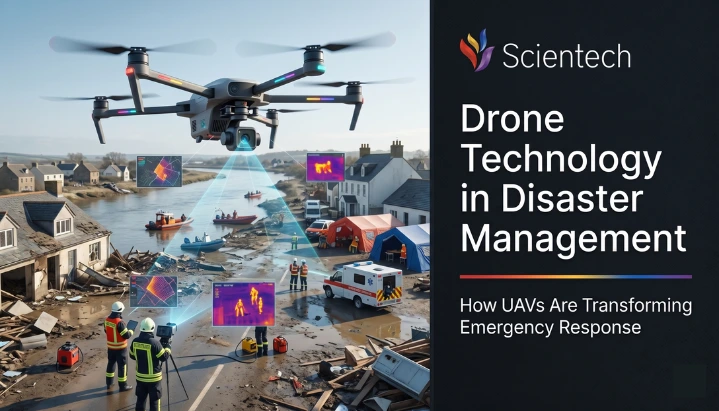
TL;DR
- This blog is for university students, engineering freshers, and technology learners who want to understand how drones in disaster management work across real world emergency scenarios, with a focus on Indian and global deployments.
- Traditional disaster response suffers from delayed situational awareness, inaccessible terrain, and communication breakdowns. Drones help address all three challenges significantly faster than many conventional ground-based methods.
- Disaster management drones perform four core functions: real time damage assessment, search and rescue using thermal imaging, delivery of critical supplies, and restoration of communication networks in affected zones.
- Real deployments such as the 2018 Kerala floods, the 2015 Nepal earthquake, and modern AI-assisted damage assessment systems such as CLARKE demonstrate that drones are no longer experimental tools, they are operational infrastructure in modern emergency response.
- Students pursuing engineering, computer science, geospatial technology, or public policy careers will find disaster drone technology to be one of most applied and socially impactful areas of UAV development in the next decade.
When disaster strikes, first hours are most critical.
Rescue teams must have information about which roads are blocked, where survivors are trapped, areas that are still flooded and where first aid supplies should be delivered. This information is very hard to collect in the event of a large-scale disaster. Ground teams often have to navigate rubble-filled environments, which slows assessment and rescue operations. There are not enough helicopters and they are costly. Satellites offer wide coverage but often lack the resolution, responsiveness, and deployment flexibility required for immediate disaster response.
That’s where drones come into disaster management.
Drones can be deployed within minutes to deliver aerial footage of disaster sites in the event of an earthquake, flood, landslide or fire. They can be used to detect damage, detect closed roads and pinpoint where aid is required.
A disaster management drone should not substitute for rescue personnel. It provides the worker with much more information, much earlier, and in much safer conditions. In a nation such as India, where geographies are prone to periodic disasters like floods, cyclones, earthquakes, and forest fires, the use of drones has proven to be a game-changer in the realm of disaster management, providing unparalleled capabilities for swift response, real-time data collection, and improved coordination.
This blog looks at disaster management drones, their working and how they’ve been used in the real world to save lives.
What Makes a Drone Effective in Disaster Scenarios
To appreciate the unique value UAVs provide in emergency response, it is useful to understand the characteristics that make them more effective than many traditional response methods.
Traditional disaster response faces three major challenges. First, responders often struggle with delayed situational awareness because they cannot quickly obtain a complete picture of conditions on the ground. Second, damaged roads, bridges, and pathways can make affected areas difficult or impossible to access. Third, communication networks frequently fail during disasters, limiting coordination between response teams when it is needed most.
Disaster zones are often unsafe for rescue teams. Roads could be closed and communication lines could be down. These can be reached by drone in a matter of minutes and emergency responders can get aerial information in real time, rather than hours or days.
Drones are unique compared to manned helicopters in that they are able to go lower, penetrate small openings, and record high quality images and videos without risking human life.
The swiftness, agility, and reduced risk of operation make disaster management drones incredibly useful. They are significantly faster than traditional assessment methods in many disaster scenarios. They can access areas that are difficult or dangerous for many other response methods to reach.
Key Sensors That Enable Disaster Response
Disaster drones are not your typical consumer drones. They are equipped with specific sensor payloads for mission-specific applications.
A drone is able to spot a heat signature, meaning the camera can see a person trapped under rubble or debris in complete darkness or heavy smoke. Optical cameras with high resolution provide a detailed view of structural damage to create aerial maps for damage assessment. The LiDAR sensors provide a very accurate model of the terrain in 3D, essential to map unstable terrain following an earthquake or landslide. In the event of an accident in an industrial area, the gas sensors will measure the level of dangerous chemicals in the atmosphere.
These drones help emergency responders organize relief efforts more effectively. They are force multipliers for the fire, police and medical rescue services.
Rapid Damage Assessment: Seeing Full Picture First
Situational awareness is the first drones’ function in disaster management. The emergency commanders have to be able to assess the extent and character of the damage before any effective rescue operations can be coordinated.
Rapid damage assessment is important after a catastrophic event. In minutes, drones fitted with high resolution cameras and LiDAR sensors can map affected areas and supply accurate data to decision makers to prioritise rescue efforts.
Think about the issue that drone technology can solve. After the devastating floods in Kerala in 2018, one of the worst natural disasters in recent history of India, drones were deployed for flood surveying and situational assessment. Real time drone surveillance enabled authorities to plan their rescue efforts, look for trapped people and to track the rising water. This not only allowed them to spread out and cover the area quickly, but also gave them useful data that made their efforts considerably more effective.
Here the speed difference is great. The drone can fly through terrain in minutes compared to ground teams taking hours, particularly in flooded and debris-filled areas.
AI Powered Damage Assessment: CLARKE System
The addition of AI to drone imagery is driving this even higher. Researchers at Texas A&M University developed a system called CLARKE to accelerate disaster damage assessment. Technology is called CLARKE (Computer Vision and Learning for Analysis of Roads and Key Edifices) and can assess damage to buildings, roads and other infrastructure in just a few minutes using artificial intelligence and drone imagery.
CLARKE has been trained to analyze drone images of more than 21,000 homes in 10 major disasters. The system can provide damage assessments for 2,000 houses in seven minutes, a game changer for rural counties where they can gain an understanding of damage levels in their area without having to wait days for information from other sources.
This is the trend the field is following. Data is collected by the drone. It takes AI much shorter time and scale to process. The output is sent to the emergency command in minutes, not days.
Search and Rescue: Locating Survivors When Every Minute Counts
After a large-scale disaster, the possibility of survival decreases rapidly over time. This directly determines the speed of rescue operations and subsequently the number of lives saved in the event of the search and rescue.
In cases of an earthquake, a flood or other catastrophic event, identifying survivors is a race against time. Thermal imaging drones can locate human thermal signatures, even in debris or dense forests, which can enhance rescue efficiency.
The principle behind the system is straightforward. Heat is produced in the human body. In some situations, thermal imaging can help detect heat signatures from survivors beneath debris, although effectiveness depends on rubble depth, material composition, and environmental conditions. A thermal imaging drone can cover a lot of ground by scanning systematically and marking at points where it detects heat, for teams on the ground to investigate. It drastically decreases the time spent searching areas without survivors, and increases the speed of response to areas where people actually are trapped.
The Department of Homeland Security has spearheaded research on the use of emergency drones to aid in search and rescue. Thermal sensors can be used to alert to people where they are difficult to see, hiding under debris and rubble or hiding for safety until assistance is provided. Drones are also able to fly in places where manned aircraft are not, like tunnels.
Real World Deployments in Search and Rescue
An illustrative real life example of the usefulness of drones in information collection was seen after the 2015 Nepal earthquake. Damage assessment was a significant aspect in which drones assisted, especially when dealing with areas that are hard to reach. Similarly, after the 2016 Ecuador earthquake, drones were efficiently used to provide a fast and high quality assessment of the road network.
The Indian Army used drones for surveying damage and searching for survivors after the disastrous flash floods in Uttarakhand in 2012, and assisted authorities in locating stranded individuals and supporting rescue operations in affected areas.
Drones have proven to be beneficial in disaster management, especially in areas with earthquakes, such as the Himalayas, where access roads become blocked due to landslides and debris.
These are just a few examples. They are consistent and reflect the following: a disaster’s onset to when responders have actionable information is minimized, and the time saved directly translates to lives saved.
Supply Delivery: Getting Critical Aid to Inaccessible Areas
One of the most critical challenges in any large scale disaster is logistics. Roads are closed, bridges have been torn up and boats cannot be transported inland. Medical supplies, food and emergency equipment may be unavailable in a community for days.
Drones can provide enhanced resilience during crises, by carrying small payloads and by providing connectivity when there is no access by ground or infrastructure. They can carry lightweight items like medication, radios or blood supplies to work around flooded or blocked routes to keep response teams and survivors alive.
One of the most promising applications is medical supply delivery using drones. Although not a disaster response example, humanitarian organizations have used drones to transport medical samples and deliver medical assistance to remote communities in Western Province, Papua New Guinea (PNG), demonstrating the technology’s logistics potential.
Specifically for disaster scenarios, supplies that are most frequently supplied are insulin, antibiotics, blood bags, vaccines, water purification tablets, first aid kits and Emergency communication radios. These are all the very things that can’t wait until roads clear and bridges are rebuilt.
Research suggests that multi-purpose drone platforms, combined with AI-based analytics, can improve efficiency by supporting monitoring, delivery, and communication functions within a single disaster-response system.
In the north-east of India, where floods and landslides often isolate areas during the monsoon season, drone delivery of medical supplies is not a distant dream, it’s a reality.
Communication Restoration: Reconnecting Disconnected
Failure of the communication systems is one of the most important, but least talked about, failures in a major disaster. Mobile towers go down. Power grids fail. Emergency responders lose radio contact with other emergency responders and command centers.
The initial infrastructure that falls will most often be the communication system. Disaster management drones can be used to create a flying cell tower for satellite communication to extend coverage, to provide internet connectivity to disaster command centers and to keep the police, fire and medical forces connected.
The drone can be tethered, and fly at an altitude above a disaster area, where it can be used as an air-to-air repeater, providing radio and LTE coverage to affected areas. This is not an exclusive feature for rescue teams. It enables activated agencies to coordinate in the event of a complex disaster, where NDRF, state police, medical team and NGOs are working together simultaneously and enables survivors with mobile devices to call for help when network access is restored.
In a mass disaster, the number of agencies generally required to go into the rescue are many. Drones offer a level playing field for all agencies to view and coordinate movement, manage resources and avoid duplication of effort.
Research has focused on multi-purpose drone systems that can be used for monitoring, delivery and mobile connectivity. Research has shown the benefits of multipurpose drone configurations in relation to single purpose drone configurations in complex disaster environments.
Wildfire Monitoring and Fire Management
Drones are especially useful in the face of wildfires, which come with their unique set of problems. Wildfires can change direction rapidly, spread quickly, and create life-threatening conditions for firefighting crews on the ground.
Fire detection and monitoring drones are equipped with high definition thermal cameras, multi-spectral cameras and gas sensors. These tools are used to observe through smoke, detect hotspots that cannot be seen by the naked eye and to delineate the chemical makeup of smoke plumes.
The aerial view drones give incident commanders helps them monitor wildfire spread in real time and helps to evacuate safely and better contain the blaze. Dynamic perimeter tracking enables real-time tracking of the perimeter of fire advances, which can be used to update evacuation zones and to direct people to safe ingress and egress.
There is evidence that this application has proven useful in deployment. In the 2020 Grizzly Creek Fire in Colorado, drones were used to ignite controlled backburns by dropping incendiary devices, helping remove vegetation ahead of the advancing fire and reduce available fuel. Drones were not just observers, but engaged in fire management strategy.
Drones in Disaster Management: Indian Context
India’s geographic and climatic profile makes it one of the most disaster-prone countries in the world for natural disasters. The Himalayan arc is a seismically active area. Cyclone seasons occur annually along coastal states. Large scale flooding occurs every monsoon season in the Indo Gangetic Plains. Forest fires have always been a problem in central and north-eastern India.
Drones are already used in disaster mapping by numerous organizations, including ISRO, National Disaster Response Force (NDRF) and several IIT research labs. The use of drones for disaster management continues to grow in India, particularly for flood monitoring, terrain mapping, earthquake assessment, and emergency response. For flood and earthquake monitoring.
India’s regulatory environment is also witnessing changes in its favour. DGCA has continually revised its drone policy framework with the drone rules 2021 and subsequent amendments allowing commercial and public sector deployment of UAVs at a higher level. This lays the groundwork for a policy framework for the deeper integration of drones into India’s national disaster response system.
From identifying survivors and assessing damage to buildings, to distributing aid materials, drone technology has become a vital part of any disaster response kit. Time is of the essence, and the first responder can have aerial information at their fingertips in a matter of minutes.
Challenges and Limitations
No technology operates without constraints, and disaster management drones are no exception. Understanding these limitations is as important as recognizing capabilities.
Regulatory clearance in active disaster zones can delay deployment. Flying over populated areas, near airports, or across state boundaries requires permissions that may not be simple to obtain quickly during an unfolding emergency.
Battery life remains a significant constraint. Most commercial disaster drones have flight times between 30 and 60 minutes, requiring frequent returns for recharging or battery swapping. Long endurance missions require tethered systems or relay based operations.
Weather sensitivity is a fundamental challenge. High winds, heavy rain, and dense fog, which are precisely conditions present during cyclones and major flooding events, can ground UAVs or severely limit their effectiveness.
Skilled operators are not universally available. Deploying a drone in a disaster zone and extracting actionable data requires trained operators, mission planners, and data analysts. Building this human capacity at district and state level remains a significant gap in India’s disaster preparedness infrastructure.
Data processing speed can be a bottleneck. High resolution aerial footage from multiple drones generates enormous data volumes. Without AI assisted analysis tools like CLARKE, processing this imagery fast enough to be operationally useful is a challenge.
Future of Disaster Management Drones
The direction of development is becoming increasingly clear. Future disaster-response drones are expected to become more autonomous, support heavier payloads, achieve longer endurance, and integrate more deeply with AI-based decision-support systems.
The overall utilization of drones in the field of disaster and emergency management has potential to have a paradigm shift in the disaster response operations in all stages of the disaster life cycle, from pre-disaster preparedness to active response and post-disaster recovery.
There are a few particular developments forming this future. Drone swarms will allow for multi sector coverage of large disaster areas, with the individual members of the swarm automatically sharing responsibility. Drones may be able to autonomously recharge and redeploy from dedicated docking stations without human involvement. 5G-equipped drones could support higher-bandwidth, lower-latency transmission of live HD video in areas with suitable network coverage, Priority maps for rescue teams will be created in minutes after the first deployment of AI damage assessment systems.
In this context, India will see considerable growth in the drone sector through 2030, driven by domestic production of UAVs, a booming drone pilot training ecosystem and bodies such as ISRO and NDRF integrating drone capability into their operations.
Conclusion
The basic idea of drones used in disaster management is very simple: it is to fill the time lag between the disaster and the availability of data for effective action.
From emergency response, logistics, to post disaster monitoring, UAVs have proven their value in delivering life saving supplies in a timely manner, and in providing real time information for decision making during crises.
This field is important for students pursuing careers in technology. Disaster management drones are far from being a niche application: they lie at the crossroads of aerospace, AI, geospatial, embedded systems and public policy. All of these disciplines play a role in the operation of future generations of UAVs in emergency responses.
This is one of the most practically relevant fields for engineering and technology graduates to gain expertise in, given India’s vulnerability to frequent occurrences of large scale disasters and expanding government’s interest in drone technology.
From designing drone hardware to computer vision, disaster risk governance, and autonomous systems, the technology of drones is relevant to all of these career pathways when responding to emergencies. Learn about the open source UAV platforms, learn to use geospatial data tools such as QGIS, read information from NDRF and ISRO publications on UAV applications, and how your technical base can make a difference in systems which are faster, further, and save more lives in the event of an emergency.
FAQs
A disaster management drone is a specialized UAV built or configured for emergency operations. Unlike consumer drones, these systems carry advanced sensor payloads including thermal imaging cameras, LiDAR sensors, gas detectors, and payload delivery mechanisms. They are designed to operate in adverse weather conditions, fly for longer durations, and transmit data reliably in environments where communication infrastructure has failed.
In India, disaster management drones have been deployed during 2018 Kerala floods for damage survey and survivor location, during 2021 Uttarakhand flash floods for search and rescue coordination, and increasingly by NDRF and ISRO for flood mapping and terrain monitoring. Domestic companies like ideaForge supply UAVs specifically designed for Indian emergency agencies, and IIT research labs are actively developing AI assisted drone systems for disaster applications.
Yes. Payload carrying drones can deliver essential supplies including medicines, blood units, water purification tablets, first aid kits, and communication devices to areas where roads are blocked or destroyed. Effective range and payload capacity vary by drone type , but for lightweight medical supplies in particular, drone delivery is already operational in several real world disaster scenarios.
AI is increasingly central to how disaster drones operate. AI powered image analysis tools can classify building and road damage from aerial drone footage at scale and speed that no human team can match. The CLARKE system developed at Texas A&M University, for example, can assess damage across 2,000 homes in approximately seven minutes using AI and drone imagery combined. AI also enables autonomous navigation, obstacle avoidance, and intelligent path planning during complex search operations.
Primary limitations include restricted battery life (typically 30 to 60 minutes of flight time), vulnerability to adverse weather conditions such as high winds and heavy rainfall, regulatory clearance requirements that may slow deployment in some jurisdictions, need for trained operators and data analysts, and data processing demands generated by large multi drone deployments. Research and development in all of these areas is ongoing, and each constraint is being progressively addressed through technological and policy innovation.
Foundational technical skills include UAV systems engineering, computer vision and image processing, geospatial data analysis (tools like QGIS and ArcGIS), embedded systems programming, and wireless communication protocols. Non technical skills such as emergency management principles, risk assessment frameworks, and policy literacy are equally valuable, as drone deployments in disaster contexts require coordination with government agencies, regulatory bodies, and humanitarian organizations.