


TL;DR
- This blog is meant for engineering students, freshers and all of those who are trying to find out about IoT and embedded systems for the first time, and need a simple and easy explanation for what exactly is a wireless sensor network and how it works.
- Wireless Sensor Networks (WSN) are collections of small, battery operated sensor nodes which are capable of sensing the physical world, temperature, moisture, motion, etc., and send the data wirelessly to a central node without requiring wires.
- Understanding the four main building blocks of a WSN sensor node, gateways (or base stations), communication protocols, and a central server or cloud platform makes the overall architecture much easier to understand.
- Today, WSNs are deployed on the farms, smart cities and factories, with protocols such as Zigbee, LoRaWAN and 6LoWPAN, which have different ranges and power requirements.
- WSN and IoT skills open up career opportunities for fresh engineering graduates. Entry-level salaries vary widely depending on the role, company, location, and skill set. Candidates with strong embedded systems and IoT skills may receive higher offers, depending on the company, location, and skill set and the demand for these skills is more in Bengaluru, Hyderabad, Pune etc.
From soil moisture sensors on Indian farms to air quality sensors in smart cities, wireless sensor networks have quietly become an integral part of the connected infrastructure we have come to rely on. By 2026, industries will be increasingly moving toward automation and real-time monitoring, making it a must for any electronics, computer science and IoT student to learn the working of a wireless sensor network. The guide explains what a WSN is, how its architecture comes together and why it is important before you get into technical jargon you’ll see in coursework or interviews.
Also Read,
- https://scientechworld.com/wind-turbine-blade-inspection-drone/
- https://scientechworld.com/drones-in-infrastructure-inspection/
- https://scientechworld.com/drone-swarm-applications/
What Is a Wireless Sensor Network? A Simple Starting Point
Imagine a big farm in Punjab where a farmer wants to understand the moisture content of the soil, without having to walk the whole field each morning. Now envision dozens of tiny devices spread throughout that field collecting soil data and reporting it back to an app on the phone. A WSN is nothing but a network of wireless sensors.
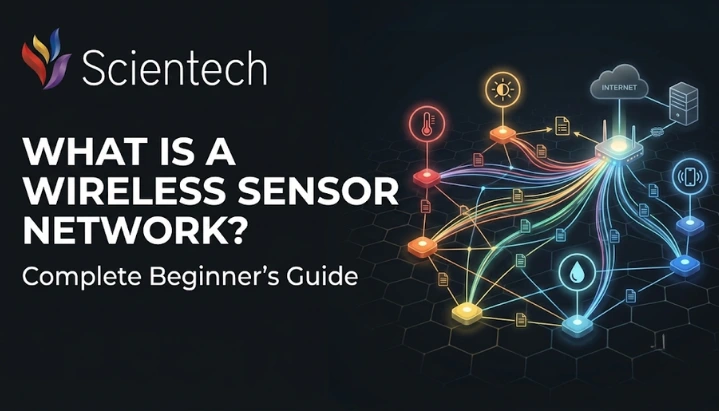
Technically speaking, a wireless sensor network is a series of tiny devices with low power consumption, known as sensor nodes, that share a common function of measuring a phenomenon in the physical world and reporting the results via wireless transmission to a central location. The nodes are usually responsible for measuring one or more physical parameters, like temperature, humidity, light intensity, vibration, or movement, and then transmit the measurement to another node or directly to a gateway or to a fixed base station, without the use of a wire.
Here, the term “network” is important. A single smart sensor is nothing more than a sensor. A wireless sensor network is a group of such sensors operating together, frequently sending data through the network from node to node until it arrives at a central point. This collaboration makes it possible to have a WSN that is capable of covering a large area such as an entire farm, factory floor or even city block, and that is composed of small, cheap devices.
A WSN can be likened to a set of “watchmen” stationed throughout a large property, each only able to monitor a small section, but whose complete network can provide a comprehensive picture of the entire property. In that mental image, it will aid when we delve deeper into how each piece fits together.
Wireless Sensor Network Architecture: Building Blocks Explained
This is where most students get lost, because textbooks tend to jump straight into technical diagrams. Before that, it helps to understand wireless sensor network architecture the same way you would understand a courier delivery system.
Imagine a small package (a single sensor reading) that needs to travel from a village (sensor node) to a district office (base station), and finally to head office in a city (cloud server). At every stage, someone or something is responsible for moving that package closer to its destination. A wireless sensor network is organized in almost the same way.
Sensor Nodes: Data Collectors
A sensor node is the smallest functional entity of a WSN; data collection starts at the level of a sensor node. A typical sensor node consists of four main components that collaborate in its construction.
A sensing unit is an actual sensor, part that measures temperature, humidity, light, pressure or motion, and typically has a small circuit called an ADC (analog to digital converter) that converts a physical reading to digital data a computer can process. A processing unit is a small microcontroller that does this locally, and determines what to do with it before passing it on. A communication unit is a small radio transceiver which allows nodes to communicate wirelessly with other nodes or base stations in close proximity. The power source is typically a small battery, and sometimes an energy harvesting solar panel.
One of the most significant design challenges for engineers deploying WSNs is reducing the power consumption of the nodes; being placed in the middle of a field or on top of a factory pipeline, where access is difficult, is a prime example.
Gateway or Base Station: Middleman
A base station, sometimes called a sink node or gateway, acts as a district office in our courier analogy. It receives data collected by all individual sensor nodes and prepares it for the next leg of journey. A base station usually has far more processing power and a more reliable power source than a regular sensor node, since it needs to handle incoming data from many nodes at once.
Once a base station gathers this data, it typically forwards it to the internet or a company’s server, acting as a bridge between the wireless sensor network and the wider digital world.
Communication Protocols: How Nodes Actually Talk
Sensor nodes cannot just start transmitting data randomly. They need a shared language and set of rules, known as a communication protocol, to send data efficiently and avoid signals colliding with one another. Some of the most widely used protocols in wireless sensor network architecture include Zigbee, 6LoWPAN, and LoRaWAN, each suited to different situations depending on range, power needs, and data volume. We will look at how these differ later in this guide.
Central Server or Cloud Platform: Where Data Becomes Useful
A final stop is usually a cloud platform or central server, where all collected sensor data is stored, processed, and turned into something a human can actually use, such as a dashboard, an alert, or an automated action like switching on an irrigation pump.
How Data Actually Travels: Understanding Network Topology
After understanding the four building blocks, the next obvious question is, how do all these sensor nodes connect to each other? Network topology, however, is where it comes into play and it is not that complicated.
A star topology consists of all the sensor nodes in the network being connected to a central node like the spokes of a bicycle wheel. Easy to install but if the central point fails the network fails with it.
In a mesh topology, all nodes are connected to one another, and if a node can’t send data directly to the base station, it can pass data to another node that can send it to the base station, and so on. This is like a message travelling from person to person in a group of friends standing in a large field, each following a message to the next person who is in earshot, until the message gets to the person who needs it. The mesh topology is more resilient because if one node fails, it does not necessarily cause the network to fail, but also requires more careful coordination.
In the real world, most deployments of WSNs are of a hybrid type, where smaller deployments are simplistic and implemented as star topology, while larger deployments would need to be resilient and implemented as a mesh topology.
Types of Wireless Sensor Networks by Deployment Environment
A wireless sensor network may have a variety of designs, since the environment in which it operates changes nearly all of its design.
Most well-known are terrestrial WSNs, where hundreds or thousands of sensor nodes are deployed in an open space like a farm, forest or smart city area, dispersed randomly or in a specific configuration. The concept of underground WSNs is a difficult one as radio signals do not travel easily through soil and rock and are used in applications such as underground pipeline monitoring, soil monitoring, and mining, although wireless communication underground is significantly more challenging than above ground. The underwater WSNs are utilized in the applications such as Ocean monitoring where the radio wave does not propagate well under water and they depend on acoustic as well. The mobile WSNs include sensor nodes that are mobile, typically attached to vehicles, drones or robots, and are ideal for situations such as disaster response, where the location of sensing is not known a priori.
The type of WSN a project requires is typically the first engineering decision to be made in the deployment, which influences hardware selection, communication protocol, etc.
Communication Protocols Compared: Zigbee, LoRaWAN, and 6LoWPAN
Choosing the right communication protocol is a bit like choosing between a scooter, a car, and a truck for a delivery, because each is built for a different range and payload. WSN protocols work the same way, trading off range, power consumption, and data speed.
| Protocol | Typical Range | Power Usage | Best Suited For |
| Zigbee | Up to 100 meters (mesh extends this) | Low | Smart homes, industrial automation, indoor monitoring |
| LoRaWAN | 2 to 15 kilometers | Very low | Agricultural fields, smart city sensors, rural deployments |
| 6LoWPAN | Similar to Zigbee, short to medium range | Low | IPv6 based smart devices needing internet connectivity |
Zigbee, built on IEEE 802.15.4 standard, is popular for short range applications where many nodes are packed into a smaller area, such as a smart building or a factory floor. LoRaWAN, on other hand, is designed for long range, low power communication, which makes it a strong fit for sprawling Indian farms where sensor nodes might be spread across several kilometers with no easy way to recharge batteries frequently. 6LoWPAN takes a different approach by allowing sensor nodes to use IPv6 addressing directly, making it easier to connect a WSN straight into the broader internet.
Engineers rarely pick a protocol based on speed alone. Battery life matters just as much, sometimes more, since replacing batteries on a sensor node buried in a farm field or mounted on a remote tower is expensive and time consuming. This is why cyclic sleep modes, where nodes power down between readings and briefly wake up to transmit data, have become a standard energy saving technique across nearly all modern WSN protocols.
Real World Applications of Wireless Sensor Networks in 2026
Wireless sensor networks are not a futuristic concept anymore. They are already running quietly across multiple sectors in India and globally.
Smart Agriculture
Indian agri tech companies are already putting WSNs to practical use. IoT sensors that alert farmers to over irrigation, helping optimize watering and reportedly Either cite the exact source or remove the number of irrigation water across its deployment. Companies like CropIn and Farmonaut use similar sensor driven approaches, combining soil and weather sensors with satellite data to guide farmers on irrigation, pest control, and crop health. This directly supports the government’s push toward precision farming under missions like Digital Agriculture Mission and PM Kisan.
Smart Cities
Many Indian cities have started deploying wireless sensor networks to monitor traffic flow, air quality, streetlight usage, and water distribution as part of a broader Smart Cities Mission. These sensors help city administrations make faster, data backed decisions instead of relying on manual inspections.
Healthcare Monitoring
In hospitals and increasingly in home care, wireless sensor networks track patient vitals such as heart rate, oxygen levels, and body temperature, sending alerts to medical staff the moment something looks abnormal, without requiring a nurse to physically check every patient every few minutes.
Industrial Automation
On factory floors, WSNs monitor machine vibration, temperature, and performance, catching early signs of equipment failure before a breakdown halts production. This approach, often called predictive maintenance, is now standard practice across manufacturing hubs.
Environmental and Disaster Monitoring
WSNs track air and water quality, forest conditions, and early warning signals for floods or landslides, feeding real time data to disaster management authorities so they can respond faster than traditional monitoring would allow.
Challenges Engineers Face When Building Wireless Sensor Networks
Like any technology, a WSN has its set of limitations, and it’s as crucial to know that as to know how a WSN works, particularly if you are thinking about pursuing a career in this area.
The highest energy demand continues to be the primary hurdle. Most of the sensor nodes are powered by small batteries, and replacing thousands of nodes in a large farm or in a forest is impractical and costly, thus a lot of sensor research is directed towards energy efficient protocols and sleep / wake cycles.
Scalability comes with its challenges. The network with fifty nodes is running smoothly but the network with five thousand nodes may behave very differently as there are more nodes, which means that there are more opportunities for collisions in the signals, data congestion, and failures in coordination.
As WSNs use increasingly sensitive data, ranging from patient vital signs to industrial control systems, security is becoming an increasing concern. These sensor nodes may be physically vulnerable and are typically low-power devices, > making them vulnerable to physical tampering, eavesdropping, and data manipulation if appropriate security measures are not implemented to eavesdropping or data tampering.
Another practical challenge is environmental reliability. Outdoor sensor nodes are exposed to the elements and are subject to heat, moisture, dust and physical damage, which can affect their performance and shorten their operational life significantly more than anticipated.
Career Opportunities in Wireless Sensor Networks and IoT for Indian Students
Wireless sensor networks is not a subject for examination but a field of engineering for students of India. They are a key foundation of the nation’s fastest-growing segment of the tech industry.
Students with backgrounds in Electronics and Communication (ECE), Computer Science (CSE), Instrumentation, or IoT are well suited for this field, Instrumentation and courses with a focus on IoT are ideal candidates for this field. Some essential skills that will be helpful are embedded C and C++ programming, knowledge of communication protocols such as MQTT and CoAP, and WSN specific protocols like Zigbee and LoRaWAN, knowledge of basic cloud platforms such as AWS IoT or Azure IoT, and hands on experience with microcontroller boards like the ESP32 or Arduino.
Salaries vary considerably depending on the company, role, and location. Product companies and semiconductor firms often offer higher starting packages than many IT services companies, especially for candidates with strong embedded systems and IoT skills
In addition to base pay, sectors in the WSN and IoT space are wide and expanding, ranging from smart agriculture and automation in industry to smart city infrastructure and healthcare technology. Many people have built a small home project with an ESP32 board, or participated in a college precision agriculture project, which is enough to prove to the recruiters that they have practical experience in the WSN field, which is as important as theoretical knowledge.
Future of Wireless Sensor Networks: What to Expect
Wireless sensor networks are growing rapidly, and some trends are emerging on the path forward for technology.
AI is increasingly being integrated directly into WSN routing and data processing, enabling more intelligent decisions of which nodes to route data through and when, thereby saving battery life and cutting down on unnecessary transmissions. Edge intelligence and TinyML, which means implementing light-weight AI models on the tiny microcontroller instead of sending all raw data up to the cloud, is one of the most sought-after skillsets of engineers going into this area, as it cuts data latency and power usage.
Energy harvesting methods using small solar panels or vibration-based power generation systems are also gaining popularity, bringing WSNs closer to the true end goal of true maintenance free operation in remote deployments. With 5G networks being further adopted in India, WSNs too are likely to be increasingly embedded in larger IoT networks, enabling applications that benefit from lower latency and improved connectivity.
If you are new to this field today these trends are pointing to areas where you’ll need further knowledge in addition to the basics of this guide.
Conclusion
At the heart of a wireless sensor network is a group of very small devices that collectively sense the real world and wirelessly transmit the data to a central system; once you grasp four fundamental parts of a sensor network sensor nodes, base stations, communication protocols, and cloud platforms the rest of the network begins to feel less daunting. WSNs have already been integrated into everyday infrastructure around the country, with the likes of the sensor-based irrigation and precision agriculture solutions, and smart city applications such as traffic monitoring and air quality monitoring on the rise, and their influence will grow even greater in the years to come as AI-powered routing, edge intelligence and energy harvesting technologies continue to advance. This is not only theory but also practical work in Engineering. It is a very real and useful skill set that has strong graduates who can pursue roles such as IoT engineer, embedded systems engineer, or wireless systems engineer, with salaries varying by employer, location, and skill level in some of the fastest growing tech hubs of India and a good career path in it. Even a small hands-on project while studying in the course of WSN can make the difference between knowing the theory and being ready to be a working professional when time comes.
FAQs
A wireless sensor network is a group of small, battery powered devices called sensor nodes that measure something in the physical world, such as temperature or soil moisture, and send that data wirelessly to a central system without needing any wired connections between them.
Wireless sensor network architecture is generally made up of four core parts: sensor nodes that collect data, a base station or gateway that gathers this data from multiple nodes, a communication protocol that carries data, and a cloud platform or server where data becomes usable information.
Zigbee is best suited for short range, densely packed deployments like smart homes or factory floors, while LoRaWAN is designed for long range, low power communication, making it a better fit for spread out deployments like large agricultural fields.
Yes, wireless sensor networks are actively used across India, including in smart agriculture through companies like Fasal and CropIn, smart city infrastructure under Smart Cities Mission, and industrial automation across major manufacturing hubs.
Students with backgrounds in ECE, CSE, or IoT can pursue roles like IoT engineer or embedded systems engineer, with fresher salaries in India typically ranging between ₹4.5 lakhs and ₹8.5 lakhs per annum, and strong demand concentrated in cities like Bengaluru, Hyderabad, and Pune.
Core skills include embedded C or C++ programming, familiarity with communication protocols like Zigbee, LoRaWAN, and MQTT, basic cloud platform knowledge such as AWS IoT, and hands on experience building small projects with microcontroller boards like ESP32 or Arduino.

