

TL;DR
- This blog is for engineering students, freshers, and GATE, SSC JE, and RRB JE aspirants who want a clear, beginner friendly explanation of what a power supply in electronics actually is and how it works.
- Many electronic devices need a stable DC voltage to function, while electricity from wall sockets is supplied as AC. A power supply converts and regulates electrical energy to meet the requirements of a device, bridging the gap between the available electrical source and the circuit’s required voltage and current.
- A power supply performs four core jobs in sequence: stepping down voltage, converting AC to DC, smoothing out ripples, and regulating final output.
- There are multiple types of power supply in electronics, from simple linear designs to efficient switch mode power supplies (SMPS), each suited to different applications.
- Understanding power supply basics is not just important for exams such as GATE and SSC JE; it is also a foundational skill for careers in power electronics, EV technology, and embedded systems in India.
Whether it’s a mobile charger or a data center server, most electronic devices require a reliable and appropriately regulated electrical power source to operate safely. In electronics, a power supply is a device that transforms the raw supply voltage and current into the precise voltage and current required by a circuit. Without the appropriate power conversion and regulation, components such as microprocessors, sensors, and integrated circuits may be damaged or fail to operate correctly.
This blog discusses power supply in electronics in simple terms, beginning with its function, an insight into how it works internally, and a discussion of the various types you’re likely to ever encounter in devices and in your GATE or SSC JE syllabus. There is also a numerical example with a solution, a section of India specific context and an insight into career opportunities in this field.
Also read,
- Synchro Transmitter and Receiver: Working Principle and Applications
- Step Down Chopper vs Step Up Chopper: Key Differences Explained
- What Is a Power Quality Analyzer? Working Principle, Types, and Application
What Is a Power Supply in Electronics?
Consider topping up the cellphone. Electricity from the wall socket is 230 volts alternating current (AC), but the phone receives regulated DC power from its charger, typically through a USB charging interface, while the phone’s internal charging circuitry manages the battery’s required charging voltage and current. It is a process of converting one type of electricity into another, which your phone will be able to safely use, and that is the job of something in-between. That thing is the power supply.
More simply put, a power supply is a device or a circuit that accepts electrical energy from a source (wall socket, battery, etc.) and transforms it into a particular voltage, current and current type needed by an electronic device or circuit. Does not generate electricity. It changes it and controls it.
A power supply may perform several functions depending on its design. It can step voltage up or down, convert AC to DC, filter unwanted ripple, regulate the output, and provide protection against conditions such as overvoltage, overcurrent, and short circuits. Due to these functions, a power supply is sometimes referred to as an “electric power converter”, but not simply a “wire”.
Why Electronic Devices Cannot Run on Mains Power Directly
Now here’s one to ponder. Why doesn’t the electricity company just send 19 volts DC to the home, rather than 230 volts AC? The solution is related to the way electricity is created, moved and consumed, by very different types of equipment.
Power grids use high voltage alternating current, since the voltage of AC can be easily increased and decreased with transformers, and long-distance transmission can be accomplished without much loss in energy. At the time when this AC power reaches your home by the distribution network, it is stepped down to the standard household voltage that is 230V, 50Hz in India.
Most electronic circuits, however, such as the microchips found in your phone, router, or laptop use a constant, low (direct current) voltage to operate properly. If mains AC were applied directly to a circuit designed for low-voltage DC, the excessive voltage could cause severe damage to components and create a serious electrical safety hazard. That’s why every electronic device has (or requires to connect to) a power supply.
How Does a Power Supply Work?
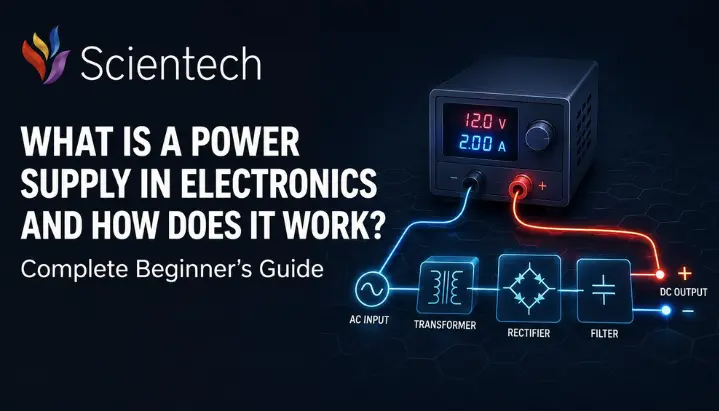
A conventional linear regulated power supply often uses four main stages: transformer, rectifier, filter, and regulator. Modern power supplies, especially SMPS designs, may use a different sequence and additional conversion stages, each handled by a specific block of circuitry. Understanding these stages one at a time makes the whole process far less intimidating.
Stage 1: Transformer
In a conventional transformer-based supply, the transformer changes the AC voltage and can provide galvanic isolation from the mains. In many SMPS designs, the incoming AC is first rectified, then switched at high frequency before passing through a high-frequency transformer. Therefore, the transformer’s position and operating frequency depend on the power-supply architecture, most commonly stepping it down from a higher voltage like 230V to a much lower AC voltage, perhaps 12V or 15V, depending on what device needs downstream. In an isolated transformer-based supply, the transformer uses electromagnetic induction between its windings and can provide galvanic isolation between the mains input and the output. However, not every power supply provides isolation.
Stage 2: Rectifier
Once voltage has been stepped down, it is still alternating current, meaning it keeps reversing direction many times a second. A rectifier’s job is to convert this AC into a form of DC where current flows in only one direction. This is done using diodes, which act like one way valves for electric current. Common rectifier types include half wave rectifiers, full wave rectifiers, and bridge rectifiers, with bridge rectifiers being most widely used in practical power supply for electronics designs because of its efficiency.
Stage 3: Filter
output straight out of a rectifier is not smooth DC. It is a pulsating waveform that rises and falls, still carrying traces of its AC origin. This unwanted fluctuation is called ripple. A filter, typically built using a capacitor, smooths this pulsating output into something much closer to pure, steady DC by storing charge during voltage peaks and releasing it during dips.
Stage 4: Voltage Regulator
Even after filtering, some ripple remains, and output voltage can still shift slightly depending on load connected to it. A voltage regulator is the final stage, and its job is to maintain the output voltage within a specified range despite changes in input voltage and load current. Common regulator components include IC 7805 for a fixed 5V output, LM317 for adjustable output, and more advanced switching regulators used in compact modern devices.
Put together, these four stages form the complete working principle of a power supply in electronics: step down, rectify, filter, regulate. Many conventional regulated power supplies follow this general conversion sequence, although modern devices may use different architectures, particularly switch-mode power supplies.
Worked Example: Calculating Ripple Factor and Efficiency
Numbers make this concept concrete, and ripple factor calculations show up often in GATE and SSC JE papers. Suppose the AC component of a rectifier’s output has an RMS value of 2 V and the DC component has an average value of 20 V.
ripple factor is calculated as:
Ripple Factor = RMS value of AC component / DC value of output
Ripple Factor = 2V / 20V = 0.1, or 10 percent
A lower ripple factor means a cleaner, more stable DC output, which is exactly why filter and regulator stages matter so much in a well designed power supply.
Now consider efficiency. If this power supply draws 100W from AC mains and delivers 85W of usable output power to load, its efficiency is calculated as:
Efficiency (%) = (Output Power / Input Power) x 100
Efficiency = (85 / 100) x 100 = 85 percent
This 85 percent figure is a realistic benchmark for a good switch mode power supply, while a simple linear power supply can have substantially lower efficiency than an SMPS, depending on the input and output voltage difference and load conditions because it wastes more energy as heat.
Types of Power Supply in Electronics
All devices do not require the same type of power supply. There are several different types, depending on the size, noise level, efficiency and cost.
A linear power supply is a type of power supply that can produce a clean, low noise output by using a transformer, rectifier, filter and linear voltage regulator. It is easy and reliable and produces minimal electrical interference, but it is bulky and heavy, and will not work very well at higher power levels since the voltage difference across the regulator causes unused electrical energy to be dissipated as heat.
A switch mode power supply (SMPS) is a type of power supply that uses high frequency switching transistors rather than a linear regulator to control the output voltage. This enables it to have much smaller transformers and parts, and to be much smaller, lighter, and efficient than a linear design. Most contemporary laptop chargers, mobile adapters and computer power supplies are now of the SMPS type.
An unregulated power supply does not actively maintain a constant output voltage. Its output can vary with changes in the input voltage and load. For sensitive electronics, the regulated power supply incorporates active circuits to maintain output voltage stability in the presence of these fluctuations.
A programmable power supply can digitally control parameters such as output voltage and current and may support remote monitoring, sequencing, or other programmable functions. A programmable power supply allows users to set output parameters such as voltage and current digitally. It may also support remote control, sequencing, monitoring, and automated testing, making it useful in laboratories and production environments.”
| Type | Efficiency | Size | Noise | Best Suited For |
| Linear Power Supply | Low (40 60%) | Large, heavy | Very low | Audio equipment, lab instruments |
| Switch Mode Power Supply (SMPS) | High (75 90%) | Compact, lightweight | Higher | Laptops, computers, chargers |
| Unregulated Power Supply | Varies | Small, cheap | Moderate | Simple, non sensitive loads |
| Regulated Power Supply | Moderate to high | Depends on design | Low to moderate | Sensitive ICs, microcontrollers |
| Programmable Power Supply | High | Depends on design | Low | Testing labs, R&D setups |
Choosing between these types in real design work usually comes down to a trade off between cost, noise tolerance, and how compact the final product needs to be.
Power Supply in Electronics for Indian Students and Devices
Understanding power supply in electronics carries extra weight for Indian students because India’s electrical infrastructure has its own standards that directly shape how devices are designed for the local market. Household mains supply in India operates at 230V AC, 50 Hz, governed by Bureau of Indian Standards (BIS) specifications, which is different from 120V, 60 Hz standard used in countries like the United States.
Devices sold in India must be compatible with the local electrical supply, either through a built-in power supply or an appropriate external adapter. Many modern adapters support a wide input range, such as 100–240 V AC. Indian manufacturers must therefore ensure that their power-conversion stages can safely operate with the local 230 V, 50 Hz supply, while modern SMPS designs may first rectify the AC and then perform high-frequency switching. Students studying power electronics in Indian universities encounter this context directly when analyzing circuits for local appliances.
relevance goes further with India’s rapid EV and renewable energy push. EV charging systems use power-electronic conversion stages to manage electrical energy between the grid and the vehicle battery. In AC charging, the vehicle’s onboard charger converts AC to DC for the battery, while DC fast chargers perform the AC-to-DC conversion outside the vehicle and India’s expanding EV-charging sector is also increasing demand for engineers with power-electronics skills. Similarly, solar inverters used across Indian homes and industries depend on power supply and conversion stages to make solar generated DC power usable and grid compatible.
Uninterruptible Power Supplies, or UPS systems, are another familiar example for Indian students, since power cuts remain common in many parts of the country. A UPS is a power-protection system that combines energy storage with power-conversion and control circuitry to provide backup power during interruptions. Depending on its topology, it may continuously supply the load through an inverter or switch to battery-backed operation when mains power fails.
GATE, SSC JE and RRB JE Exam Relevance
Power-supply concepts can appear in the electrical and electronics portions of competitive exams such as GATE, SSC JE, and RRB JE, depending on the specific syllabus and exam pattern, and it usually appears under Power Electronics or Analog Electronics sections of syllabus.
In GATE Electrical Engineering, expect conceptual questions on rectifier types, ripple factor calculations, and voltage regulation, often combined with numerical problems similar to the worked example above. SSC JE Electrical and RRB JE exams frequently test block diagrams of a regulated DC power supply, asking candidates to identify or explain function of each stage, namely transformer, rectifier, filter, and regulator.
A commonly asked question type involves comparing linear and switching power supplies on parameters like efficiency, size, and noise, exactly the kind of comparison covered in the table above. Numerical questions on efficiency percentage and ripple factor are also common, so being comfortable with these formulas gives you a real scoring advantage.
Given how frequently this topic surfaces, treating power supply basics as a high yield area for revision is a smart strategy rather than an optional add on, particularly for candidates targeting Electrical and Electronics Engineering PSU roles through GATE.
Career and Salary Scope in Power Electronics in India
Beyond exams, understanding power supply in electronics opens doors into a genuinely strong career track in India. India’s power systems and power electronics sector is expanding rapidly, driven in part by India’s target of achieving 500 GW of non-fossil fuel-based electricity generation capacity by 2030 and rising demand for EV power electronics expertise.
For students targeting government-sector roles, PSU salaries vary significantly by organization, pay scale, role, allowances, and recruitment route. Candidates should check the latest official recruitment notifications for current compensation details. Some senior-level PSU positions can offer compensation of ₹15 lakh per year or more, but figures vary substantially by organization and role. Several PSUs, including organizations such as NTPC, BHEL, POWERGRID, and NHPC, have used GATE scores for recruitment to specific engineering positions.
Private-sector compensation for power-electronics engineers varies widely with experience, location, industry, and specialization. Roles in EV powertrains, SMPS design, and renewable-energy conversion can offer strong growth opportunities, particularly for engineers with specialized skills in these areas. Skills in power supply design, combined with tools like MATLAB, Simulink, or PSCAD, tend to command a noticeable premium in the current job market.
Whether the goal is a stable PSU career through GATE or a specialized private sector role in EV or renewable energy power electronics, a strong grasp of power supply fundamentals is one of building blocks that recruiters and interview panels consistently expect candidates to demonstrate.
Conclusion
A power supply in electronics might seem like a background component, but it is the reason every device you use actually works without damaging itself the moment you plug it in.In a conventional regulated supply, electrical energy may pass through stages such as voltage transformation, rectification, filtering, and regulation. Modern SMPS designs use different switching and conversion architectures to achieve the required output efficiently.
Key takeaways to carry forward: a power supply converts and regulates electrical energy rather than generating it, four core stages are transformer, rectifier, filter, and regulator, different types like linear and SMPS suit different applications, and this topic is both exam relevant and career relevant for engineering students in India. As a next step, work through a few more ripple factors and efficiency numericals on your own, since practice with these calculations is what turns textbook understanding into exam ready confidence.
FAQs
A power supply in electronics is a device that takes electrical energy from a source like a wall outlet or battery and converts it into specific voltage and current type that an electronic circuit or device needs to operate safely.
The four main stages are transformer, which steps voltage up or down, rectifier, which converts AC to DC, filter, which smooths out ripples, and voltage regulator, which keeps output voltage stable.
A linear power supply is simple and low noise but bulky and inefficient at higher power levels, while a switch mode power supply, or SMPS, uses high frequency switching to achieve much higher efficiency and a smaller, lighter design, which is why most modern chargers use SMPS technology.
Mains power is high voltage AC, optimized for efficient long distance transmission, while most electronic circuits require a low, steady DC voltage to function without damage, so a power supply for electronics is needed to bridge this gap safely.
Ripple factor is calculated by dividing RMS value of AC ripple component by DC value of output voltage. A lower ripple factor indicates a cleaner, more stable DC output.
Yes, power supply in electronics is a frequently tested topic in GATE Electrical Engineering, SSC JE, and RRB JE exams, commonly appearing as questions on rectifier types, block diagrams, ripple factor calculations, and comparisons between linear and switching power supplies.