


TL;DR
- This blog is for engineering students, freshers, and beginners who want to understand what a power quality analyzer is, how it works, and why it matters in real world electrical systems.
- Electricity is never perfectly steady. A power quality analyzer is an instrument that catches every glitch, dip, and distortion hiding inside the supply.
- It works in four stages: sensing signal, converting it to digital form, running math (FFT and related algorithms), and displaying results.
- International standards such as IEEE 519 and IEC 61000 are driving wider adoption of power quality monitoring across modern electrical systems.
- Power quality is a growing specialization for electrical engineering graduates, with clear career paths in DISCOMs, industrial plants, renewable energy, and instrumentation companies.
Have you ever noticed your tube light flicker for a second when the office AC switches on? Or seen a computer restart on its own during a thunderstorm, even though power never actually went off? These are not random glitches. They are power quality problems, and they happen far more often than most people realize.
A power quality analyzer is an instrument engineers use to catch, measure, and understand these problems before they turn into equipment failures or safety hazards. This guide breaks down what a power quality analyzer is, how it actually works step by step, what it measures, and where it is used, written for students and beginners who are meeting this topic for the first time.
By the end, you will understand not just the textbook definition but the actual logic behind the device, along with its relevance to modern power systems and the career opportunities this specialization opens up.
Also Read,
- Wireless Sensor Network (WSN): Architecture & Working
- Drones in Renewable Energy: Solar & Wind Inspection Guide
- Drone Swarm Applications in Defense, Agriculture & Industrial Automation
What Is a Power Quality Analyzer?
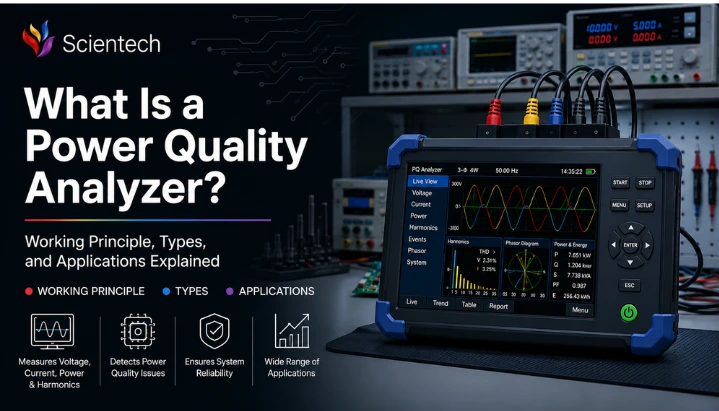
A power quality analyzer is a specialized electrical measuring instrument that monitors and records these power parameters in real time. It measures values such as voltage, current, frequency, power factor, energy consumption, and harmonic distortion while detecting power quality issues like voltage sags, swells, interruptions, flicker, and transients.
In simple terms, a power quality analyzer is a diagnostic tool for electrical systems. Just as a doctor uses an ECG machine to identify heart problems, engineers use a power quality analyzer to identify hidden electrical issues that can reduce efficiency, damage equipment, increase energy costs, or cause unexpected downtime.
The analyzer itself does not correct these problems. Instead, it provides accurate data about what the issue is, when it occurred, and how severe it was, helping engineers choose the most effective solution to improve reliability and performance of the electrical system.
Why Does Power Quality Even Matter?
Before going deeper into how the analyzer works, it helps to understand why anyone would need one in the first place. Modern equipment, from hospital ventilators to server racks to CNC machines, is far more sensitive to power disturbances than incandescent bulbs and simple motors of a few decades ago. A brief voltage dip that would have gone completely unnoticed in an old induction motor can crash a server, corrupt a PLC program, or trip a variable frequency drive in a factory today.
Power quality issues can lead to costly equipment failures, production downtime, and unexpected maintenance across industrial and commercial facilities. Voltage sags, short interruptions, transients, and harmonic distortion are among the most common causes of these problems, which is why power quality has evolved from a niche technical topic into an important engineering and business concern.
Poor power quality does not always announce itself with a blackout. Sometimes it shows up as a motor running hotter than it should, a transformer humming louder than usual, or unexplained equipment failures that nobody can quite pin down. This is exactly the kind of hidden problem a power quality analyzer is built to expose.
Power Quality Analyzer Working Principle
Here is where most explanations jump straight into jargon. Let’s avoid that and build it up step by step instead.
Imagine you are trying to check whether a river’s water level is steady or fluctuating wildly. You cannot just glance at it once. You need a sensor to continuously measure depth, convert that reading into a number your computer understands, run some calculations to detect patterns or spikes, and finally show you the result on a screen or graph. A power quality analyzer follows almost exactly the same logic, just applied to voltage and current waveforms instead of water.
Step 1: Sensing Voltage and Current
analyzer first needs to “see” raw electrical signal. Since grid voltages and currents are far too high and dangerous to feed directly into any electronic circuit, analyzer uses voltage probes and current sensors, such as current transformers or Rogowski coils, to safely scale these signals down. A 400V supply, for example, might be stepped down to a small, safe voltage like 5V that internal circuitry can handle without getting damaged.
This stage also involves signal conditioning, which is simply cleaning up a signal: filtering out unwanted noise and amplifying it slightly so the next stage receives an accurate, usable version of waveform.
Step 2: Converting Analog to Digital (ADC)
Real world voltage and current signals are analog, meaning they vary smoothly and continuously over time. Computers, however, only understand digital data made up of discrete numbers. So the analyzer uses an Analog to Digital Converter (ADC) to sample the waveform thousands of times per second and turn it into a series of digital values.
Think of this like taking rapid fire photographs of a moving object. faster and more frequently you sample, more accurately you capture what is actually happening. This is why sampling rate of an analyzer directly affects how precisely it can catch fast events like a lightning induced transient that lasts only a few microseconds.
Step 3: Digital Signal Processing and Math Behind It
This is the brain of an analyzer. A digital signal processor (DSP) or microprocessor takes a digitized waveform and runs mathematical algorithms on it, most commonly Fast Fourier Transform (FFT).
Here’s an easy way to understand FFT without intimidating math. Imagine a music equalizer that takes a song and breaks it down into bass, mid, and treble frequencies. FFT does something similar to a distorted electrical waveform. It breaks a distorted waveform into its individual frequency components, a pure 50 Hz fundamental wave plus all unwanted harmonic frequencies riding on top of it. This is exactly how the analyzer calculates parameters like Total Harmonic Distortion (THD).
DSP also runs comparison logic against reference thresholds to detect sudden events such as sags, swells, or transients, and timestamps each one so engineers know exactly when it happened.
Step 4: Display and Communication
Finally, all this processed data needs to reach the user. Modern analyzers show results on an LCD screen with waveform graphs, trend charts, and histograms, while also storing historical data internally. Most units also offer communication ports like USB, Ethernet, RS 485, or Bluetooth, so data can be exported, viewed remotely, or fed into a larger power quality management or SCADA system for continuous monitoring across a facility or substation.
Key Parameters a Power Quality Analyzer Measures
Once you understand the working principle, parameters it measures start to make a lot more sense. Here is what each one actually means in plain terms.
Voltage Sag and Swell: A sag is a temporary drop in RMS voltage of 10–90%, while a swell is a temporary rise of 10–80%, both typically lasting from half a cycle to one minute. Picture the lights in your house dimming briefly when a heavy motor starts elsewhere on the same line. That dimming is a voltage sag in action.
Total Harmonic Distortion (THD): Harmonics are unwanted frequencies riding on top of pure 50 Hz wave, usually caused by non linear loads like variable frequency drives, LED drivers, and computer power supplies. THD tells you, as a percentage, how “impure” the waveform has become. A higher THD means more distortion and more stress on connected equipment.
Flicker: This refers to rapid, repetitive fluctuations in voltage that are small enough not to be classified as a sag or swell, but frequent enough to cause visible flickering in lighting. It is measured using a flicker severity index rather than a simple percentage.
Frequency Deviation: Indian grid runs at 50 Hz. Any deviation from this, even a small one, can cause synchronization problems between generators and connected equipment.
Voltage Unbalance: In a three phase system, all three phases should ideally carry equal voltage. When they don’t, it puts uneven stress on three phase motors and can cause overheating in one winding while others stay normal.
Transients: These are extremely brief, high magnitude spikes, often caused by lightning strikes or sudden switching of large inductive loads, lasting anywhere from a few microseconds to a few milliseconds.
Types of Power Quality Analyzers
Not every power quality analyzer is built the same way, and choosing the right one depends heavily on accuracy needs and application. The most important classification comes from the IEC 61000 4 30 standard, which defines Class A and Class S analyzers.
Class A analyzers are the benchmark for measurement accuracy and are typically used for contractual, legal, or dispute resolution measurements, where even a small measurement error could matter. Class S analyzers are more relaxed in accuracy requirements and are commonly used for general statistical surveys and preliminary troubleshooting, where absolute precision is less critical.
| Type | Best For | Portability | Typical Accuracy | Common Use Case |
| Portable Power Quality Analyzer | Field troubleshooting, spot checks | High, handheld or clamp style | Class A or Class S | Site surveys, complaint investigation |
| Panel Mounted / Fixed Analyzer | Continuous monitoring in one location | None, permanently installed | Usually Class A | Substations, critical industrial panels |
| Online / Networked PQ Monitoring System | Facility wide or grid wide monitoring | None, but covers multiple points | Class A, multi point | DISCOM networks, large industrial plants, smart grids |
Portable units are what most students and junior engineers will encounter first, since they are used for quick diagnostic visits. Fixed and networked systems are more common at utility or large industrial scale, where continuous, long term data logging matters more than portability.
Power Quality Analyzer vs Multimeter vs Energy Meter
A common point of confusion for students is how a power quality analyzer differs from a more familiar multimeter or energy meter. It’s a fair question, since all three deal with electrical measurement.
A multimeter gives you a snapshot reading, a single voltage or current value at one instant, with no memory of what happened before or after. An energy meter tracks how much energy has been consumed over time, mainly for billing purposes, but it does not care about waveform quality or brief disturbances.
A power quality analyzer, on other hand, continuously watches the waveform shape itself, not just its magnitude. It can tell you that a 40 millisecond voltage sag occurred at 3:14 PM last Tuesday, exactly how severe it was, and how it compared against IEEE or IEC thresholds. Neither a multimeter nor a standard energy meter is built to catch or classify that kind of event.
Applications of Power Quality Analyzers Across Industries
Power quality analyzers are not limited to power stations and utilities. Their applications span nearly every sector that depends on stable electricity.
In industrial manufacturing, they help identify the exact cause of unexplained equipment trips, motor overheating, or reduced production efficiency, often tracing issues back to harmonics from variable frequency drives.
In commercial buildings and data centers, analyzers protect sensitive IT equipment and critical loads by catching disturbances before they cause costly downtime, especially important where uninterrupted uptime is a business requirement.
In healthcare facilities, stable power directly affects patient safety, since equipment like ventilators, monitors, and imaging systems cannot tolerate unpredictable voltage behavior.
In the renewable energy sector, power quality analyzers are increasingly used to monitor how solar inverters and wind turbine systems interact with the grid, since power electronics based generation tends to introduce its own harmonic content.
In utilities and DISCOMs, they are used for compliance monitoring, complaint investigation, and long term grid health assessment, especially as regulations around reporting power quality data become stricter.
Power Quality Standards and Regulations in India
- Power quality is becoming increasingly important as modern electrical systems rely on sensitive electronic equipment.
- Industries and utilities are expected to monitor key power quality parameters such as voltage, frequency, and harmonic distortion.
- International standards like IEEE 519 and IEC 61000 provide widely accepted guidelines for maintaining power quality.
- Regular power quality monitoring helps improve system reliability, reduce equipment failures, and support regulatory compliance.
- As renewable energy adoption and power electronics continue to grow, power quality analysis is becoming an essential part of modern power system management.
Conclusion
A power quality analyzer might look like just another measuring instrument on a shelf, but it plays a genuinely important role in keeping modern electrical systems reliable. It works by sensing raw voltage and current signals, digitizing them, running mathematical analysis like FFT to detect harmonics and disturbances, and presenting all of this in a form engineers can act on.
For students and freshers, understanding this device is not just about acing an exam question. It connects directly to real industrial problems, power quality standards, and a career path that remains underexplored compared to more crowded specializations. As Indian grids become more complex with growing renewable integration and stricter compliance expectations, professionals who understand power quality will only become more valuable.
If this topic interests you, the natural next step is exploring related concepts like harmonic filters, power factor correction, and specific IEC and IEEE standards mentioned in this blog, each of which builds on the foundation you now have.
FAQs
A power quality analyzer measures and records electrical parameters like voltage, current, frequency, and harmonics to detect disturbances such as sags, swells, and distortion. Its main function is diagnostic, helping engineers identify exactly what is wrong with a power supply and when a problem occurred.
Class A analyzers offer highest measurement accuracy and are used for contractual or legally binding measurements. Class S analyzers have relaxed accuracy requirements and are typically used for general surveys and quick troubleshooting where exact precision is less critical.
No, a power quality analyzer only detects and measures problems. Fixing them requires separate corrective equipment such as voltage stabilizers, harmonic filters, or dynamic voltage restorers, based on what the analyzer’s readings reveal.
Yes, it is a growing and relatively less crowded specialization within electrical engineering. With tightening CEA regulations and increasing industrial reliance on sensitive electronic equipment, engineers skilled in power quality analysis are increasingly valued at DISCOMs, industrial plants, and instrumentation companies.
THD measures how much a voltage or current waveform deviates from a pure sine wave, expressed as a percentage. Higher THD indicates more distortion caused by non linear loads, which can lead to equipment overheating, reduced efficiency, and premature failure.
An energy meter primarily tracks how much electrical energy has been consumed over time for billing purposes. A power quality analyzer goes much further, continuously monitoring the waveform itself to detect brief disturbances, harmonics, and anomalies that an energy meter is not designed to capture.

