

TL;DR
- This blog is useful for engineering students, EV technology learners, automotive professionals, and educators who want to understand what is power electronics andtheir role in electric vehicles.
- It focuses on controlling and converting electrical power using semiconductor devices, making it essential for managing energy in EV systems.
- enables critical functions in electric vehicles such as DC-AC power conversion, motor control, battery charging, and energy management.
- Technologies like inverters, DC-DC converters, and regenerative braking systems help increase vehicle efficiency, reduce energy loss, and extend driving range.
- Advancements in semiconductor materials, smart control systems, and EV training programs are making power electronicsa key area for research, innovation, and technical education in the growing electric mobility industry.
Power electronics in electric vehicles play a critical role in managing energy flow. The electric vehicle industry is growing rapidly, with governments and industries focusing on sustainable transportation and reducing carbon emissions. EVs also have become a significant segment of the modern car industry with
an increasing number of consumers being interested in the ecological issues and the shift to clean mobility. Unlike regular cars, EVs are grounded in sophisticated systems of electricity to ensure the management of the energy flow, the operation of the motors, and the battery recharging mechanism. To understand the technology of such vehicles, one should have a clue of power electronics. It is a branch of electrical engineering that deals with the distribution and conversion of electrical power using semiconductor components that include transistors, converters and switching circuits. In electric vehicles, power electronics play a crucial role in regulating the flow of energy between the battery, the motor and other electrical parts. Power electronics enables efficient conversion and regulation of electrical energy, ensuring smooth motor operation, optimizing motor functionality and improving energy efficiency. It also supports such essential functions as regenerative breaking and optimum battery consumption. Because of these capabilities, power electronics has been said to be the cornerstone of the existing electric cars and one of the technologies that will drive the future of clean cars.
Related Blogs:
What are Power Electronics?
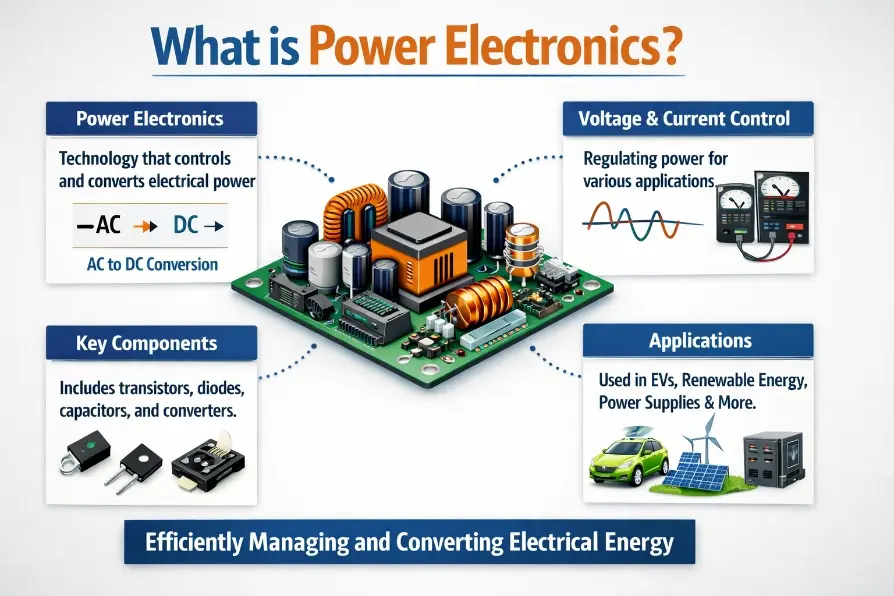
Power electronics is a branch of electrical engineering that focuses on controlling and converting electrical power using electronic circuits. In simple terms power electronics may be redefined as technology that controls the conversion and efficient distribution of electrical energy to systems. It works with semiconductor components such as the IGBTs, MOSFETs, diodes and regulates the voltage, current and frequency.
Power electronics in electric cars include key components such as converters, inverters, switching controllers, which play their role in converting electrical power into the required type of power to be utilized in different operations of the vehicles. The systems facilitate the effective supply of the battery to the motor and other electric devices. Understanding power electronics in EV technology is essential as it ensures efficient energy conversion, better control of motor and overall vehicle performance.
Role of Power Electronics in Electric Vehicles
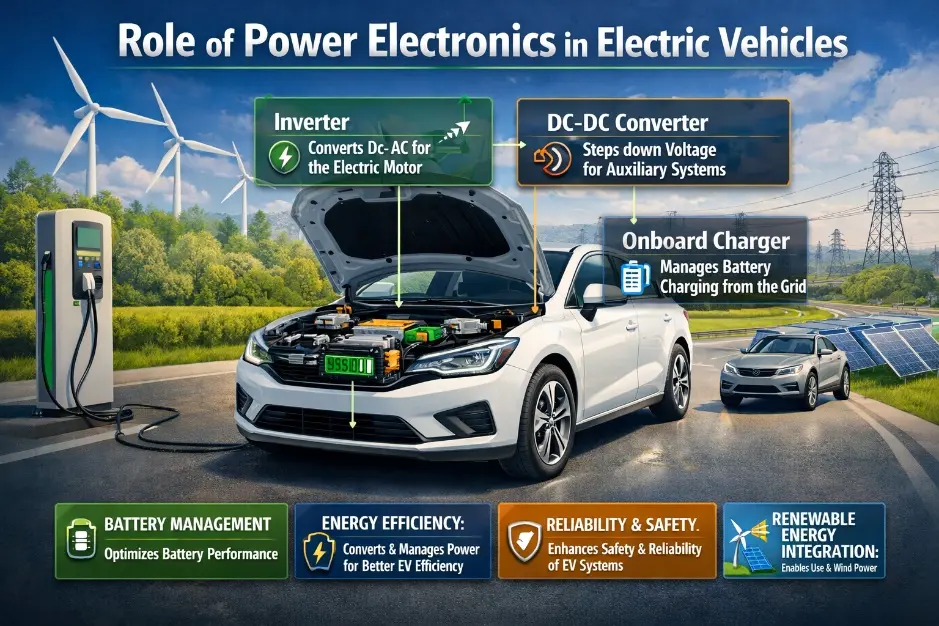
Power electronics are significant in controlling and regulating the distribution of electrical energy in electric vehicles. It ensures efficient distribution of power to all vehicle components including the electric motor, the system of charging and the auxiliary electronics with the power stored in a battery. Power electronics helps in making sure that vehicles are safe and efficient in performance by regulating the voltage and power.
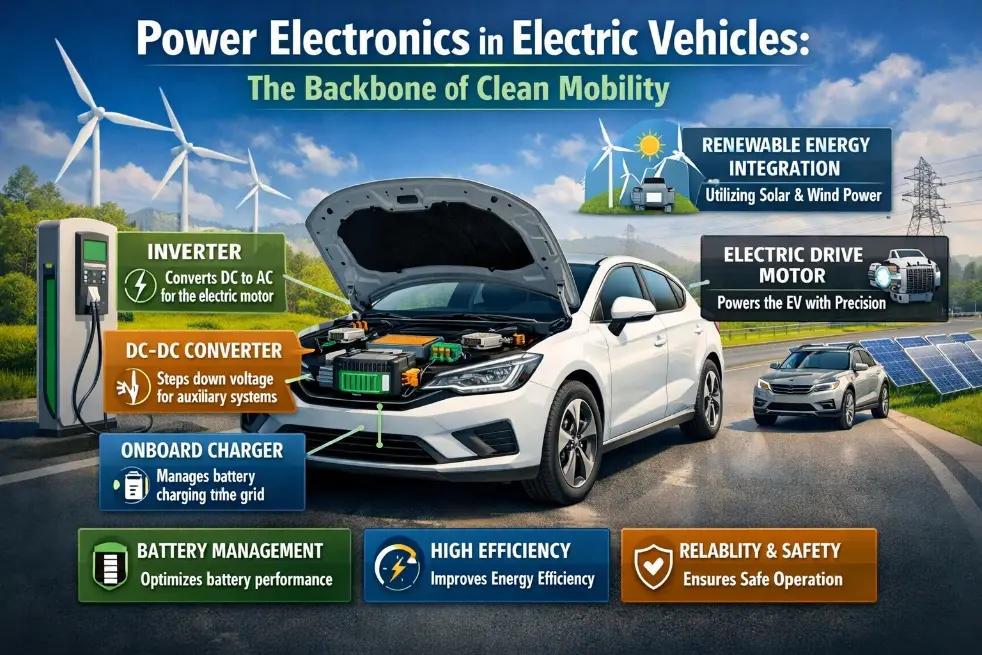
One of the most important applications of power electronics in EVs can be regarded as conversion of the DC power in the battery into an AC power that can be utilized by the electric motor. This is achieved through equipment such as inverters which allow the motor to operate smoothly and efficiently. Without such a conversion process, the motor would not function properly Power electronics also control the speed and the torque of the electric motor by changing the degree of power input to it. This absolute control facilitates electric cars to offer smooth acceleration, high driving abilities and use of energy. Power electronics can significantly increase the energy efficiency, reliability and performance of electric vehicles in general through power management and energy conversion optimization.
1. Inverters
Power electronic inverters are one of the most important components in electric vehicles. They convert the DC power in the battery to AC power required by the electric motor. It is with the help of this conversion that this motor will be able to work effectively and contribute to the normal movement of the vehicles. The speed and torque of the motors are also regulated by inverters which have become essential to the overall workability of the EV.
2. DC-DC Converters
DC-DC converters are used to transform the power that the EV battery contains to the low voltage levels required by the auxiliary systems. These systems include infotainment, interior lights, sensors and other electronic controls in the vehicle. Power electronics involve the use of DC-DC converters to make sure that different components are fed the appropriate voltage to be safely and reliably operated.
3. Onboard Chargers
Onboard chargers play a crucial role in EV charging. They change AC power supplied in the charging stations to DC which would be stored in the vehicle battery. One of the key components of power electronics is onboard chargers that will prove useful in controlling the charge and preserving the battery.
4. Battery Management Systems (BMS)
A Battery Management System (BMS) is applied in the monitoring of the important battery parameters such as voltage, temperature, and health. It also works in collaboration with power electronics to make sure that batteries operate safely without any unnecessary overcharging or overheating and increases the lifespan of batteries. The system will guarantee that the EV battery will work effectively under different circumstances.
Benefits of Power Electronics in Electric Vehicles
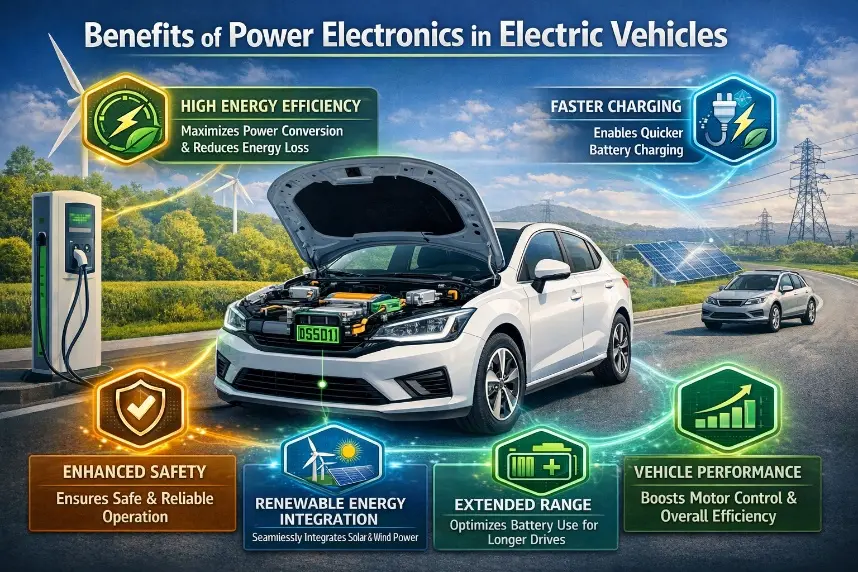
● High energy efficiency -Power electronics ensure efficiency in converting the battery to the motor as well as in the distribution of electrical energy and that power is not wasted.
● Better motor control and performance – It provides precise control of voltage and current, which enables it to smooth acceleration and precise torque control, and have a superior driving performance.
● Minimum energy loss – Power electronics systems are well advanced to minimize the loss of energy in the conversion of power to enhance the performance of the electric vehicle systems.
● Better driving range – The electric cars can achieve greater distance on a fully charged battery because the battery power usage has been optimized using power electronics.
Power Electronics and Regenerative Braking
Another notable characteristic of electric cars is regenerative breaking, which enables the cars to harness energy during breaking. EVs do not dissipate energy in the form of heat as the traditional braking systems but rather recycle the kinetic energy of the car to electrical energy. Power electronics are important in this process as they manage the motor to act as a generator when breaking. This is what converts mechanical energy to electrical energy, and it is sent back to the battery. Consequently, power electronics aid in enhancing better energy economy, further driving range, and improved battery utilization and longer lifespan in electric cars.
Technological Advancements in Power Electronics for EVs
The recent developments in the field of power electronics are making electric cars much more effective and efficient. A significant breakthrough is the employment of wide bandgap semiconductor materials including Silicon Carbide (SiC) and Gallium Nitride (GaN) that enable power devices to run at increased temperature, voltages, and switch rates. The materials contribute to an improved performance of the system and less energy wastage.
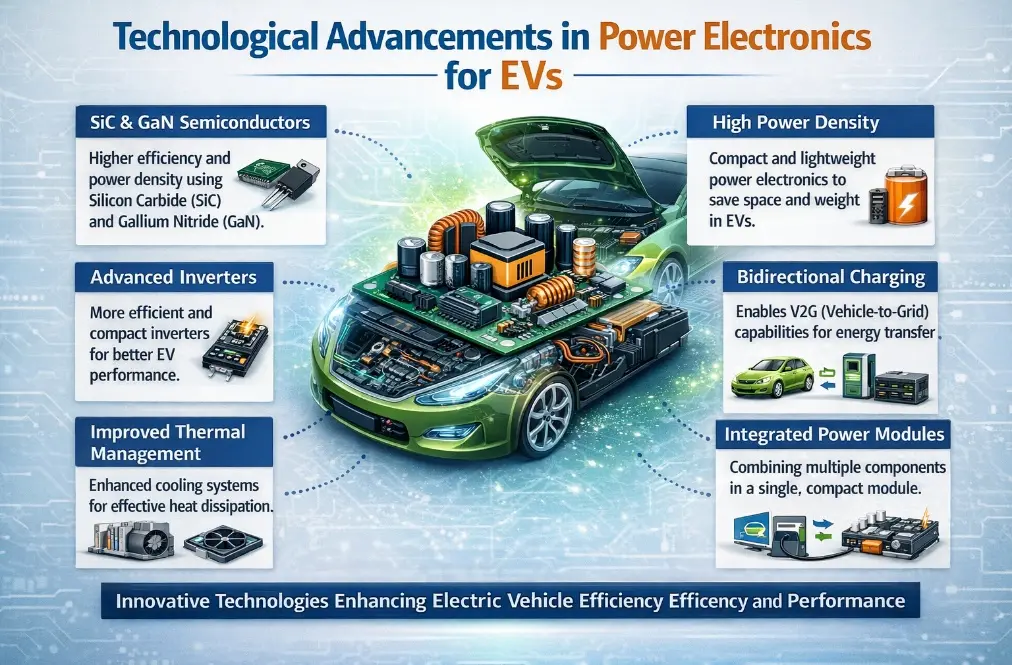
New EVs also incorporate more efficient converters to enhance the conversion of power between the battery, motor, and auxiliary systems. Moreover, power electronics have been developed, and this has made the designs smaller and lighter, which has assisted in minimizing the total weight of the electric vehicles and made the designs more energy efficient. EV systems can also be more reliable and efficient because of the integration with smart control systems and advanced software which improves power management.
Importance of Power Electronics Education and Training
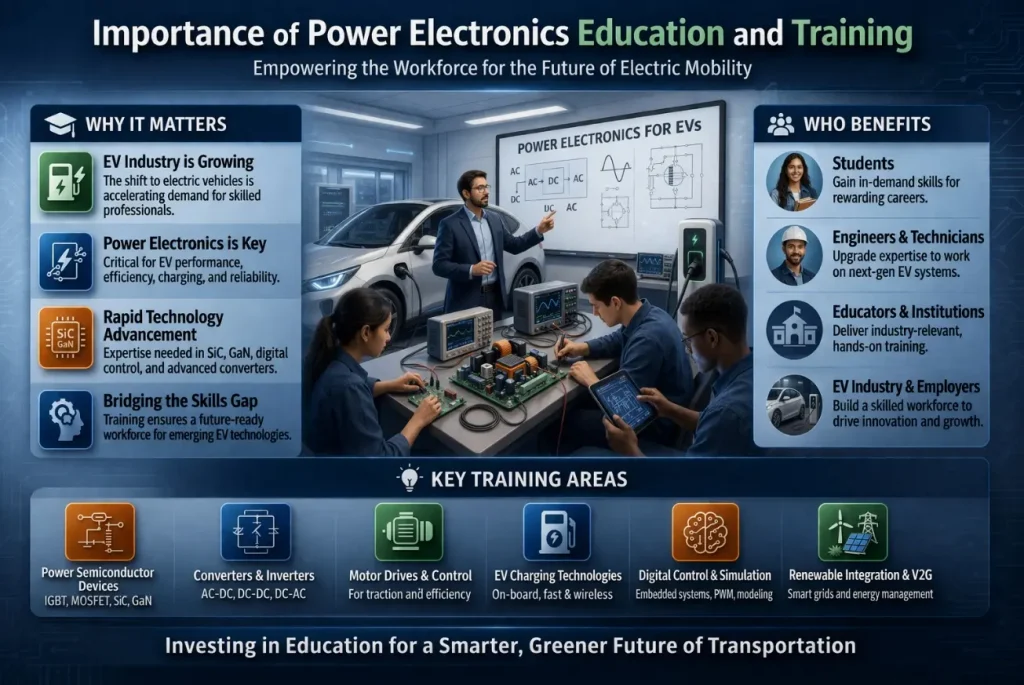
As the industry of electric vehicles grows, there is a great demand for engineers knowledgeable in the field of power electronics. With the ongoing development of EV technology, it is now observed that highly knowledgeable experts on energy conversion, motor control, and electronic power systems are becoming the necessary personnel in the creation and upkeep of a modern electric vehicle. Schools are thus starting to emphasize EV training programs and specialized labs to teach the students how power electronics can be applied in electric cars. Having physical learning and live experiment opportunities will help students get practical skills on EV parts, energy management, and motor control technology, equipping them with abilities that will enable them to work in the expanding electric mobility market.
Conclusion
Power electronics can be simply described as the technology of controlling and transforming electrical energy with the help of electronic devices. Power electronics in electric cars are important in controlling the use of batteries, motor functioning, in charge systems and enhancing efficiency of the vehicle. Since it allows effective energy conversion, improved motor control, and other new capabilities such as regenerative braking, power electronics are a popular view on the foundation of clean mobility. With the future expansion of the EV industry, future studies, research, and education in power electronics will be critical in more efficient, reliable, and sustainable electric vehicle technologies.
Power electronics in electric vehicles is the technology used to control and convert electrical energy from the battery to power the motor and other systems efficiently, from the battery to operate the electric motor and other vehicle systems. It ensures efficient energy management, smooth motor control, and reliable EV performance.
Power electronics is significant in that it regulates the flow of electrical energy between the battery and the motor and other parts. It enhances energy efficiency, supports regenerative braking, and assists to maximize the overall performance and the driving range of EVs.
Electric vehicles have inverters, DC-DC converters, onboard chargers, and battery management systems (BMS) as the major power electronics. These parts assist in the conversion and control of electrical power on the various functions of the vehicle.
Power electronics enable the electric motor to act as a generator when braking. It transforms the kinetic energy of the vehicle into electrical energy and recharges the battery back, which makes the vehicle more energy efficient and increases the driving range.
Students should also learn power electronics as it is a major technology of electric cars. Knowledge in power electronics assists engineers to build efficient EV systems, create improved energy management systems, and build up the rising electric mobility sector.