

TL;DR
- This blog is designed for engineering students, automation professionals, control system engineers, and industry professionals who want to understand the role of PID controllers in Process Control systems used in modern industries.
- Process Control involves monitoring and regulating industrial variables such as temperature, pressure, flow, and level to keep operations stable, efficient, and safe.
- PID controllers (Proportional–Integral–Derivative) continuously calculate the error between the desired setpoint and the actual process value and adjust the system to maintain accurate process control.
- They help maintain system stability, improve productivity, reduce process variability, ensure consistent product quality, and enhance industrial safety.
- PID-based Process Control systems are widely applied in industries such as chemical processing, oil and gas, power generation, manufacturing, and food processing to maintain reliable and efficient operations.
Automation and advanced control systems play a crucial role in modern industries by ensuring accuracy, efficiency, and productivity. Process control is one of the fundamental principles that enables industrial systems to operate smoothly. Process Control is used to maintain temperature in chemical reactors, regulate pressure in pipelines, and ensure industrial processes operate within desired limits.
The PID controller (Proportional–Integral Derivative controller) is one of the most popular and effective methods of industrial automation. PID controllers have played a central role in Process Control systems for decades as they offer precise, reliable, and responsive control of industrial processes.
Across manufacturing plants, power generation facilities, chemical industries, and robotics systems, PID controllers are used to ensure consistency, improve product quality, and increase the safety of operations. This article explains the importance of PID controllers in Process Control, the principle of operation, components, industrial uses, benefits, and future trends.
Know More:
- From Idea to Prototype: How Students Build Real Projects with PCB Prototyping and 3D Printing
- How Technical Training Institutions Can Prepare Students for Semiconductor Careers
- Developing Industry-Ready AI Skills Through Industry-Aligned Training
Understanding Process Control
Process Control can be defined as the mode of controlling and managing the industrial processes to make them perform in desired levels. It involves monitoring key process variables such as temperature, pressure, flow rate, and liquid level, and controlling them automatically through control systems.
The main objective of Process Control is to keep the process variables within accepted limits in order to keep the output steady and constant.
Several elements are involved in Process Control of industrial systems such as:
- Sensors to measure process variables
- Controllers to process data and make decisions
- Actuators to adjust system parameters
- Feedback loops to ensure accuracy
Importance of Process Control in Industry
Process control is very important in industrial operations, as it assists in maintaining efficiency, reliability, and safety. In the absence of appropriate Process Control systems, the industrial processes may become volatile, and production will be lost, equipment will be damaged, or safety hazards may occur.
Key benefits of Process Control include:
- Improved Product Quality
Constant Process Control is used to make sure that products are produced as per the required specification. This is particularly necessary in sectors like pharmaceuticals, food processing and electronic manufacturing.
- Increased Efficiency
Process Control systems minimize energy use and wastage of materials by automatically controlling the process variables.
- Enhanced Safety
Industrial operations usually come with high temperatures, pressures or dangerous chemicals. Hazardous working conditions are avoided through effective process control.
- Reduced Human Intervention
Process control automation reduces the need for manual adjustments and minimizes errors.
What is a PID Controller?
One of the most common control loop mechanisms in Process Control is a PID controller that is utilized to control the desired output of a process.
PID Controller Test Bench
PID Controller Test Bench is a complete training setup designed to demonstrate and control industrial processes using two-point (ON/OFF) control and three-point (PID) control techniques. The system allows temperature control using an industrial PID controller and provides practical exposure to key industrial components such as a thermocouple temperature sensor, PID controller, and heating system.
This test bench enables users to understand the installation, operation, and configuration of process control instruments used in industrial automation.
Why PID Controllers Are Important in Process Control
The PID controllers are very popular in Process Control due to the fact that they offer a relative ease of use and functionality. They might be used in many industrial processes, and they are capable of handling simple and complicated control activities.
The main reasons as to why PID controllers are common are:
- High accuracy in controlling process variables
- Ability to reduce system errors quickly
- Adaptability to different industrial processes
- Reliable performance in dynamic environments
Due to these benefits, PID controllers are still the control method in the majority of the Process Control systems in the world.
How PID Controllers Work in Process Control
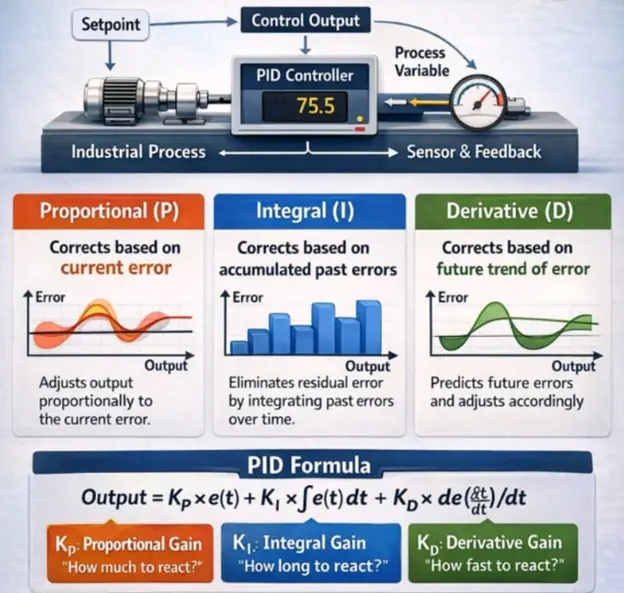
PID controllers are used in a feedback control loop, whereby the output of a system is continuously monitored and compared against the desired setpoint. According to this comparison, the controller is used to automatically adjust the process in order to minimize any deviation. It is through this mechanism that industries are able to have a stable and correct Process Control.
The operation of PID controller is usually based on the following steps:
Measurement
Measurement of the process variable is by sensors of temperature, pressure, flow rate, or level. These measurements give real-time information concerning the situation of the process at the moment.
Comparison
The controller uses the desired setpoint and determines the difference between the measured process variable and the desired setpoint. This comparison will show whether the process is functioning above or below the desired value.
Error Calculation
The actual measured value is compared with the desired setpoint to obtain the difference between the two. The difference is referred to as the error that shows the extent of the correction required in the Process Control system.
Control Action
The PID controller corrects the error by applying three control elements of proportional, integral, and derivative. These are the calculations that are used to decide the corrective action, which is required to minimize the error.
Adjustment
Actuators may be valves, motors, or heaters which adjust the system parameters based on the calculated control output. This assists in approaching the process variable to the desired setpoint.
Importance of PID Controllers in Industrial Process Control
Industrial processes rely heavily on PID controllers as they ensure consistent, effective, and precise operations. PID controllers allow Process Control systems to run evenly by constantly observing and changing the process variables thus keeping them within the desired limits.
Industrial Applications of PID Controllers
Many industries that require Process Control to ensure a stable and efficient operation make use of PID controllers.
Maintaining Process Stability
- Industrial processes (chemical reactors, furnaces, pumps) are often dynamic and nonlinear.
- A PID controller keeps key variables (temperature, pressure, flow, level) stable despite disturbances.
- Without PID control, processes could oscillate, drift, or even become unsafe.
Improving Product Quality
- Consistent control of process variables ensures uniform product quality.
- Example: In a chemical plant, precise temperature and flow control can ensure the chemical reaction produces the desired concentration every time.
Reducing Waste and Energy Consumption
- By keeping processes at the optimal setpoint, PID controllers reduce overuse of energy and raw materials.
- Example: Overheating in a furnace wastes fuel; underheating produces defective products. PID control balances this efficiently.
Handling Disturbances
- Industrial processes are affected by:
- Load changes (e.g., more material in a tank)
- Environmental variations (e.g., ambient temperature)
- PID controllers adjust the output in real time to compensate, maintaining performance.
Automation and Scalability
- PID controllers enable continuous automatic operation without constant human intervention.
- They are scalable for small machines or large industrial plants, making them versatile and reliable.
Enhancing Safety
- Prevents dangerous deviations in critical variables (pressure spikes, overheating, overflows).
- Example: In a boiler, PID control ensures pressure stays within safe limits, avoiding accidents.
Cost-Effectiveness
- PID controllers are simple, robust, and widely understood.
- They require minimal maintenance compared to more complex control schemes, reducing operational costs.
Real-World Industrial Examples
Chemical Industry
PID controllers are used in chemical plants to control critical process variables such as reactor temperature, pressure levels, flow rates, and mixing processes. Adequate Process Control makes sure the chemical reactions are carried out under the conditions to enhance efficiency and quality of the products.
Oil and Gas Industry
PID controllers are used in oil refineries and pipeline systems to ensure maintenance of pressure control, flow control and temperature stabilization. The Process Control systems are used to provide safety and efficiency in the transportation and processing of petroleum products.
Power Generation
PID controllers are used in power plants to control the parameters like boiler temperature, steam pressure and turbine speed. Effective Process Control is used to ensure an electric generation that is stable and also to protect the equipment as well as enhance efficiency in the operations.
Manufacturing Industry
The manufacturing processes need to be under strict control of machines and production parameters. CNC machines, assembly automation on an assembly line, and robotic motion control are all applications of PID controllers. Precise Process Control assists in a consistent flow of operations and good quality of the product.
Food Processing Industry
The production of food involves severe regulations of temperature, humidity, and pressure. The PID-based Process Control systems have ensured the safe production of food products with consistent quality production.
Conclusion
One of the significant tools of the contemporary Process Control systems is the PID controllers. Their effectiveness in offering stable, accurate, and reliable control of the processes in industries makes them a necessity in all industries.
PID controllers make sure that the work processes are efficient and safe in the production of chemicals, power generation, and robotics. They ensure high-quality products, better efficiency, and industrial safety by constantly checking the performance of the whole system and implementing corrective measures.
With the development of technology PID controllers will keep on advancing and getting incorporated with current automation systems. Even though sophisticated methods of control have been introduced, PID-based Process Control is still a core element of industrial processes.
Realizing the significance of PID controllers in Process Control, engineers and industrial workers may create more effective and safe systems that can be used to sustain increasing needs of the contemporary industry.
Innovative technology solutions for electronics education, research laboratories, and industrial testing.
FAQs
A PID controller is a control mechanism that is applied in Process Control systems to ensure desired conditions in the processes. It is based on proportional, integral and derivative calculations aimed at reducing the deviation between the set point and the actual process variable.
The importance of PID controllers lies in the fact that they can be used to ensure a stable and precise Process Control with the help of the automated adjustment of the process parameters. This enhances productivity, quality of products and safety in operations of industrial systems.
When industries like chemical processing, oil and gas, power generation, manufacturing, and food processing need accuracy in Process Control of temperature, pressure, and flow, PID controllers are commonly applied.
To control and minimize errors, a PID controller constantly measures process variables and is used to vary the control outputs. This real time correction assists to keep the optimum operating conditions, thus enhances the overall performance of Process Control systems.
A PID controller has three key elements including: Proportional (P), Integral (I), and Derivative (D). The three components are interrelated and serve a purpose of error analysis and correction measures to ensure Process Control remains within stable limits.