


TL;DR
- This blog is written for engineering students, physics learners, and electronics enthusiasts who want a clear, jargon-free explanation of what a band gap is and why it matters in semiconductor devices.
- Band gap is the energy difference between valence band and the conduction band in a solid, and its size decides whether current can flow through a material.
- Semiconductors sit in a sweet spot: their band gap is small enough for electrons to cross with a little energy, making them controllable and useful.
- Distinction between direct and indirect band gap determines which materials work for LEDs and lasers vs. transistors and solar cells (Si).
- Band gap engineering, the deliberate tuning of this energy difference through alloying, heterostructures, strain, and quantum confinement, is the foundation of modern chip design, LED technology, and solar energy systems.
One of the most fundamental concepts in solid-state physics is the band gap, which defines the electrical and optical behavior of a material. To explain in simple terms, The band gap of a material is the energy difference between electrons bound in the valence band and free-moving electrons in the conduction band. The band gap is an energy range in a solid where no electron states are available. Its magnitude strongly determines whether a material behaves as a conductor, semiconductor, or insulator. Understanding the band gap of materials helps explain how current flows in devices and how light is absorbed or emitted through technologies such as solar cells and LEDs. Along with the semiconductors you study, or with the world of modern electronics, band gap offers a concise framework of why materials act as they do and how engineers can customize them to particular uses.
Related Blogs:
- Challenges in Process Control and How Advanced Control Strategies Solve Them
- What is Hall Effect? A Complete Beginner’s Guide
- What is the Four Probe Method? Principle, Setup & Applications Explained
What is Band Gap?
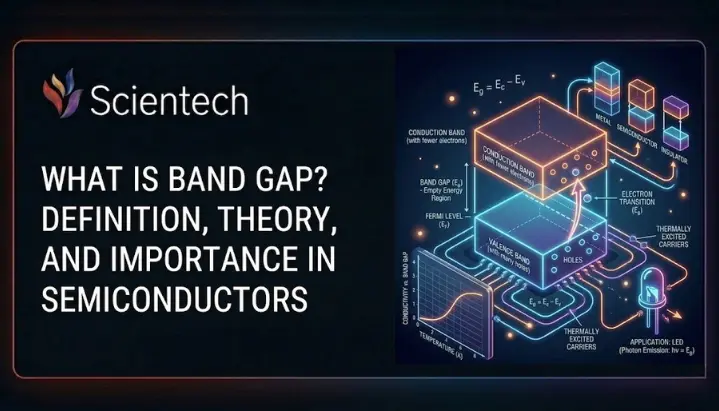
In the physics of solids, the band gap is an energy interval within a solid that contains no electron states. More realistically, it is the difference in energy between the top of the valence band and the bottom of the conduction band.
Imagine it as a jump. The electrons in a material sit in the valence band where they are bound to atoms and cannot move freely. Electrons are free to move in the conduction band and carry electricity. Band gap is the height of that energy barrier.
To move an electron across the valence band into the conduction band, it needs to have at least this much energy in the form of heat, light or an applied electric field. After it crosses, it becomes a charge carrier that is free and can contribute to an electric current.
This is one of the most important parameters, band gap energy (measured in electron volts, or eV), which can tell you almost everything about the way a material will behave both electrically and optically.
Valence Band, Conduction Band, and the Gap Between Them
To fully understand what band gap means in a semiconductor, you need to picture what’s happening at atomic level.
In a crystalline solid, electrons do not occupy random energy levels; they exist in specific energy bands, which are ranges of allowed energies. The two most important ones are:
Valence Band: The highest energy band that is fully occupied by electrons at absolute zero. Electrons here are attached to atoms and cannot move on their own.
Conduction Band: Band above the valence band. When electrons reach here, they are free to move throughout the crystal lattice and carry current.
Between these two bands lies a band gap a forbidden zone where no electron states exist. No electron can exist in this zone; it must either be in the valence band or the conduction band.
The width of this gap in electron volts is what separates conductors, semiconductors, and insulators.
Conductors, Semiconductors, and Insulators Explained Through Band Gap
Band gap concept beautifully explains why different materials conduct electricity differently.
Conductors: In materials like copper and aluminum, valence and conduction bands overlap. There is effectively no band gap. Electrons can flow freely at any temperature, which is why metals conduct electricity so well.
Semiconductors: Materials like silicon (Si) and germanium (Ge) have a small but non-zero band gap. Silicon’s band gap is 1.12 eV. At room temperature, thermal energy is enough to push some electrons across this gap, creating a small but useful number of free carriers.
At room temperature, thermal energy (~0.026 eV) is much smaller than the band gap of silicon (~1.12 eV), which is why only a small fraction of electrons are thermally excited.
By adding controlled impurities, you can precisely control conductivity—this is what enables transistors to function.
Insulators: Materials like diamond or glass have very large band gaps. Thermal energy is nowhere near sufficient to push electrons across. These materials do not conduct under normal conditions.
Boundary between semiconductors and insulators is roughly 3.0 eV. Materials with a band gap below this are generally classified as semiconductors; those above it are insulators.
This classification is not just academic. It directly shapes which materials you use in which devices.
Band Gap of Common Semiconductor Materials
Different semiconductor materials have very different band gap values, and these differences determine their applications:
Material | Band Gap (eV) | Type |
Germanium (Ge) | 0.67 | Narrow gap, indirect |
Silicon (Si) | 1.12 | Narrow gap, indirect |
Gallium Arsenide (GaAs) | 1.42 | Direct |
Gallium Nitride (GaN) | 3.4 | Wide gap, direct |
Silicon Carbide (SiC) | 3.26 | Wide gap, indirect |
Diamond (C) | 5.5 | Insulator |
Silicon dominates the electronics industry not because it has “best” band gap for every job, but because it is abundant, well-understood, and its 1.12 eV gap is well suited for transistors and solar cells.
Wide band gap semiconductors like GaN and SiC are now emerging as next frontier particularly in EV power electronics and 5G RF components because they handle higher voltages, temperatures, and frequencies that silicon cannot sustain.
Direct Band Gap vs Indirect Band Gap
This is where band gap concept becomes especially important for optical and optoelectronic devices. Not all band gaps are created equal.
What is a Direct Band Gap?
In a direct band gap semiconductor, bottom of conduction band and top of valence band occur at same point in momentum space. This means an electron can transition between two bands by simply absorbing or emitting a photon with no change in momentum required.
This makes transition fast and efficient. Materials like GaAs, InP, and GaN are direct band gap semiconductors. They emit light efficiently when electrons and holes recombine, which is why they are used in LEDs, laser diodes, and photodetectors.
What is an Indirect Band Gap?
In an indirect band gap semiconductor, conduction band minimum and valence band maximum occur at different momentum values. An electron transitioning between two bands must also change its momentum which requires involvement of a phonon in addition to a photon.
This three body process (electron + photon + phonon) is statistically much less likely. As a result, indirect band gap materials are poor light emitters.
Silicon and germanium are most well known indirect band gap semiconductors. This is why silicon is rarely used in LEDs or lasers it simply cannot emit light efficiently. Instead, silicon shines in transistors, microprocessors, and solar cells, where its electronic switching properties matter more than its optical ones.
Why Does This Distinction Matter?
Direct vs indirect band gap distinction is not just theoretical. It directly determines which material you pick for a device:
- LEDs and laser diodes:Direct band gap materials
- Solar cells:Both types are used; silicon solar cells need to be hundreds of microns thick because silicon absorbs light poorly due to its indirect gap; thin film solar cells use direct gap materials like CdTe or CIGS and can be just 1-2 microns thick
- Transistors and microprocessors:Indirect gap silicon dominates here
- Power electronics:Wide band gap materials are taking over from silicon
How Does Temperature Affect the Band Gap of a Semiconductor?
Most textbooks skim through this, and it is very important to understand actual semiconductor performance in the real world.
As the temperature increases, atomic vibrations in the crystal lattice intensify. This leads to a decrease in the band gap due to lattice expansion and electron–phonon interactions, which reduce the effective energy separation between the valence and conduction bands.
In silicon, the band gap decreases between 1.17 eV at 0 K and 1.12 eV at room temperature. Varshni has given an empirical equation describing this relationship.
It is due to this that semiconductor devices have temperature requirements. At very high temperatures, the density of thermally excited electrons of a semiconductor increases dramatically, altering its electrical characteristics. The importance of wide band gap semiconductors such as SiC is that they retain their electrical characteristics up to temperatures of over 200 o C, something that is not possible with conventional silicon.
What is Band Gap Engineering?
Band gap engineering is the deliberate tuning of a semiconductor’s band gap by controlling its composition, structure, strain, and quantum confinement.
This is done by creating alloys of two or more semiconductors. For example:
- Mix GaAs and AlAs to form GaAlAs you can tune band gap across a range by varying the aluminum fraction
- InGaAs alloys allow you to hit specific wavelengths for fiber-optic lasers and detectors
- In quantum dots and nanostructures, quantum confinement shifts the effective band gap based on particle size
Band gap engineering is what allows engineers to design semiconductors for exact wavelengths of light emission, specific breakdown voltages, and optimized carrier mobility. Modern heterojunction bipolar transistors (HBTs), multi-junction solar cells, and laser diodes all depend on this precise control.
In India, research in this field is active at institutions like IIT Bombay, IISc Bangalore, and various DRDO labs working on compound semiconductors for defense and space applications.
Why is Band Gap Important? Real World Applications
Understanding what band gap means in a semiconductor unlocks logic behind almost every modern electronic component.
Solar Cells: The band gap determines which wavelengths of sunlight a material can absorb. Silicon’s 1.12 eV gap aligns well with visible light spectrum, which is one reason it remains dominant solar cell material despite its indirect band gap.
LEDs and Displays: The color of light emitted by an LED is directly determined by band gap of material. GaN emits blue light; adding indium shifts gap and changes color. The entire RGB LED display technology in your phone, TV, and street lights is built on this principle.
Transistors and Microchips: The switching behavior of transistors depends on precisely controlling electron flow across band gap through applied voltages. Every logic gate, every processor, every memory chip is built on this.
EV Power Electronics: Wide band gap semiconductors (SiC and GaN) are now replacing traditional silicon in EV inverters and chargers. They switch faster, handle higher voltages, and generate less heat enabling more efficient electric vehicles and faster charging.
Photodetectors and Sensors: Infrared sensors, optical fiber receivers, and medical imaging detectors are all engineered around specific band gap materials that respond to particular wavelengths of light.
Conclusion
The band gap is a fundamental concept that explains the behavior of materials in relation to electricity and optical properties. It is the difference between electrons in the valence band and those in the conduction band that move and conduct electricity. The small range of energy defines how a material is a conductor, a semiconductor, or an insulator, and is necessary to the study of modern electronics.
Real world applications are also driven by band gap of a material, whether it is absorption of sunlight by solar cells or emission of various colors by LEDs. This has become not merely a theoretical notion with the development of such things as wide band gap semiconductors and band gap engineering, actively developing the future of faster, more efficient and more reliable electronics.
The band gap is the smallest energy required to move an electron in a solid material in a stationary state (valence band) to a free moving state. A material which has a small band gap conducts electricity with a small amount of energy input, thus is a semiconductor.
At room temperature, the band gap of silicon is about 1.12 eV. This has made it a widely used semiconductor for transistors and solar cells. It is a relatively indirect band gap material and this limits its optical applications such as LEDs.
In a direct band gap semiconductor, electrons can transition, electrons are allowed to change bands by either absorbing or emitting a single photon. The momentum must also be conserved with a phonon in an indirect band gap semiconductor. LEDs and lasers make use of direct band gap materials; transistors and solar cells make use of indirect ones.
The band gap defines the electrical conductivity, optical characteristics, operating temperature and applicability of a semiconductor to a given application. Designing a device, be it electronic or optoelectronic, is inseparably connected with the choice of right band gap material.
A wide band gap semiconductor has a band gap that is usually larger than 2 eV. The most prominent ones are GaN (3.4 eV) and SiC (3.26 eV). They are able to work at higher voltages, temperatures and frequencies compared to the conventional silicon, and are thus suitable in EV power electronics, 5G devices and industrial power converters.
Yes. Temperature causes a slight decrease in band gap since more vibrations between atoms tend to increase the distance between atoms and decrease the energies of interaction between electrons. This is the reason why semiconductor devices do have operating temperature limits, and why wide band gap materials are favored in high temperature applications.