

TL;DR
- This blog is designed for engineering students, instrumentation engineers, automation professionals, and industry professionals who want to understand the role of smart sensors in modern industrial instrumentation and control systems.
- Instrumentation helps industries measure and control critical parameters like temperature, pressure, flow, and level to maintain safe and efficient operations.
- Unlike traditional sensors, smart sensors include microprocessors, digital communication, and self-diagnostics, improving monitoring and automation in industrial instrumentation systems.
- Technologies such as IoT, AI, wireless sensor networks, edge computing, and cloud connectivity are enabling smarter and more connected industrial instrumentation and control environments.
- With the rise of Industry 4.0, smart sensors will play a key role in improving efficiency, predictive maintenance, safety, and data-driven decision-making in modern industries.
Instrumentation is an essential part of modern industries because it enables accurate measurement and control of industrial processes. It supports the foundation of the industrial processes and ensures that systems operate safely, efficiently, and reliably in fields such as manufacturing, power generation and chemical processing.
In the process of industrial instrumentation, important process variables include temperature, pressure, flow, and level. These measurements are used by operators to keep track of the processes and achieve the best conditions. Industrial instrumentation and control when combined with the automation systems make the process efficient, less downtime, and more productive.
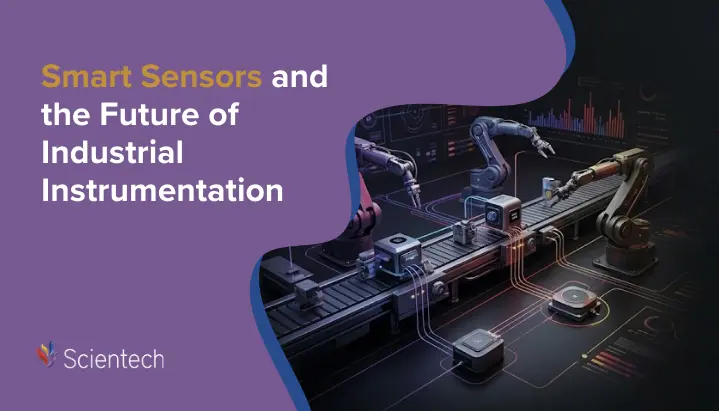
Smart sensors are transforming the field of industrial instrumentation and control. These sensors can collect data, perform self-diagnostics, and communicate digitally with control systems to give real-time information on how to make better decisions.
Following the emergence of Industry 4.0, industries have been rapidly switching to intelligent sensing technologies. The future of instrumentation lies in smart sensors that enable more connected, automated, and data-driven industrial environments.
More Insights
- Data Logging and Remote Monitoring: Driving Efficiency Across Research and Industry
- Enabling Hands-on AI and ML Education with Development Platforms
- Smart Agriculture Labs for Agritech Learning
What is Industrial Instrumentation?
Industrial instrumentation can be described as a system of instruments which are employed to measure, monitor and control several industrial processes. In very simple terms, Instrumentation makes sure that such vital process variables such as temperature, pressure, flow, and level are measured correctly to enable industries to operate safely and efficiently.
An average industrial instrumentation and control system is made up of a number of important components collaborating. The physical process environment provides the sensor with physical parameters. The sensor signals are transformed to standardized signals which can be transmitted to control systems by the transmitters. This data is analyzed by controllers (PLCs or DCS) and decisions are made by adhering to prearranged settings. Lastly, end control components such as control valves, motors or actuators are used to bring the process to the desirable conditions.
Industrial instrumentation may be regarded as important in numerous industries. In Oil and Gas it is useful in monitoring pressure, flow and safety conditions. In Power Plants, instrumentation would provide consistency in production and safeguard of equipment. In Chemical Processing industries, measurements are essential in maintaining the quality and safety of products whereas in the Manufacturing sectors, they have instrumentation systems which help them automate their production and enhance efficiency in their operations.
Understanding Smart Sensors
Smart sensors are enhanced sensors used in modern Instrumentation systems which measure process variables besides processing and communicating digitally. These sensors are important in modern industrial instrumentation and control systems as they provide intelligent data to enhance monitoring and automation.
Smart sensors have built-in intelligence unlike the traditional sensors, which detect and transmit signals. They are able to analyze data, do internal processing and can communicate directly to control systems and this enhances performance of industrial instrumentation networks.
There are a number of features that smart sensors have. They usually include internal microprocessors which handle the results of measurements. A large number of them have self-calibration that helps to minimize the use of manual maintenance. The digital communication enables them to easily connect to the modern control systems and industrial networks. Also, real-time diagnostics assist in identifying faults or performance defects before they can impact the process.
Smart sensors enhance the efficiency and reliability of industrial instrumentation and control systems by providing accurate data and enabling intelligent monitoring, helping industries improve productivity and control.
Key Technologies Behind Smart Sensors
The technology of smart sensors is enhancing contemporary Instrumentation by integrating digital technologies on sensing equipment. These technologies enable sensors to capture, process and transmit data more effectively and thus are vital in the contemporary industrial instrumentation and control systems.
Sensing Elements
- These are the core components that detect physical or chemical changes:
- Temperature sensors (thermistors, RTDs)
- Pressure sensors
- Motion sensors (accelerometers, gyroscopes)
- Gas and humidity sensors
They convert real-world signals into electrical signals.
- Microcontrollers & Embedded Systems
Smart sensors include built-in processors (often microcontrollers) that:
- Process raw sensor data
- Perform calculations or filtering
- Enable decision-making at the device level
This is what makes them “smart” rather than just passive sensors.
- Signal Conditioning
Raw signals from sensors are often weak or noisy. Signal conditioning involves:
- Amplification
- Filtering
- Analog-to-digital conversion (ADC)
This ensures accurate and usable data.
- Data Processing & Edge Computing
Modern smart sensors use edge computing, meaning they:
- Analyze data locally instead of sending everything to the cloud
- Reduce latency
- Improve efficiency and privacy
They may also run simple algorithms or even AI models.
- Wireless Communication Technologies
Smart sensors can transmit data using:
- Wi-Fi
- Bluetooth / BLE
- Zigbee
- LoRaWAN (for long-range, low-power communication)
This enables integration into IoT (Internet of Things) systems.
- Power Management
Efficient power usage is critical, especially for battery-operated devices:
- Low-power electronics
- Energy harvesting (solar, vibration)
- Sleep modes and duty cycling
- MEMS (Micro-Electro-Mechanical Systems)
Microelectromechanical systems
MEMS technology allows sensors to be:
- Extremely small
- Low-cost
- Highly reliable
Examples include accelerometers in smartphones.
- AI & Machine Learning Integration
Some advanced smart sensors use:
- Pattern recognition
- Predictive analytics
- Anomaly detection
This enables applications like predictive maintenance and smart health monitoring.
- IoT Integration
Internet of Things
Smart sensors are key components of IoT ecosystems, where they:
- Collect data
- Communicate with other devices
- Enable automation and remote monitoring
Applications of Smart Sensors in Industrial Instrumentation
Process Monitoring and Control
Smart sensors continuously measure parameters like:
- Temperature
- Pressure
- Flow rate
- Level
They feed data into control systems such as SCADA and Distributed Control System, allowing:
- Real-time monitoring
- Automated adjustments
- Improved process stability
Example: Maintaining optimal temperature in a chemical reactor.
Predictive Maintenance
Using data analytics and Machine Learning, smart sensors can:
- Detect anomalies in vibration, temperature, or noise
- Predict equipment failures before they occur
- Reduce unplanned downtime
Example: Monitoring motor vibrations to predict bearing failure.
Industrial Automation & Robotics
Smart sensors enable precise control in automated systems:
- Position sensors guide robotic arms
- Vision sensors enable object detection
- Proximity sensors prevent collisions
Used widely in automated manufacturing lines and robotics.
Energy Management
Smart sensors help industries optimize energy consumption by:
- Monitoring power usage
- Detecting inefficiencies
- Supporting smart grid integration
Example: Adjusting machine operation based on load demand to save energy.
Safety and Hazard Detection
They improve workplace safety by detecting:
- Gas leaks
- Fire or smoke
- Toxic chemicals
Example: Gas sensors in oil & gas plants to prevent explosions.
Quality Control and Inspection
Smart sensors ensure product quality by:
- Detecting defects in real time
- Measuring dimensions and surface quality
- Enabling automated inspection systems
Example: Vision sensors checking product alignment on assembly lines.
Environmental Monitoring
Industries use smart sensors to track:
- Air and water quality
- Emissions
- Waste levels
This helps in regulatory compliance and sustainability efforts.
Remote Monitoring and Control
Through Internet of Things, smart sensors allow:
- Remote diagnostics
- Centralized monitoring of multiple plants
- Reduced need for manual inspections
Smart Manufacturing (Industry 4.0)
Smart sensors are the backbone of Industry 4.0:
- Enable data-driven manufacturing
- Support digital twins
- Improve flexibility and customization
Benefits of Smart Sensors in Industrial Instrumentation
- Higher measurement accuracy: Smart sensors give more accurate and reliable measurements which enhance the work of the modern Instrumentation systems.
- Real-time data monitoring: These sensors provide real-time data transmission to the control systems, which is responding quicker in industrial instrumentation and control processes.
- Reduced downtime through predictive maintenance: Smart sensors detect equipment faults early, helping prevent unexpected failures and downtime.
- Improved operational efficiency:: Smart sensors help with improved automation and process optimization through availability of correct and timely data in industrial instrumentation and control.
- Enhanced safety and compliance: Smart sensors measure the key parameters and assist in ensuring the safe working conditions in industrial settings.
- Lower maintenance costs: Smart sensors ensure that in contemporary Instrumentation systems, the cost of maintenance is minimized due to the automated diagnostics and less manual inspection.
Smart Sensors and Industry 4.0
Smart sensors are a significant contributor to the digital transformation of the contemporary Instrumentation systems. With the shift towards Industry 4.0, intelligent monitoring and automated decision-making of industrial instruments and control systems are only achievable via smart sensors to collect real-time data.
These sensors are easily combined with advanced automation systems which include SCADA systems, Distributed Control Systems (DCS) and PLC-based automation. This integration gives industries a chance to remotely monitor processes, enhance system responsiveness, and have a better control of processes due to modern industrial instrumentation networks.
Smart sensing technology is able to enhance industrial instrumentation and control structures by offering real-time data and sophisticated diagnostics. It assists industries to create more networked, efficient and data-driven systems that contribute to smarter and dependable industrial activities.
Conclusion
Instrumentation is becoming modern with the smart sensors which are giving accurate data, real time monitoring as well as intelligent diagnostics. Their high-end functions enhance productivity, dependability and automation in industrial instrumentation systems in most industries.
With the shift of industries towards the digital world and the creation of smarter manufacturing, the use of intelligent sensing technologies is becoming unavoidable. The smart sensors are used to assist organizations in accuracy of the processes, minimization of downtimes, and enhance the safety in the industrial instrumentation and control systems.
The smart sensing technology will surely continue to transform the industrial instrumentation and control systems in the years to come. Smart sensors will be used to create more efficient and future-proof industrial work with more connectivity, automation and data-driven decisions.
FAQs
Smart sensors are a type of modern sensing instrument in industrial instrumentation that is not only able to measure the process variables but also processing, analyzing and transmitting data digitally. They usually have in-built microprocessors, self-diagnosis and digital communications to enhance monitoring and automation.
Conventional sensors merely measure the physical parameters and transmit signals to the control systems. More efficient to modern instrumentation and control systems in the industrial sector, smart sensors are able to process data directly, can self-calibrate and give real-time diagnostics.
Smart sensors find extensive application in the process control system, predictive maintenance, energy management, safety monitoring, and environmental monitoring. The applications are used in industries to make their operations more efficient and reliable.
IoT, Artificial Intelligence (AI), wireless sensor networks, edge computing, and cloud connectivity technologies facilitate smart sensors and allow smarter and more interconnected industrial instrumentation and control settings.
Industry 4.0 cannot be competitive without smart sensors as it offers real-time information, automation, and allows predictive maintenance. This assists the industries to enhance their efficiency, safety and decisions in the contemporary Instrumentation systems.