


TL;DR
- This blog is designed for manufacturing professionals, plant managers, engineers, business leaders, policymakers, and educational institutions seeking to understand what is smart manufacturing and how the smart manufacturing industry 4.0 is transforming global production systems.
- Smart manufacturing is reshaping manufacturing through digital connectivity, automation, and data-driven systems that enhance efficiency, reduce waste, and improve competitiveness.
- Advanced technologies such as IIoT, AI & Machine Learning, Big Data analytics, robotics, digital twins, and cloud/edge computing power modern smart manufacturing solutions.
- Smart manufacturing technology is driving innovation across automotive, aerospace, electronics, pharmaceutical, and food industries while delivering resilience, agility, and global competitiveness.
- Industry 4.0 lab solutions help institutions produce future-ready graduates, foster industry collaboration, and support research—building a workforce capable of leading the next phase of digital industrial transformation.
The manufacturing sector is undergoing a structural transformation driven by digitalization, connectivity, and intelligent automation commonly referred to as Industry 4.0.
Driven by rapid technological advancements, Industry 4.0 is reshaping the way products are designed, manufactured and delivered to customers. Established production paradigms are being redefined by digital systems, smart automation, and connected networks that can facilitate more responsive and data-driven operations.
Smart manufacturing is at the center of this change. With the help of advanced technologies, machines and systems can now communicate seamlessly, allowing them to streamline processes, make real-time decisions, and operate autonomously.
Although smart manufacturing and Industry 4.0 share the goal of optimizing manufacturing through technology, they are not synonymous.
Also Read:
- Transforming Labs with Workbenches: Bringing Industrial Discipline to Education
- Developing Industry-Ready AI Skills Through Industry-Aligned Training
- Enabling Hands-On AI and ML Education with Development Platforms
What Is Smart Manufacturing?
Smart manufacturing is a technology-based way of manufacturing that involves interconnected systems, real-time data, automation, and advanced analytics to optimize processes across the entire lifecycle, including design, production, supply chain operations, and after-sales services.
It extends beyond mere automation. While automation replaces manual tasks, smart manufacturing focuses on intelligent systems that are adaptive, predictive, and self-optimizing.
Core Characteristics
- Connectivity – Machines, sensors, and systems communicate via industrial networks.
- Real-Time Data – Continuous data collection enables instant monitoring and insights.
- Advanced Analytics – AI and machine learning extract actionable intelligence.
- Autonomous Decision-Making – Systems can self-adjust without human intervention.
- End-to-End Integration – Design, production, logistics, and customer systems are digitally connected.
Traditional vs Smart Manufacturing
Aspect | Traditional Manufacturing | Smart Manufacturing (Industry 4.0) |
Production Approach | Linear, rigid, and batch-oriented | Flexible, adaptive, and continuous |
Automation | Basic automation; repetitive tasks only | Advanced automation with AI, robotics, and autonomous systems |
Connectivity | Minimal digital integration; machines operate in isolation | Fully connected digital ecosystem linking machines, sensors, and humans |
Data Utilization | Limited data collection; mostly manual records | Real-time data collection and analytics for predictive insights |
Maintenance | Reactive, scheduled maintenance | Predictive and condition-based maintenance |
Technology Dependency | Minimal; mostly mechanical and electrical machines | High dependency on IIoT, AI, cloud computing, robotics, and analytics |
Industry 4.0
Focus: Industry 4.0 emphasizes the creation of fully connected digital production ecosystems. It combines machines, equipment, sensors and people to create a digital network that improves efficiency and productivity not just in the manufacturing operations but throughout the whole value chain, including product design, development, logistics, and distribution.
Scope: Industry 4.0 extends far beyond the factory floor. It can be implemented on an enterprise level, as well as on a cross-organizational level, which allows end-to-end digital integration of supply chains, and business networks.
Technologies: Cyber-physical systems, the Internet of Things (IoT), Artificial Intelligence (AI), cloud computing, big data analytics, and highly-advanced automation platforms are all advanced technologies that drive Industry 4.0.
Goals: These core technologies enable adaptable, efficient business ecosystems that leverage digital innovation to streamline operations, improve decision-making, and enhance competitiveness.
Core Smart Manufacturing Technology Powering Industry 4.0
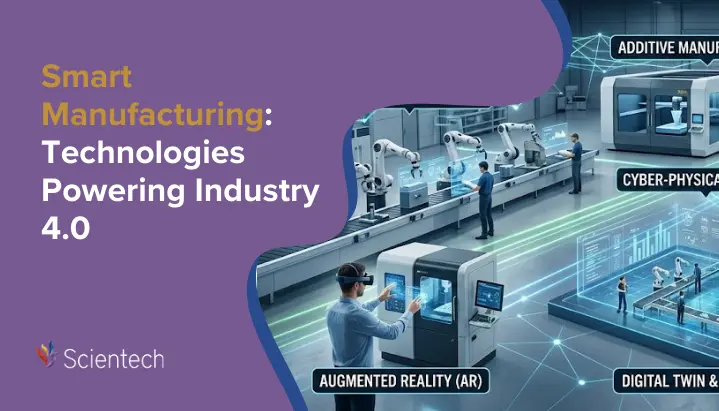
The smart manufacturing industry 4.0 ecosystem is driven by the transition to intelligent factories powered by multiple advanced technologies. Modern smart manufacturing solutions rely on these innovations.
Industrial Internet of Things (IIoT)
- Connects machines, sensors, and devices to collect real-time operational data.
- Enables predictive maintenance, remote monitoring, and improved efficiency.
Cyber-Physical Systems (CPS)
- Integrates physical machinery with digital systems for real-time control and feedback.
- Forms the backbone of smart factories by linking digital models with real-world operations.
Digital Twins
- Virtual replicas of physical assets, processes, or systems.
- Used for simulation, performance monitoring, and predictive optimization.
Advanced Robotics & Automation
- Collaborative robots (cobots) work alongside humans safely.
- Automated Guided Vehicles (AGVs) and autonomous mobile robots (AMRs) streamline material handling.
- Programmable Logic Controllers (PLCs) and CNC machines drive precise automated production.
Artificial Intelligence & Machine Learning
- Enables predictive analytics, quality inspection, anomaly detection, and process optimization.
- AI-driven decision-making enhances operational efficiency and reduces downtime.
Additive Manufacturing (3D Printing)
- Supports rapid prototyping and production of complex geometries.
- Reduces material waste and enables customized manufacturing at scale.
Cloud & Edge Computing
- Edge computing processes data near the machines for low-latency decisions.
- Cloud platforms enable centralized data storage, analytics, and cross-factory coordination.
Big Data Analytics
- Analyzes massive datasets from machines, supply chains, and production lines.
- Supports process optimization, demand forecasting, and resource efficiency.
Connectivity & Networking
- Industrial Ethernet, 5G, and secure wireless networks provide real-time communication.
- MQTT, OPC UA, and other protocols standardize machine-to-machine (M2M) communication.
Augmented Reality (AR) & Virtual Reality (VR)
- AR assists in maintenance, training, and assembly guidance.
- VR allows virtual prototyping, factory layout planning, and immersive simulation.
Industrial Cybersecurity
- Protects smart manufacturing systems from cyber threats.
- Ensures data integrity, secure IoT devices, and safe network operations.
Real-World Applications of Smart Manufacturing
Smart manufacturing is transforming global industries by integrating advanced technologies into production environments. In industries, companies are embracing intelligent manufacturing solutions in order to be more efficient, improve quality, and ensure compliance within the broader Industry 4.0 framework.
Automotive
- Robotic assembly lines
- AI-powered defect detection
- Connected supply chains
Aerospace
- Precision component manufacturing
- Digital twin simulations
- Strict compliance monitoring
Electronics
- Micro-precision robotics
- Cleanroom automation
- Real-time quality inspection
Pharmaceutical
- Batch tracking and traceability
- Regulatory compliance automation
- Controlled environment monitoring
Food & Beverage
- Automated packaging
- Contamination detection
- Temperature monitoring systems
Why Smart Manufacturing Is a Strategic Imperative
In today’s competitive and fast-changing business environment, implementing smart manufacturing is no longer a choice but a strategic necessity. As smart manufacturing within Industry 4.0 continues to redefine global production standards, organizations must embrace digital transformation in order to be relevant and competitive.
Companies that embrace smart manufacturing technology gain:
- Operational resilience
- Enhanced agility
- Global competitiveness
- Data-driven strategic insights
- Improved customer satisfaction
Organizations that delay digital transformation risk falling behind competitors who leverage intelligent systems for faster innovation and lower operational costs.
Benefits for Educational Institutions
Implementing Industry 4.0 lab solutions helps institutions to keep up with the changing Industry 4.0 environment of smart manufacturing as well as equip students with technology-based careers.
Future-Ready Graduates
Students gain real-world experience in smart manufacturing technology, automation, AI, and IoT, developing industry-relevant skills aligned with real-world smart manufacturing practices.
Alignment with Industry Trends
Programs stay aligned with current industry requirements, helping institutions strengthen their reputation and attract career-oriented students.
Industry Collaboration
Lab solutions enable partnerships with companies, improving curriculum relevance and providing real-world exposure.
Innovation & Research Growth
Institutions can become innovation hubs, supporting research and projects in advanced smart manufacturing solutions and digital technologies.
By integrating Industry 4.0 labs, educational institutions strengthen employability outcomes and contribute to building a future-ready workforce.
Conclusion
Smart manufacturing is a core pillar of Industry 4.0. It incorporates digital technologies, automation, real time analytics, and intelligent systems into a single and connected production ecosystem.
The first step is understanding what smart manufacturing entails. The next step is implementing scalable technologies and smart manufacturing solutions.
The Industry 4.0 era is reshaping factories, transforming them from isolated production facilities into intelligent, adaptive, and data-driven ecosystems.
FAQs
Smart manufacturing is a technology-driven production approach that uses connected systems, real-time data, automation, and advanced analytics to optimize manufacturing processes across the entire value chain from design and production to supply chain and after-sales service.
Industry 4.0 is the broader concept of digital transformation across industrial ecosystems, while smart manufacturing focuses specifically on applying advanced technologies within manufacturing operations to improve efficiency, intelligence, and automation.
Key technologies include the Industrial Internet of Things (IIoT), Artificial Intelligence (AI), Machine Learning, Big Data analytics, robotics, digital twins, cloud computing, and edge computing.
Smart manufacturing solutions improve productivity, reduce downtime through predictive maintenance, enhance product quality, optimize supply chains, lower operational costs, and increase overall business agility.
As industries adopt smart manufacturing technology, there is growing demand for professionals skilled in automation, data analytics, AI, and digital systems. Educational institutions implementing Industry 4.0 labs help prepare students for these high-demand careers