Wireless mobile communication systems provide access to the capabilities of the global network at any time, irrespective of the location or mobility of the user. The Direct Sequence Spread Spectrum (DS-SS) technique, incorporated into CDMA can accommodate a large number of users in one radio channel depending on the voice activity level. This feature also provides immunity to jamming signals and enables resolution of multi-path components in a time dispersive radio propagation channel. The system is useful for understanding dsss modulation and cdma modulation concepts in wireless communication systems.
Spread Spectrum is a type of modulation that spreads data transmission across available frequency bands, in excess of minimum bandwidth required to send the information. Spreading makes the signal resistive to noise and other interference. Spread Spectrum is commonly used with personal communication devices such as cell phones and LAN’s. Spread Spectrum has many unique properties that cannot be found in other techniques like the ability to eliminate or alleviate multi-path interference, communication privacy due to unknown random codes, multi user handling capacity over a single frequency, and low power Spectral density since Signal is spread over a large frequency band. These applications are widely related to dsss modulation and demodulation techniques.
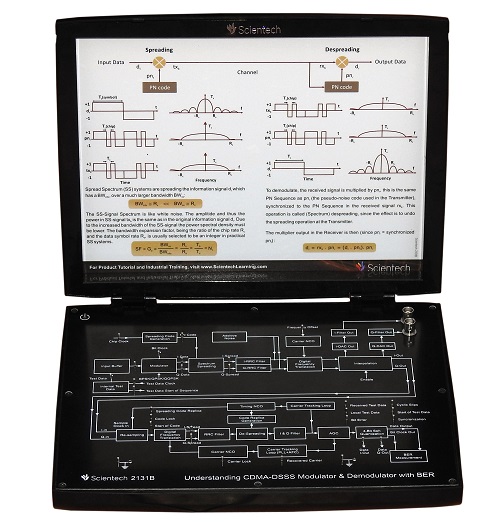
Scientech 2131B TechBooks provide a detailed understanding of the concepts behind CDMA-DSSS, and various points that need to be considered in the design of a Direct Sequence Spread Spectrum System. They include generation of various pseudorandom (PN) codes like Gold, MLS & Barker with user selectable tappings, variable Chip rate, and baseband modulations BPSK, QPSK, OQPSK & Digital AWGN noise with Root Raised Cosine filter (RRC) FIR low pass filter. Bit Error Rate (BER) measurement with known data sequence, overall data rate dependency parameters, spreading & despreading with DSSS, SNR control, offset control & so on can be performed on Scientech 2131B. The trainer is ideal for practical learning of dsss modulation, dsss modulation and demodulation, and cdma modulation systems.
Features
- A complete CDMA-Direct Sequence Spread-Spectrum (DSSS) system
- Customized real-time software
- Analysis in Digital time, Analog time, and Frequency domain
- Separate CDMA-DSSS Modulator and Demodulator for higher learning
- More than 25 nos. of test point
- On-board BNC connector for Analog I-Q signal analysis
- Software based variable Chip rate up to maximum 10Mchip/s
- User selectable different types of Gold code
- User selectable different types of Maximum Length Sequences
- User selectable different types of Barker code
- User can design his own Gold / MLS code
- I-Q Spread Signals QPSK Constellation RF Spectrum of Spread Spectrum with Filter QPSK Constellation with Doppler
- Time and Frequency domain analysis and measurement of baseband BPSK, QPSK and OQPSK Modulation with output spectral shaping I-Q filter
- Built-in I & Q channel root-raised Cosine filter for spectral shaping
- Built-in Digital Data Generator
- Built-in additive White gaussian noise (AWGN) Generator for analysis of noise gain effect on the Signal
- Built-in Frequency offset (Doppler) Generator for analysis of frequency offset effect on the Signal
- Measurement of BER with internal data which is being transmitted
- Measurement of BER with different SNR
Why Choose Scientech 2131B?
Scientech 2131B is an advanced training platform designed to help students, researchers, and engineering professionals understand the fundamentals and practical implementation of DSSS modulation, DSSS modulation and demodulation, and CDMA modulation systems. With real-time signal analysis, BER measurement, and spread spectrum experimentation, it provides hands-on learning for modern wireless communication technologies.
- Comprehensive learning platform for DSSS modulation and demodulation concepts
- Practical implementation of CDMA modulation techniques with BER analysis
- Real-time analysis in digital, analog, and frequency domains
- Supports BPSK, QPSK, and OQPSK modulation experiments
- Built-in AWGN and Doppler generators for advanced wireless communication analysis
- User-selectable PN codes including Gold, MLS, and Barker codes
- Ideal for engineering colleges, telecom labs, and communication system training
- Software-controlled chip rate and signal analysis for enhanced learning experience
- Designed for hands-on understanding of spread spectrum and wireless communication systems
- Reliable educational platform for studying DSSS modulation in modern communication networks
FAQs
1. What is DSSS modulation in wireless communication?
DSSS modulation (Direct Sequence Spread Spectrum) is a communication technique that spreads signals over a wide frequency band to improve resistance against noise, interference, and jamming in wireless communication systems.
2. What is the use of the Scientech 2131B CDMA-DSSS trainer kit?
Scientech 2131B is used for practical learning of CDMA modulation, DSSS modulation and demodulation, BER analysis, spread spectrum communication, and wireless signal processing experiments.
3. Which modulation techniques are supported in Scientech 2131B?
The trainer supports multiple modulation techniques including BPSK, QPSK, and OQPSK along with DSSS modulation and CDMA communication system analysis.
4. How does BER measurement help in communication systems?
BER (Bit Error Rate) measurement helps analyze the accuracy and reliability of transmitted data by calculating errors caused due to noise, interference, and signal distortion in communication channels.
5. What are the key applications of CDMA-DSSS systems?
CDMA-DSSS systems are widely used in mobile communication networks, wireless LANs, satellite communication, secure military communication, and spread spectrum wireless technologies.