

scientech_white_logo_lg
Search
Edit Content
Click on the Edit Content button to edit/add the content.
Scientech_logo
Menu Close
Search

100MHz Mixed Signal Oscilloscope

MSO5104

Share On:


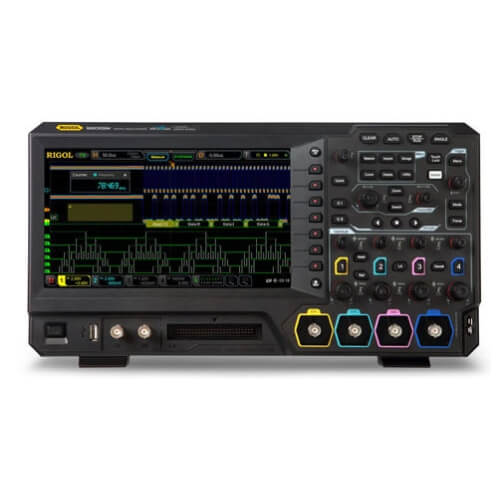
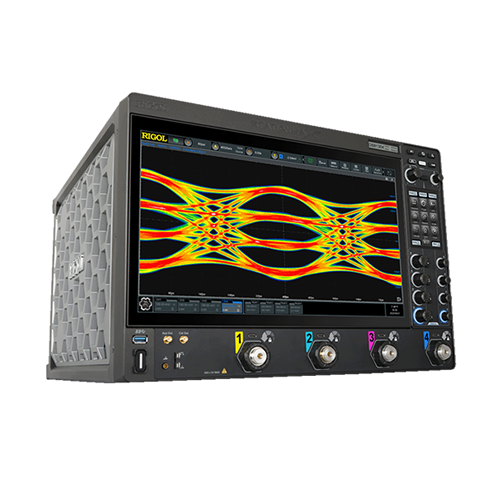
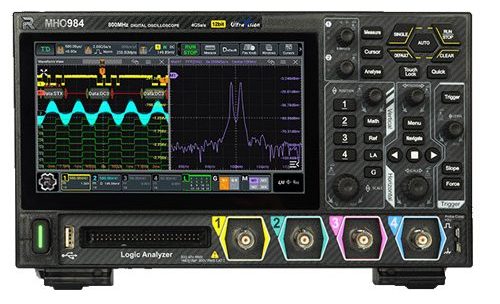
MSO5104 100 MHz Mixed Signal Oscilloscope is a high-performance test and measurement instrument designed for engineers, researchers, and professionals in the field of electronics. It combines powerful analog and digital analysis capabilities, making it ideal for debugging complex embedded systems and circuit designs.

This oscilloscope features 4 analog channels and 16 digital channels, enabling simultaneous observation of analog and digital signals. With high real-time sampling, deep memory, and advanced triggering functions, it is well-suited for applications such as circuit analysis, communication protocol testing, and electronic system debugging.

The MSO5104 delivers excellent signal analysis performance with a 10.1-inch capacitive multi-touch display, high waveform capture rate, and versatile connectivity options including USB, LAN, and HDMI.

Features

  • Bandwidth: 100 MHz oscilloscope should be used to ensure that it analyzes the signals accurately.
  • Analog Channels: 4
  • Digial Channels: 16 (logic analyzer functionality)
  • Real Time Sampling: 10 Gsa/sec
  • Memory Depth: 100 Mpts (up to 200 Mpts standard / higher optional variants)
  • Waveform Capture Rate: Up to 500,000 wfms/s (typical for MSO5000 series)
  • Vertical Resolution: 8 bits
  • Vertical Scale: 1 mV/div to 10 V/div
  • Timebase Scale: 5 ns/div to 1 ks/div
  • Trigger (optional): RS232, I2C, SPI, CAN, FlexRay, LIN
  • Serial Protocol Analysis (optional): RS232, I2C, SPI, CAN, FlexRay, LIN
  • Display:10.1 inch capacitive multi-touch screen
  • Connectivity: USB Host & Device, LAN, HDMI
  • Bandwidth Upgrade: Optional upgrade to 200 MHz / 350 MHz
  • Option: Inbuilt 2 channel 25 MHz Waveform Generator.

Advanced Triggering & Protocol Analysis

The mixed signal oscilloscope supports advanced triggering and serial bus protocol analysis for:

  • RS232
  • I2C
  • SPI
  • CAN
  • FlexRay
  • LIN

These are features of the 100 MHz oscilloscope that render it suitable in debugging embedded systems and analysis of communication signals.

Models

Model Bandwidth Analog Channels Real-Time Sample Rate Max. Memory Depth Waveform Capture Rate Digital Channels Built-In Signal Source
MSO5072 70MHz 2 8GSa/s 200Mpts(opt.) 500,000 wfms/s 16 25MHz, 2CH(opt.)
MSO5074 70MHz 4 8GSa/s 200Mpts(opt.) 500,000 wfms/s 16 25MHz, 2CH(opt.)
MSO5102 100MHz 2 8GSa/s 200Mpts(opt.) 500,000 wfms/s 16 25MHz, 2CH(opt.)
MSO5104 100MHz 4 8GSa/s 200Mpts(opt.) 500,000 wfms/s 16 25MHz, 2CH(opt.)
MSO5204 200MHz 4 8GSa/s 200Mpts(opt.) 500,000 wfms/s 16 25MHz, 2CH(opt.)
MSO5354 350MHz 4 8GSa/s 200Mpts(opt.) 500,000 wfms/s 16 25MHz, 2CH(opt.)

Probe


Passive Probe

Model Description
RP1018H 18kV 150MHz High voltage probe
RP1300H 300MHz High voltage probe (2kV)
PVP2350 350MHz, 10:1/1:1, passive high resistance probe (single strip)
RP6150A 1.5GHz Passive low resistance probe (500ohm)

Current Probe

Model Description
RP1000P 4CH Power Adapter
RP1001C 300KHz, 100A DC
RP1002C 1MHz, 70ADC
RP1003C 50MHz, 30A
RP1004C 100MHz, 30A
RP1005C 10MHz, 150A
RP1006C 2MHz, 500A

High Voltage Differential Probe

Model Description
PHA1150 High voltage differential probe, DC-100MHz, 1500V
PHA0150 High voltage differential probe, DC-70MHz, 1500V
RP1100D 100MHz, 6.5KV
RP1050D 50MHz, 6.5KV
RP1025D 25MHz, 1.4KV

Logic Probe

Model Description
PLA2216 16-channel logic analyzer probe

FAQs

1. What is a mixed signal oscilloscope?

A Mixed Signal Oscilloscope (MSO) combines an analog oscilloscope with a logic analyzer, allowing the simultaneous capture of analog and digital signals. It is ideal for debugging mixed-signal systems like embedded circuits. MSOs offer both waveform visualization and digital signal analysis. This enables engineers to troubleshoot both analog and digital components in a single device.

2. What is a 100 MHz oscilloscope used for?

A 100 MHz oscilloscope is used to measure and analyze electrical signals with frequencies up to about 100 MHz. It is suitable for testing audio, analog circuits, and low- to mid-speed digital signals. Engineers use it to observe waveforms, signal integrity, glitches, and timing issues. It’s commonly applied in electronics labs, circuit debugging, and educational purposes.

3. What is the advantage of a mixed signal oscilloscope over a digital oscilloscope?

The main advantage of a Mixed Signal Oscilloscope (MSO) over a standard digital oscilloscope (DSO) is that it can simultaneously capture both analog and digital signals. This allows engineers to correlate digital logic events with analog waveforms, making it easier to debug mixed-signal circuits. MSOs also provide digital channel analysis and protocol decoding, which a regular DSO cannot. Essentially, it combines two instruments in one, saving time, cost and improving insight into complex systems.

4. How many channels does the MSO5104 100 MHz mixed signal oscilloscope have?

The MSO5104 Mixed Signal Oscilloscope 100 MHz mixed‑signal oscilloscope has 4 analog input channels for measuring continuous signals and 16 digital channels for logic analysis. This lets you capture and view both analog and digital signals simultaneously in mixed‑signal designs

5. What is the sampling rate of the MSO5104 100 MHz oscilloscope?

The MSO5104 mixed signal oscilloscope, with a 100 MHz bandwidth, has a maximum sampling rate of 1 GSa/s (Giga-samples per second). This high sampling rate allows it to capture fine details of fast signals, which is particularly useful for observing high-frequency waveforms and accurately reconstructing signal shapes.


More Products

Request Demo

Request a Callback

No Spam. Just a quick Call

Request a Price

=

Apply for Internship

Select Area of Interest