

TLDR
- This blog is useful for engineering students, instrumentation engineers, industrial automation professionals, and anyone interested in understanding how sensor and transmitter systems are used in process measurement.
- A measurement sensor is a device that detects physical parameters such as temperature, pressure, flow, and level and converts them into signals for monitoring and analysis.
- In industrial instrumentation, sensors and transmitters work together: sensors detect process variables, while transmitters convert these signals into standardized outputs such as 4–20 mA or digital communication protocols.
- Sensors and transmitters are widely used in industries such as oil and gas, power generation, chemical processing, food manufacturing, and water treatment plants for accurate process monitoring.
- With advancements in automation and Industry 4.0, modern measurement sensor technologies and smart transmitters are enabling more accurate, reliable, and real-time industrial process control.
Process measurement is an essential component of modern industrial operations, where physical parameters such as temperature, pressure, flow, and level are continuously measured to ensure efficient and safe production. Accurate measurement helps industries maintain product quality, improve operational efficiency, and reduce the risk of system failures. A measurement sensor plays a vital role in detecting these physical variables and converting them into signals that can be analyzed for process control. Without proper measurement systems, industries may face production inconsistencies and safety risks.
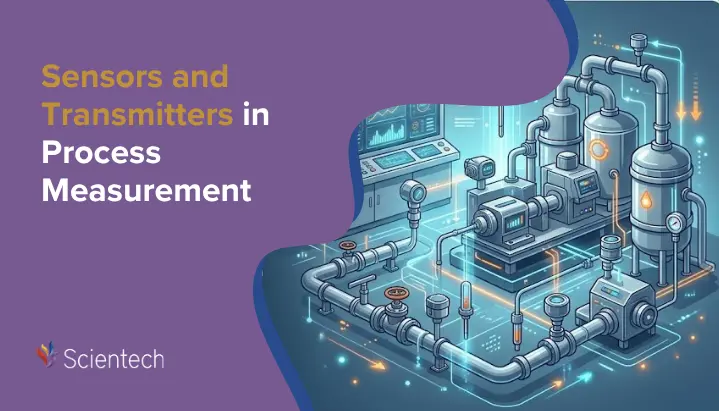
Modern industries rely heavily on sensors and transmitters working together to measure and transmit process data accurately.The sensor measures the physical parameter, and the transmitter converts the sensor signal into a standardized output that can be sent to monitoring and control systems such as PLC or SCADA. Together, sensors and transmitters enable real-time monitoring, automation, and improved decision-making in industrial processes making them an essential part of modern process measurement systems.
What is a Sensor in Process Measurement?
A sensor in process measurement is a device that detects a physical parameter such as temperature, pressure, flow, or level in an industrial process and converts it into a measurable signal, usually electrical, for monitoring and control. It acts as the primary element of a measurement system by directly interacting with the process variable and providing real-time data to instruments like controllers or displays, thereby enabling accurate measurement, automation, and efficient operation of industrial processes..
What is a Transmitter in Process Measurement?
A transmitter in process measurement is a device that receives the signal from a sensor and converts it into a standardized output signal, typically 4–20 mA or a digital signal, which can be transmitted over long distances to control systems, displays, or recorders. It processes and conditions the raw signal from the sensor to make it more accurate, stable, and suitable for monitoring and control, playing a key role in ensuring reliable communication of measured values within industrial automation systems.
The transmitter processes the raw sensor signal and converts it into standardized outputs such as 4–20 mA current signals or digital communication protocols. (e.g. HART, Modbus or Fieldbus). These conventional signals enable the data to be relayed in a long distance without much reduction in accuracy. The transmitters in industrial control systems are very important as they transmit real-time information about the processes to a PLC, SCADA, or DCS. This sensor and transmitter integration allows complex industrial processes to be effectively monitored, automated, and controlled.
Relationship Between Sensor and Transmitter
In process instrumentation, the sensor and transmitter work together to measure and transmit process variables accurately.The physical parameters that the measurement sensor identifies in the process environment include temperature, pressure, flow, or level and a raw signal is generated based on the parameter of interest. This signal is typically very small, and hence it cannot be conveyed effectively to long distances. This signal is then sent to the transmitter, where it is conditioned to improve accuracy and converted into a standardized output such as 4–20 mA or digital communication.
The processed signal is then passed to the control system such as PLC, SCADA or DCS where the information is monitored and utilized to control the process. The synergistic functioning of the sensor and transmitter guarantees the efficiency of the transmission of the data and assists industries to remain efficient, safe, and automated.
Types of Sensors Used in Process Measurement
Industrial process measurements entail the use of common measurement sensor devices such as:
- Temperature Sensors (RTD, Thermocouple) – Temperature sensors measure temperature variations in industrial equipment and processes and they are commonly employed in manufacturing, power plants and petrochemical industries.
- Pressure Sensors – These are used to measure the pressure of a gas or liquid inside a pipeline or a tank system or processing system.
- Flow Sensors- The sensors are used to measure the flow rate of fluids in pipelines, and are used to monitor the flow of liquids or gas in industrial systems.
- Level Sensors-Level sensors measure the amount of liquid or solid material inside tanks, containers, or storage systems.
- Humidity and gas sensors measure moisture levels and detect specific gases in industrial environments to ensure workplace safety and proper process control.
When integrated with a sensor and transmitter system, these sensors help industries collect accurate process data for monitoring and automation.
Types of Industrial Transmitters
In industries, there are various kinds of transmitters which transform the signals of a measuring sensor into standardized outputs:
- Temperature Transmitters – Convert signals from temperature sensors such as RTDs or thermocouples into standardized electrical signals.
- Pressure Transmitters- These transmit pressure measurements from the measurement sensor to industrial control systems.
- Flow Transmitters – Receive signals from flow sensors and transmit flow rate data to control systems.
- Level Transmitters- This is used to measure and relay information on how much liquid or solid is present in a tank or vessel.
- Smart and Digital Transmitters – High-tech transmitters enabling digital communication, remote monitoring and enhanced connection to automation systems.
These transmitters work with the sensor and transmitter combination to provide reliable data for industrial process control and monitoring.
Conclusion
The sensor and transmitter system is a crucial part of modern process measurement, enabling accurate detection and transmission of key process variables. Sensors measure physical parameters such as temperature, pressure, flow, and level, and convert them into signals, which are then processed by transmitters into standardized outputs suitable for monitoring and control systems. Together, sensors and transmitters ensure reliable data communication and effective control of industrial processes.
Measurement sensors play a vital role in industrial automation by providing real-time data necessary for maintaining stable and efficient operations. With ongoing advancements in smart sensors, digital transmitters, and integrated control systems, process measurement technology continues to evolve. As industries adopt more advanced technologies, improved sensor and transmitter systems will further enhance efficiency, safety, and data-driven decision-making in industrial environments.
FAQs
A sensor detects a physical parameter such as temperature, pressure, or flow and converts it into a raw signal.The sensor sends this signal to a transmitter that converts it into a standardized output signal that is capable of being sent to the control systems. The sensor and transmitter allow proper monitoring of the process.
The sensor and transmitter system assists industries to measure and monitor critical process variables on a real time basis. This improves control of industrial practices, efficiency and better safety in the manufacturing and processing facilities.
There is a wide range of physical measurements that can be detected using a measurement sensor, and they can be temperature, pressure, flow rate, liquid level, humidity, and gas concentration. These measurements assist the industries to have a stable and controlled production process.
The sensor and transmitter combination is widely used in industries such as oil and gas, chemical and pharmaceutical manufacturing, power plants, food and beverage processing, and water treatment facilities.
Transmitters commonly convert sensor signals into standardized outputs such as 4–20 mA current signals, voltage signals, or digital communication protocols like HART, Modbus, and Fieldbus, allowing the data from the measurement sensor to be easily transmitted to PLC, SCADA, or DCS systems.