

TL;DR
- This blog targets electronics students, beginners, embedded system learners, and early-career engineers who want a clear understanding of logic analyzer vs oscilloscope and when to use each tool.
- Oscilloscopes work by measuring and displaying continuous voltage waveforms, making them ideal for analog signals, power electronics, and signal integrity analysis.
- Logic analyzers focus on digital signal states (0s and 1s) and timing relationships, making them best for debugging microcontrollers, FPGAs, and digital communication buses.
- The key difference in logic analyzer vs oscilloscope lies in signal type and analysis approach: voltage accuracy vs multi-channel digital timing and protocol decoding.
- In real-world electronics debugging, both tools are complementary, and using them together provides the most complete insight into system behavior.
The appropriate measurement tool can save hours of time in debugging in electronics design, testing and troubleshooting. Logic analyzer vs oscilloscope are two of the most frequently used testing tools in the laboratory and development environment. Although they both apply to the observation of signals they are intended to fulfill different functions and shine in various situations. This is usually confusing, particularly to students, beginners and even young engineers in the profession.
This tutorial describes the differences between Logic analyzer vs oscilloscope in a simple, practical manner including how each instrument works, what issues each tool is most helpful to solve, and how to select the appropriate instrument in the application.
What Is an Oscilloscope?
An oscilloscope is an electronic test device to display electrical signals in continuous waveforms. It graphs voltage on vertical axis versus the time on the horizontal axis enabling engineers to view the way a signal acts in real time.
Oscilloscopes are originally used in the analysis of the analog signal, the modern digital oscilloscopes are also capable of processing digital signals. They are very common in the analysis of the shape, amplitude, frequency, noise, rise time, distortion, and transient behavior of a waveform.
Typical uses of an oscilloscope include:
- Analyzing sine, square, and complex waveforms
- Measuring voltage levels and timing parameters
- Observing noise, overshoot, ringing, and signal integrity issues
- Debugging power electronics and analog circuits
Oscilloscopes usually have 2 to 4 channels, high voltage resolution, and advanced triggering options for capturing specific waveform events.
What Is a Logic Analyzer?
A logic analyzer is a special instrument that is used to analyze a digital signal. Rather than displaying waveforms of the voltage level, it displays whether a signal is logic high or logic low versus time.
Systems with a large number of digital lines at once, e.g. microcontroller interfaces, FPGAs, and communication buses, are best analyzed with logic analyzers. They can record and examine dozens of signals much at once and are especially practical in the debugging of digital timing and protocol.
Common applications of logic analyzers include:
- Debugging microcontroller and FPGA designs
- Analyzing digital communication protocols (I²C, SPI, UART, CAN, etc.)
- Checking timing relationships between multiple digital signals
- Verifying firmware–hardware interaction
Logic analyzers typically offer 8 to 100+ channels, high sampling rates, and built-in protocol decoding features.
Logic Analyzer vs Oscilloscope: Working Principle
The fundamental difference between the logic analyzer vs oscilloscope in terms of comparison is the format in which the two instruments record and show signals.
An oscilloscope determines the true signal voltage value on a very fine scale. This is good in the observation of analog behavior and faint electrical properties.
A logic analyzer, in contrast, measures digital signals and converts them into logic states (0s and 1s) based on a predetermined voltage level. It does not show exact voltages changes but just underlines logic transitions and time associations.
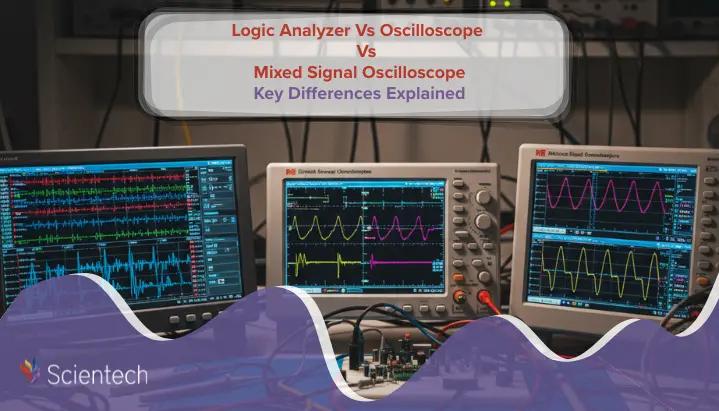
Logic Analyzer vs Oscilloscope Vs Mixed Signal Oscilloscope: Key Differences Explained
The comparison between Logic analyzer vs oscilloscope although they are both applied in analyzing electronic signals, there are apparent differences based on their purpose, working mode, and best applications. These differences would allow you to select the appropriate tool in order to debug faster and more accurately.
Parameter | Oscilloscope | Logic Analyzer | Mixed Signal Oscilloscope (MSO) |
Signal Type Analyzed | Designed for analog signals; shows exact voltage variations over time | Designed for digital signals; interprets signals as logic HIGH (1) or LOW (0) | Both analog and digital signals |
Measurement Focus | Waveform shape, amplitude, noise, rise/fall time, distortion | Timing relationships, logic transitions, and event sequences | Correlation between analog waveforms and digital logic states |
Channel Count | Typically 2–4 channels (more in advanced models) | 8, 16, 32, or 100+ channels, ideal for complex digital systems | 2–4 analog + 8–16 digital channels |
Voltage Resolution vs Logic Threshold | Measures precise voltage levels with high resolution | Uses voltage thresholds to classify signals as 0 or 1 | High-resolution analog + logic thresholds for digital |
Triggering Capabilities | Voltage-based triggers (edge, pulse width, glitch, level) | Event- and pattern-based triggers, including protocol conditions | Cross-triggering between analog and digital events |
Protocol Decoding | Limited protocol decoding, usually on fewer channels | Advanced protocol decoding (I²C, SPI, UART, CAN, USB, etc.) | Protocol decoding synchronized with analog waveforms |
Conclusion
Knowledge of which is an important value when dogging the electronics with the knowledge of what a logic analyzer vs oscilloscope is, what is the difference. An oscilloscope is capable of displaying voltage waveforms and analog behaviour and a logic analyzer is capable of digital timing and protocol analysis and multi-signal debugging.
In the decision of logic analyzer vs oscilloscope, which is better, it depends on what you are doing. Different types of analog and power electronics require an oscilloscope, and an embedded system and digital communication would be best served by a logic analyzer. Through a combination of both tools, in most real-life projects, one can get a more complete understanding of a scenario and reach a reliable design in the most expeditious manner.
FAQs
The main difference between a logic analyzer vs oscilloscope is the type of signal they analyze. An oscilloscope measures and displays continuous voltage waveforms, while a logic analyzer focuses on digital logic states (0s and 1s) and their timing relationships.
You should use an oscilloscope when analyzing analog signals, voltage levels, noise, signal integrity, rise/fall time, or power electronics. In the logic analyzer vs oscilloscope comparison, oscilloscopes are best for observing real-world voltage behavior.
A logic analyzer is better when debugging digital systems such as microcontrollers, FPGAs, or communication buses. In logic analyzer vs oscilloscope use cases, logic analyzers excel at multi-channel digital timing and protocol decoding.
Yes, modern digital oscilloscopes can display digital signals. However, in logic analyzer vs oscilloscope analysis, oscilloscopes show voltage waveforms, while logic analyzers provide clearer insight into digital timing and protocol behavior.
A Mixed Signal Oscilloscope combines features of both tools in the logic analyzer vs oscilloscope comparison. It provides analog waveform analysis along with multiple digital channels, allowing engineers to correlate analog and digital events.