

TL;DR
- This blog is targeted at engineering colleges, universities, technical institutions, lab managers, automation trainers, and industry professionals seeking to implement IoT integration and IoT integrated solutions in industrial automation laboratories.
- IoT integration transforms isolated lab environments into smart, Industry 4.0-ready ecosystems by connecting PLCs, sensors, gateways, and cloud platforms.
- IoT integrated solutions provide hands-on experience in real-time monitoring, predictive maintenance, remote operations, and data-driven decision-making.
- Successful implementation requires smart sensors, IoT-enabled PLCs, gateways, cloud platforms, SCADA/HMI systems, analytics tools, and cybersecurity infrastructure.
- Structured IoT integration supports research, strengthens industry collaboration, enhances institutional reputation, and prepares students for careers in smart manufacturing and interconnected industrial systems.
Technical education, research, and skill development in engineering institutions and industrial training centers have long relied on industrial automation laboratories. Traditionally, these labs focused on programmable logic controllers (PLCs), SCADA setups, motor control systems, sensors, actuators, and process control trainers, often operating in isolated applications.
In a world where connectivity defines industrial innovation, modern lab solution providers now offer integrated platforms that combine IoT, IIoT, and AIoT into a single, practical learning ecosystem. Through robust IoT integration, students can experience real-time sensor–PLC–cloud–analytics operations, replicating real-world smart factory conditions
These IoT integrated solutions bridge the gap between classroom theory and real-world industrial application. Students operate interconnected devices, data collection systems, edge computing platforms, and analytics tools based on AI in order to gain insights into predictive maintenance, remote monitoring, energy efficiency, and intelligent automation.
By implementing structured IoT integration systems in automation laboratories, institutions can transform traditional setups into Industry 4.0-ready environments. Modular and scalable IoT integrated solutions offered by Scientech enable engineering colleges, universities, and technical institutes to future-proof their curriculum to increase practical exposure.
Related Blogs:
- How MES Laboratory Training Improves Practical Manufacturing Skills
- Transforming Labs with Workbenches: Bringing Industrial Discipline to Education
- Developing Industry-Ready AI Skills Through Industry-Aligned Training
Understanding IoT integration in Industrial Automation
In the industrial sector, this evolves into Industrial IoT (IIoT), where machines, sensors, controllers, and software platforms are interconnected to gather, transmit, and analyze data over secure networks.
In industrial environments, IIoT connects machines, controllers, and production lines to monitor, optimize, and automate processes.
What is IoT integration?
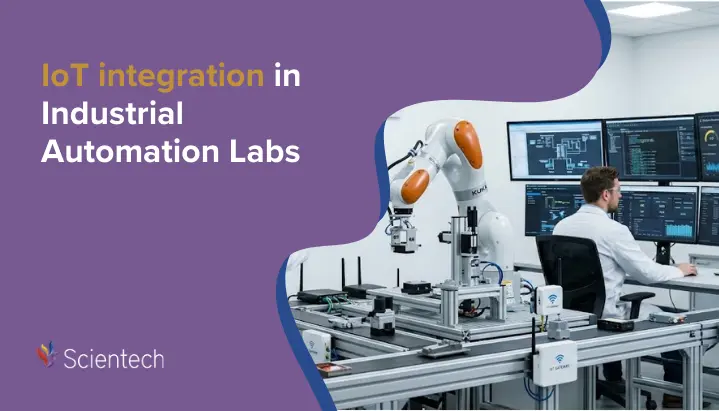
IoT integration in industrial automation labs involves:
- Connecting PLCs, sensors, and actuators to IoT gateways
- Enabling cloud-based data storage and analysis
- Providing real-time dashboards and remote access
- Implementing intelligent analytics and predictive maintenance
- Creating digital twins of lab systems
Rather than working as isolated training setups, automation labs become interconnected ecosystems simulating real manufacturing environments.
Why IoT integration Matters in Automation Labs
Bridging the Gap Between Education and Industry
Industries in the modern day rely on interconnected systems and live data. Without proper IoT integration, automation labs may fail to replicate real-world industrial environments. Through IoT integrated solutions, institutions can equip students in terms of smart manufacturing, connected process control, data-driven decision-making and remote operations, which means that they are ready to work in the industry.
Enabling Real-Time Monitoring
In the traditional labs, machines are physically observed. Once iot is integrated, it is possible to monitor in real time such parameters as temperature, pressure, speed, energy consumption, and even the number of products produced using dashboards, enhancing learning efficiency and system familiarity.
Supporting Research and Innovation
Sophisticated iot integrated systems enable students and researchers to gather and process historical information, evaluate predictive models, and model Industry 4.0 systems. This makes automation laboratories intelligent, data-driven centers of innovation.
Core Components of IoT integrated solutions in Automation Labs
Effective IoT integration in industrial automation laboratories depends on multiple interconnected hardware and software layers. Properly designed IoT integrated solutions will mean smooth communication, correct data, and secure interconnection throughout the system.
Smart Sensors
The IoT integration is based on smart sensors that gather real-time information like temperature, pressure, flow, proximity, and vibration. These types of devices accommodate digital communication standards, which allows the transfer of data to the PLCs and IoT gateways directly. With high-level IoT integrated solutions, smart sensors will provide a continuous monitoring system and precision in obtaining data.
PLCs with IoT Capability
Automation labs are supported by PLCs. To support effective IoT integration, PLCs must support industrial communication protocols such as Ethernet/IP and Modbus TCP, and more sophisticated protocols, such as OPC-UA or MQTT. These capabilities enable PLCs to function effectively within IoT integrated solutions and monitor and control in real time.
IoT Gateways
IoT gateways play a critical role in IoT integration where the field devices are connected to cloud platforms. They receive sensor and PLC data, convert communication protocols, preprocess data, and promote secure communications. Scalable and reliable IoT integrated solutions depend on powerful gateways.
Cloud Platforms
Cloud computing allows centralized storing, analytics, and visualization of data. Within IoT integrated solutions, cloud platforms convert raw operational data into actionable insights by using dashboards and reporting solutions. Remote monitoring and advanced machine learning applications are also supported by cloud-based IoT integration.
Benefits for Educational Institutions
Future-Ready Graduates:
IoT, IIoT, and AIoT Lab Solutions offered by Scientech provide students with the industry-relevant skills that are needed in the modern connected and digitally transformed world.
Stronger Industry Collaboration:
This enables institutions to align programs with current industry trends, facilitate partnerships, hands-on exposure and project opportunities.
Innovation-Focused Learning:
These laboratory solutions create an environment where learners design intelligent internet of things applications and AI-based automation projects.
Enhanced Institutional Reputation:
Implementation of innovative IoT, IIoT, and AIoT laboratories makes institutions the leaders in technology-oriented learning.
Conclusion
Institutions that invest in structured IoT integration today position themselves at the forefront of Industry 4.0 education, producing graduates capable of designing, managing, and optimizing intelligent industrial ecosystems powered by connectivity, intelligence, and real-time analytics. Conventional standalone lab systems are no longer sufficient to support the needs of Industry 4.0.
With effective IoT integration, automation labs can become intelligent, interconnected ecosystems that replicate real industrial environments. Through strong IoT integrated solutions, institutions enable students, engineers and researchers to acquire the practical skills to support the current manufacturing and intelligent automation systems.
FAQs
IoT integration involves connecting PLCs, sensors, actuators, and SCADA systems with cloud platforms and analytics tools to enable real-time monitoring, data analysis, and remote accessibility within automation labs.
IoT integrated solutions offer practical experience with connected devices, live dashboards, predictive maintenance models, and simulated factories to enable the students to acquire industry-ready skills as per Industry 4.0.
Core components include smart sensors, IoT-enabled PLCs, IoT gateways, cloud platforms, SCADA/HMI systems, analytics tools, and cybersecurity infrastructure.
Yes, traditional labs can be enhanced by adding IoT gateways, upgrading PLC communication protocols, and integrating cloud-based dashboards to create scalable IoT integrated solutions
The IoT integration can be used by institutions to close the education-industry gap, facilitate research and innovation, enhance hands-on exposure, and provide students with skills in smart manufacturing and connected industrial systems.