


TL;DR
- This blog is designed for PCB manufacturers, electronics startups, R&D engineers, hardware developers, production managers, and technical decision-makers looking to understand how automation enhances modern PCB manufacturing machines, PCB prototyping machines, and prototype machine systems.
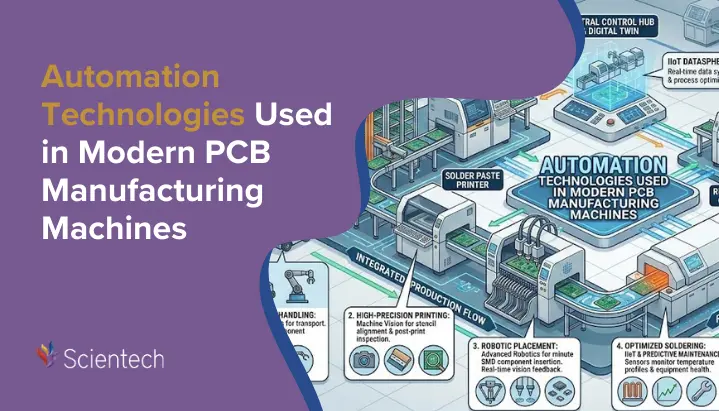
- Modern PCB production relies on integrated technologies such as CNC systems, laser direct imaging (LDI), automated optical inspection (AOI), robotic handling, AI integration, IoT monitoring, automated drilling, and controlled chemical processing.
- Automation improves precision, consistency, production speed, and cost efficiency while reducing human error, material waste, and rework cycles.
- Smart sensors, data analytics, digital twins, cloud connectivity, and predictive maintenance transform traditional facilities into intelligent, connected manufacturing ecosystems.
- Investing in an advanced pcb prototyping machine or fully automated pcb manufacturing machine enables faster innovation, scalable production, higher reliability, and long-term growth in today’s competitive electronics market.
The electronics industry has transformed significantly over the past two decades. PCBs are at the center of innovation across consumer electronics, wearable technology, industrial control systems, and aerospace applications. Behind this technological evolution lies another major transformation: automation in PCB manufacturing.
Modern production facilities no longer rely on lengthy, labor-intensive processes. They instead work using highly intelligent systems, precision robotics, AI-enabled inspection tools, and smart connected machines. Whether in a large-scale production facility or an R&D laboratory equipped with a PCB prototyping machine, automation technologies are redefining speed, accuracy, reliability, and scalability.
This article explores the automation technologies used in modern PCB manufacturing machine systems, how they are used to fit into the design-fabrication cycle, and why the development of electronics requires advanced prototype machine solutions.
Related Blogs:
- What Is a PCB Prototyping Machine? Working,Types, and Applications
- Transforming Labs with Workbenches: Bringing Industrial Discipline to Education
- From Idea to Prototype: How Students Build Real Projects with PCB Prototyping and 3D Printing
Automation Technologies in Modern PCB Manufacturing Machines
PCB manufacturing automation is not a singular system, but rather a highly synchronized ecosystem of high-precision hardware, smart software, robotics, and real-time data analytics. A modern PCB manufacturing machine integrates multiple automation layers that ensure accuracy, repeatability, and production efficiency. These technologies are the foundation of high-performance electronics manufacturing whether it is in large-scale industrial plants or small-scale R&D on a pcb prototyping machine.
Here is a closer examination of the underlying technologies of automation used on PCB production systems today:
1. CNC (Computer Numerical Control) Systems
Any advanced pcb manufacturing machine is based on CNC technology. It converts digital design files into mechanical movements precise enough to allow uniform and repeatable board fabrication.
What CNC Does:
- Drilling vias and through-holes
- Milling PCB outlines
- Routing complex board geometries
- Engraving traces (in specific prototype machine configurations)
Automation Benefits:
- Micron-level positioning accuracy
- High repeatability across production batches
- Reduced operator intervention
- Faster cycle times
In a pcb prototyping machine, CNC systems enable rapid iteration. Engineers can modify a PCB design in CAD software, and the updated toolpaths can be executed instantly without manual retooling. This dramatically reduces the design-to-validation cycle.
2. Laser Direct Imaging (LDI)
Traditional photolithography relies on physical film masks to transfer circuit patterns. Laser Direct Imaging eliminates the need for physical masks by using computer-controlled laser beams to pattern the photoresist layer.
Advantages:
- Superior resolution for fine-pitch traces
- Reduced alignment errors
- Faster setup and changeover
- Ideal for HDI (High-Density Interconnect) boards
Modern pcb manufacturing machine platforms integrate LDI systems to support smaller and denser electronic designs. In high-fidelity prototype machine systems, LDI can be used to a great effect to increase precision in testing mini-circuit layouts.
3. Automated Optical Inspection (AOI)
Manual visual inspection in quality control has been replaced by intelligent machine vision systems. Automated Optical Inspection (AOI) is a method that allows detecting defects in the manufacturing process with the help of high-resolution cameras and sophisticated image-processing algorithms.
AOI Detects:
- Missing pads
- Short circuits
- Open circuits
- Misaligned traces
- Solder defects (post-assembly)
AOI systems compare manufactured boards with reference design data. This can be used in more sophisticated prototype machine settings to do immediate validation and then move on to another design cycle. AOI embedded in high-volume PCB production lines significantly reduces defect escape.
4. Robotic Handling and Material Automation
Material handling is often underestimated, but it plays a critical role in maintaining efficiency and preventing contamination. Automation ensures smooth movement of boards between fabrication stages.
Key Applications:
- Automatic board loading and unloading
- Conveyor-based inter-machine transport
- Robotic arm-assisted board transfer
- Automated panel alignment
These robotics ease the physical burden on workers, decrease errors in handling, and provide a stable production rate. Robotic integration in completely automated lines enables the synchronization of pcb manufacturing machine systems into an ecosystem of production.
5. AI and Machine Learning Integration
Artificial intelligence is rapidly transforming PCB production from reactive manufacturing to predictive manufacturing.
Applications:
- Predictive defect detection
- Process parameter optimization
- Drill wear and spindle health monitoring
- Pattern anomaly recognition
AI-based PCB production machine systems analyze historical and real-time production data and predict trends that cannot be identified by human operators. This results in better yields, less scrap and machine performance.
AI-powered PCB prototyping machine systems help engineers identify potential layout or structural vulnerabilities early in development, reducing costly redesigns during mass production.
6. IoT and Smart Monitoring Systems
The integration of IoT connectivity enables remote and centralized control over production systems.
Capabilities Include:
- Remote machine monitoring
- Real-time performance dashboards
- Production analytics and KPI tracking
- Cloud-based data storage and reporting
The manufacturers will be able to monitor various prototype machine units in different facilities through a centralized control interface. Predictive maintenance is another area that IoT integration enables to minimize unnecessary downtime and increase the lifespan of the machine.
7. Automated Drilling Technology
Modern PCBs require thousands—sometimes tens of thousands—of microvias. Precision drilling is therefore critical.
Automation features include:
- Multi-spindle drilling heads
- Laser-based microvia drilling
- Automated tool change mechanisms
- Real-time depth and alignment monitoring
Electrical reliability and mechanical stability are direct results of the drilling accuracy. State-of-the-art PCB manufacturing machine systems maintain tight tolerance control and the via geometry is still maintained even in high density multilayer.
8. Automated Plating and Chemical Processing
Chemical processing stages such as copper plating and surface finishing must be tightly controlled to maintain board durability and conductivity.
Automation ensures:
- Controlled copper deposition thickness
- Automated chemical dosing and replenishment
- Continuous temperature and pH monitoring
- Closed-loop filtration and contamination control
Automated chemical systems ensure uniform copper thickness, improved adhesion, and long-term performance by maintaining strict process parameters. These systems are used in industrial pcb manufacturing machine lines as well as in advanced pcb prototyping machine setups handling multilayer fabrication.
Benefits of Automation in PCB Manufacturing
Automation significantly enhances the performance of modern PCB manufacturing machines and PCB prototyping machines, delivering improvements in precision, speed, cost efficiency, scalability, and quality.
- Improved Precision and Consistency:
Automation ensures reduced trace variation, uniform drill depth, consistent copper thickness, and lower rejection rates. CNC-controlled systems in a prototype machine maintain micron-level accuracy across every batch. - Increased Production Speed:
Automated systems operate continuously with minimal downtime. A modern pcb manufacturing machine can process multiple panels simultaneously, increasing throughput and reducing time-to-market. - Cost Efficiency:
Automation lowers labor costs, reduces material waste, minimizes rework cycles, and decreases downtime losses. In-house pcb prototyping machine setups also eliminate frequent outsourcing expenses. - Enhanced Scalability:
Designs validated on a prototype machine can be seamlessly transferred to full-scale production without major adjustments, ensuring consistent results at higher volumes. - Improved Quality Control:
Integrated AOI and AI-driven inspection detect defects early, improving reliability and increasing first-pass yield.
Integration of Industry 4.0 in PCB Manufacturing
Industry 4.0 has transformed conventional production environments into intelligent, connected systems. Industry 4.0 technologies are now being implemented directly into modern PCB facilities with all the sophisticated pcb manufacturing machines and even high-end pcb prototyping machine systems to enhance efficiency, visibility and predictive control.
Key Industry 4.0 Technologies Include:
- Embedded sensors will constantly check temperature, vibration, spindle speed, and tool wear on a prototype machine or full-scale production line.
- In real-time, production information is utilized to optimize the process parameters, plating and the accuracy of the drilling.
- Digital twin models simulate PCB manufacturing machine operations and engineers can test adjustments before physically implementing them.
- Remote monitoring of various machines in various facilities is possible through centralized dashboards.
- Live KPIs like yield rate, cycle time, and equipment efficiency enhance decision-making.
Intelligent factories with automated pcb manufacturing machine platforms can predict maintenance needs before breakdowns occur. This predictability minimizes downtime and maximizes the life of the machine and guarantees continuous production whether in high-volume plants or experimental labs with a pcb prototyping machine to develop something quickly.
How to Choose the Right Automated PCB Manufacturing Machine?
Precision Specifications
Select a pcb manufacturing machine that provides micron-level accuracy, spindle stability, and consistent drill depth control. High precision ensures reliable traces, accurate vias, and consistent multilayer alignment, which is highly critical when the machine is a pcb prototyping used in design validation.
Automation Features
Look for advanced features such as an auto tool changer, integrated AOI, CNC control, and CAD/CAM software compatibility. These capabilities improve efficiency and reduce manual intervention.
Scalability
Ensure the prototype machine or production system can handle increasing board complexity and higher volumes as your business grows.
Support and Maintenance
Reliable technical support, spare parts availability, and remote diagnostics are essential to minimize downtime and maintain long-term performance.
Why Automation is Essential for Competitive Electronics Manufacturing?
The modern electronics markets require rapid product introductions, reduced-size components, increased reliability, and reduced production cost. Manufacturers find it hard to deliver these expectations without automation.
A modern pcb manufacturing machine equipped with intelligent automation guarantees higher yields, faster turnaround, greater flexibility, and consistent quality. In the case of startups and R&D teams, a pcb prototyping machine allows an organization to innovate quickly in-house, lower outsourcing time, and makes the transition between design and production nearly flawless, with a dependable prototype machine environment.
Conclusion
The use of automation technologies has made a fundamental change in PCB manufacturing. Today, pcb manufacturing machine systems are more intelligent, quicker, and more dependable than ever due to CNC accuracy and laser precision, AI-based inspection, and IoT connectivity.
Automation helps manufacturers to deal with the increased complexity of the new electronics whether on a large-scale basis or with a small prototype machine to speed up the development stages.
Automation is no longer a luxury in today’s competitive environment; it is a necessity. Companies that embrace the use of advanced pcb prototyping machine solutions are well placed to have faster innovation, quality improvement and long-term growth in the dynamic electronics industry.
FAQs
An automated pcb manufacturing machine is a modern production workflow that is engineered to combine CNC control, Laser Direct Imaging (LDI), Automated Optical Inspection (AOI), robotic handling, artificial intelligence, and the Internet of Things monitoring to produce PCBs with extremely high accuracy, speed, and uniformity with a limited level of human involvement.
A pcb prototyping machine is designed for quick design validation and small batch production where the engineers are able to iterate layouts and test functionality in-house at a rapid rate. Conversely, A full-scale pcb manufacturing machine is designed for high-volume production, continuous operation and industrial level throughput.
AI can improve the current PCB manufacturing process through predictive defect detection, optimization of the process, monitoring of drill wear, and pattern anomaly recognition. AI-based systems on a prototype machine, as well as on a large-scale manufacturing facility, increase yield rates, minimize scrap, and improve overall efficiency.
Industry 4.0 technologies such as smart sensors, data analytics, digital twins, cloud connectivity, and real-time performance monitoring allow manufacturers to track machine health, optimize processes, and implement predictive maintenance. This reduces downtime and increases the reliability of every pcb manufacturing machine.
Automation improves precision, consistency, production speed, cost efficiency, scalability, and quality control. Whether using a pcb prototyping machine or a full production system, automation reduces human error, shortens time-to-market, and increases first-pass yield.