

TL;DR
- Who this blog is for: Engineering students, electronics professionals, R&D engineers, and lab technicians who want to understand what an arbitrary waveform generator is and how it is used in real-world testing.
- Explains what an arbitrary waveform generator is and why it is essential for generating complex, realistic signals beyond basic waveforms.
- Breaks down the working principle of an AWG, including waveform definition, memory, sampling rate, and DAC operation.
- Covers practical examples, applications, advantages, and limitations to help readers choose and use an AWG effectively.
- Highlights key specifications and common beginner mistakes, enabling accurate signal generation and reliable test results.
Modern electronics relies heavily on accurate signal generation. Whether it is communication system design, embedded controller testing, power electronic circuit validation, or teaching in an academic lab, the quality of test signals directly affects the accuracy of results.. The Arbitrary Waveform Generator (AWG) is one of the most potent and versatile signal generation tools on the market nowadays.
This article provides a detailed explanation of what an arbitrary waveform generator is, how it is constructed, its applications and why an arbitrary waveform generator is necessary in contemporary electronic tests. At the conclusion of this guide, you will have a clear understanding of how it works, applications, pros, and cons as well as the selection criterion of an AWG.
Introduction to Signal Generation in Electronics
Electronic systems are designed to handle signals voltage or current changes that carry information Engineers have to use controlled input signals that are close to real-world situations in order to design, test and validate these systems.
Basic waveforms like sine, square and triangular waves are capable of being generated using traditional signal generators like function generators. But practical systems have real signals which are seldom quite so simple. Biomedical signals, sensor outputs, communication signals
What Is an Arbitrary Waveform Generator?
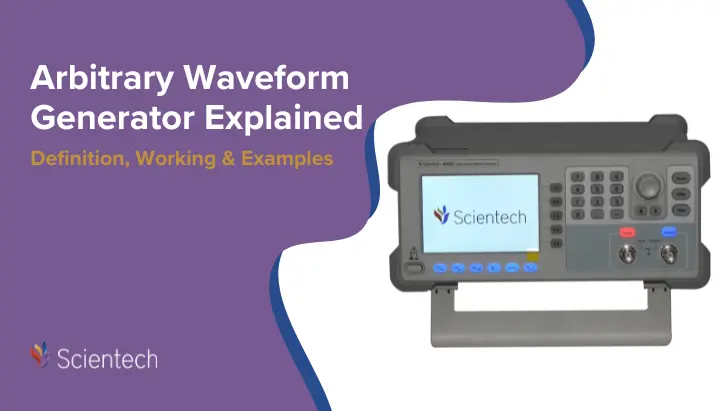
An Arbitrary Waveform Generator (AWG) is an electronic test device that can produce arbitrary waveforms rather than the usual mathematical forms. In contrast to a function generator, an AWG enables engineers to construct, edit, store and provide practically any shape of waveform that they can conceive.
An arbitrary waveform generator is a circuit that stores digitized waveform data in memory and then recreates the signal with a precise analog signal through the use of a digital to analog converter (DAC).
Contrary to standard function generators, an AWG enables the engineer to generate complex non-repetitive and real world signals with fine control of amplitude, frequency, phase, and timing. This makes arbitrary waveform generators essential for sophisticated testing in fields like communication systems, embedded electronics, power electronics, automotive testing and research laboratories.
Key Characteristics of an Arbitrary Waveform Generator
- Generates custom, non-repetitive, and complex waveforms
- Uses digital memory to store waveform data
- Converts digital samples into analog output using a DAC
- Allows precise control over amplitude, frequency, phase, and timing
- Capable of simulating real-world signals accurately
Because of these capabilities, AWGs are widely used in R&D labs, manufacturing test setups, communication system testing, automotive electronics, aerospace, and academic institutions.
Why Arbitrary Waveform Generators Are Important
Arbitrary waveform generators are important because they allow engineers to test systems using realistic, complex signals instead of idealized waveforms.. In real-life situations, signals are often characterized by noise, distortion, transients, and irregular patterns that are not possible on basic signal generators.
Using an arbitrary waveform generator, engineers can simulate actual environments of operation, reproduce captured field data and stress test circuits under edge cases and fault conditions. This results in more accurate testing, faster troubleshooting and improved product reliability – making AWGs important tools for modern R&D, manufacturing, education and advanced electronics testing.
The importance of AWGs lies in the fact that they are capable of simulating the real working conditions. Most electronic failures and design flaws occur under non-ideal, unpredictable, or transient conditions – conditions that can never be simulated by simple generators.
An arbitrary waveform generator enables engineers to:
- Test circuits under realistic signal conditions
- Reproduce field data captured from real systems
- Simulate sensor outputs, noise, glitches, and disturbances
- Validate designs before mass production
- Accelerate debugging and troubleshooting
How an Arbitrary Waveform Generator Works
The core idea of an Arbitrary Waveform Generator (AWG) is to define a signal digitally and then convert it into a precise analog output., with precision. It does not produce fixed mathematical waves, but rather recreates a waveform on a point by point basis by reference to stored data.
In the first step, the user specifies the desired waveform by software or by the instrument interface. This waveform is described by a sequence of digital representation of amplitude and is stored in the internal memory of the AWG. These values are then read by a precise clock at a fixed rate which is called the sampling rate.
The digital data is then transmitted to a Digital-to-Analog Converter (DAC) which converts the digital samples to a voltage level. The signal obtained is processed by filters and output amplifiers to regularize the signal and adjust the desired amplitude.
Lastly, the AWG produces a clean continuous analog signal at the output, that reproduces the original shape of the waveform with accuracy. This is because through this process, AWGs can produce very complex and natural signals in order to test and analyze more sophisticated electronics.
Understanding how an AWG works is essential to using it effectively. Although modern AWGs appear complex, their working principle is logical and systematic.
Basic Working Principle
At its core, an arbitrary waveform generator operates using the following steps:
- Waveform Definition
- Digital Storage
- Clocked Playback
- Digital-to-Analog Conversion
- Signal Conditioning and Output
1. Waveform Definition
Waveform definition is the first step of how an arbitrary waveform generator works. In this stage, the user defines the exact shape of the signal that is to be generated. Instead of using a predefined waveform, the user decides to create or customize a waveform by defining a series of amplitude values over time.
The user defines the desired waveform in one of several ways:
- Manually creating waveform points
- Using built-in waveform editing software
- Importing waveform data from simulation tools or measurement equipment
- Capturing real-world signals and replaying them
2. Digital Memory Storage
Once defined, the waveform data is stored in the AWG’s internal memory. This memory depth determines how long and detailed the waveform can be.
- Deeper memory → more waveform points → higher fidelity
- Shallow memory → limited waveform complexity
Memory depth is a critical specification when choosing an AWG.
3. Clock and Timing Control
A high-precision clock controls how fast the stored samples are read from memory. This clock determines the sampling rate, which directly affects:
- Maximum output frequency
- Signal accuracy
- Time resolution
Higher sampling rates allow better reproduction of fast-changing signals.
4. Digital-to-Analog Conversion (DAC)
The digital samples are fed into a Digital-to-Analog Converter (DAC). The DAC converts each digital value into a corresponding voltage level.
Key DAC parameters include:
- Vertical resolution (bits)
- Linearity
- Noise performance
Higher resolution DACs produce smoother and more accurate waveforms.
5. Output Filtering and Amplification
After DAC conversion, the signal passes through:
- Reconstruction filters to smooth waveform steps
- Output amplifiers to set voltage and current levels
The final result is a clean, continuous analog waveform at the output terminals.
Types of Waveforms Generated by an AWG
One of the biggest strengths of an arbitrary waveform generator is its versatility.
An Arbitrary Waveform Generator (AWG) can produce a wide variety of signals, making it far more versatile than basic signal generators. The main types of waveforms generated by an AWG include:
Standard Waveforms
AWGs can generate common waveforms such as sine, square, triangle, ramp, and pulse waves, which are useful for basic testing and comparison.
Arbitrary (Custom) Waveforms
Users can create completely custom waveforms by defining amplitude points over time. These include non-periodic, irregular, or real-world signal shapes that cannot be generated by traditional function generators.
Modulated Waveforms
AWGs support modulation techniques such as amplitude modulation (AM), frequency modulation (FM), phase modulation (PM), and pulse-width modulation (PWM), commonly used in communication and control systems.
Noise and Disturbance Signals
They can generate noise signals (white, pink, or Gaussian noise), glitches, jitter, and transient disturbances for stress testing and fault simulation.
Pulse and Digital-Like Signals
AWGs are capable of producing complex pulse trains, bursts, timing signals, and digital-style waveforms with precise control over rise time, width, and repetition.
Arbitrary Waveform Generator vs Function Generator
An Arbitrary Waveform Generator (AWG) and a Function Generator are both types of devices used to generate electrical signals, but they differ significantly in their capabilities and applications.
A Function Generator is used to generate standard predefined waveforms such as Sine Wave, Square Wave, Triangle Wave, Ramp Wave etc. It is easy to use, cheap and ideal for basic lab tests, education and other general testing. However, its flexibility is only in fixed mathematical waveforms.
An Arbitrary Waveform Generator, on the other hand, gives the user the option to generate and output custom, user-defined waveforms. It uses digital memory and a DAC to replicate complex, non-repetitive and real world signals with high levels of precision. AWGs provide advanced control for time, amplitude, modulation, and waveform shape, making them suitable for R&D, communication systems, automotive electronics, and advanced testing scenarios.
Understanding the difference between these two instruments is crucial.
Function Generator
- Generates fixed mathematical waveforms
- Limited flexibility
- Suitable for basic labs and education
- Lower cost and simpler operation
Arbitrary Waveform Generator
- Generates any waveform shape
- High flexibility and precision
- Suitable for advanced R&D and testing
- Higher cost but significantly more capability
Key Specifications to Consider When Choosing an AWG
Selecting the right AWG depends on application requirements.
Selecting the right Arbitrary Waveform Generator (AWG) depends on understanding a few critical technical specifications that directly affect performance and application suitability.
Sampling Rate
The sampling rate determines how fast waveform data is converted into an analog signal. Higher sampling rates allow accurate generation of high-frequency and fast-changing signals.
Vertical Resolution
Measured in bits, vertical resolution defines how finely the signal amplitude is represented. Higher resolution results in smoother waveforms with lower distortion.
Memory Depth
Memory depth controls how many data points can be stored for a waveform. Deeper memory enables longer, more detailed, and more complex signal generation.
Bandwidth
Bandwidth defines the frequency range over which the AWG can accurately reproduce signals. It should match or exceed the frequency requirements of your application.
Number of Output Channels
Single-channel AWGs are sufficient for basic testing, while multi-channel models are required for synchronized or multi-signal applications.
Output Amplitude and Impedance
Ensure the AWG supports the required voltage levels and standard output impedance (typically 50 ohms) for proper signal matching.
Software and Connectivity
Modern AWGs offer PC connectivity, waveform editing software, and automation support, which enhance usability and integration into test setups.
Advantages of Arbitrary Waveform Generators
Arbitrary waveform generators offer several key advantages that make them essential tools in modern electronics testing and development:
High Flexibility
AWGs can generate virtually any waveform shape, allowing engineers to create custom and non-standard signals that closely match real-world conditions.
Realistic Signal Simulation
They enable accurate reproduction of complex, noisy, and transient signals, helping validate system performance under practical operating scenarios.
Precision and Repeatability
With digital waveform storage and precise timing control, AWGs deliver highly repeatable and accurate signals for consistent test results.
Advanced Modulation Capabilities
AWGs support various modulation techniques such as AM, FM, PM, and PWM, making them ideal for communication and control system testing.
Wide Application Range
From R&D and manufacturing to education and automotive testing, AWGs are versatile instruments suitable for many industries.
Conclusion
An Arbitrary Waveform Generator is far more than a signal source—it is a critical enabler of accurate, realistic, and reliable electronic testing. By allowing engineers and students to generate custom, complex, and real-world waveforms, AWGs bridge the gap between ideal lab conditions and actual operating environments. From simulating sensor outputs and communication signals to stress-testing circuits under noise and transient conditions, AWGs make modern design validation faster, deeper, and more dependable. Understanding how an AWG works, how it differs from a function generator, and which specifications matter most helps users choose the right instrument for their needs. As electronic systems continue to grow in complexity, arbitrary waveform generators will remain indispensable tools for innovation, learning, and advanced testing.
FAQs
An arbitrary waveform generator is a test instrument that generates custom, user-defined electrical waveforms by storing digital data in memory and converting it into an analog signal using a DAC.
It is used to simulate real-world signals for testing and validating electronic systems in applications such as communication systems, embedded electronics, power electronics, and automotive testing.
A function generator produces fixed waveforms like sine and square waves, while an arbitrary waveform generator can create complex, non-repetitive, and fully customizable waveforms.
Yes, most AWGs can generate standard waveforms such as sine, square, triangle, ramp, and pulse waves in addition to custom waveforms.
Key specifications include sampling rate, vertical resolution, memory depth, bandwidth, number of channels, and software compatibility.
Yes, AWGs are suitable for advanced students and beginners working on complex projects, though basic learners may start with a function generator before moving to an AWG.