


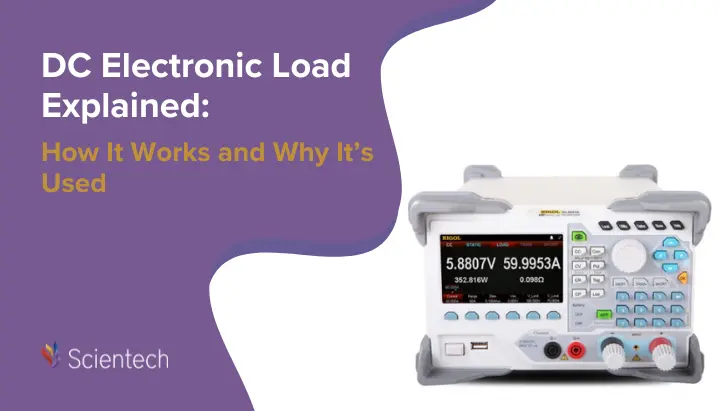
TL;DR,
- This blog is written for electronics engineers, R&D professionals, QA teams, students, and manufacturers who need a clear, practical understanding of DC electronic loads for power source testing.
- A DC electronic load is a programmable test instrument that safely absorbs power from DC sources and simulates real-world operating conditions with high accuracy.
- Unlike traditional resistive loads, it offers dynamic control over current, voltage, resistance, and power, enabling realistic and repeatable testing.
- Multiple operating modes (CC, CV, CR, CP) make it suitable for testing power supplies, batteries, converters, and renewable energy systems.
- With features like automation, precision, and built-in safety protections, DC electronic loads are essential for modern design validation and production testing.
In modern electronics, the design and validation of power sources is just as significant as the design of the devices they power. Whether it is a power supply, battery pack, DC-DC converter, or renewable energy system, engineers must ensure these sources are reliable and perform safely under real-world conditions. It is at this point that a DC electronic load will be a vital testing device.
Instead of old-fashioned fixed resistors and outdated testing techniques, engineers use programmable electronic loads to model real operating conditions with high accuracy and control. In DC electronic load, the current, voltage, resistance, or power can be controlled precisely, which makes it possible to test their performance, stability, and safety at dynamic conditions.
What Is DC Electronic Load?
A DC electronic load is a computerized test instrument designed to absorb and regulate power from a DC source such as a power supply, battery, DC-DC converter, or solar panel.Rather than delivering power, it absorbs electrical energy safely and transforms it into heat whilst keeping the amount of current, voltage, resistance or power easily controlled.
In simple terms, a DC electronic load is a smart, programmable load that helps replicate real operating conditions during electronic testing. A DC electronic load, in contrast to traditional fixed resistors, can be dynamically adjusted in its behavior, and is best used in high-precision testing conditions in the present day.
Related Blogs:
- What Is a Digital Storage Oscilloscope?
- Data Logging and Remote Monitoring: Driving Efficiency Across Research and Industry
- From Idea to Prototype: How Students Build Real Projects with PCB Prototyping and 3D Printing
Key Characteristics
- Absorbs power instead of supplying it
- Can dynamically change load conditions
- Provides accurate, repeatable test results
- Works across a wide range of voltages and currents
Why DC Electronic Loads Are Used
DC electronic loads are typically employed in both R&D laboratories, production facilities, quality assurance testing, and learning institutions to confirm that DC power sources can be reliable, efficient and safe under the various operating conditions.
Since DC electronic loads have the capability of dynamically controlling current, voltage, resistance or power as opposed to traditional resistive loads, they can be used to accurately represent real-world operating behavior. This enables the engineers to monitor the response of power supplies, batteries, and DC converters to varying load requirements, startup, and stress conditions.
The other important reason why a DC electronic load should be used is that it has a high degree of precision and repeatability. Exact values of loads can be set and the same test conditions can be reproduced again and again by the engineers which is vital in ensuring consistency in quality checks and performance checks. Also, more recent electronic loads are automated and programmable test sequences, which are well-suited to production testing and other long-term validation.
- Realistic simulation of real-world operating behavior
- Precision testing with exact current or power levels
- Repeatability for consistent quality checks
- Automation in production and validation testing
Whether validating a new power supply design or stress-testing a battery, a dc electronic load provides controlled, predictable, and measurable results.
How a DC Electronic Load Works
A DC electronic load operates by actively loading a regulated power supply of a DC source, and transforming the electrical power into heat, whilst regulating accurately the amount of current, voltage, resistance or power absorbed. As opposed to passive loads, it checks itself to ensure that it remains in the desired operating mode even when the input voltage variations take place.
The control system measures voltage and current real time by use of feedback sensors. When the input voltage varies or the load setting is altered, the control loop will adjust the conduction of the MOSFETs immediately to restore the mode chosen,e.g. Constant current or Constant Power. The energy that has been absorbed is then safely dissipated using heat sinks and cooling systems.
This loop reinforced design enables a DC electronic load to produce consistent, precise, and repeatable operation, and is therefore suitable when testing power supplies, batteries, and other DC power sources in realistic and dynamic operation.
- Connection to the DC source: The power supply, battery, or DC converter is connected to the electronic load’s input terminals.
- Load setting selection: The user selects the required operating mode Constant Current (CC), Constant Voltage (CV), Constant Resistance (CR), or Constant Power (CP) and sets the desired values.
- Power absorption: Internal power semiconductor devices (usually MOSFETs) act as electronically controlled variable resistors to draw the required current from the source.
Real-time measurement: Voltage and current sensors continuously monitor the input conditions. - Feedback control loop: The control circuitry compares measured values with the set parameters and instantly adjusts the MOSFET operation to maintain stable load conditions.
- Dynamic adjustment: If the input voltage changes or load conditions vary, the electronic load automatically compensates to keep the selected mode constant.
Key Features of a DC Electronic Load
A DC electronic load offers advanced capabilities that make it indispensable for accurate and reliable power source testing:
- Active Load Control
Precisely regulates load parameters such as current, voltage, resistance, or power to simulate real operating conditions. - High Accuracy and Repeatability
Delivers consistent and repeatable test results, ensuring dependable performance evaluation across multiple test cycles. - Multiple Operating Modes
Supports various modes including Constant Current (CC), Constant Voltage (CV), Constant Resistance (CR), and Constant Power (CP) to match different testing requirements. - Programmable and Automated Testing
Enables automated test sequences, data logging, and remote control through digital interfaces, improving testing efficiency and reducing manual intervention.
Operating Modes of a DC Electronic Load
A DC electronic load is also one of the assets that it has, as it can be used in various modes, which means that engineers can replicate various real-world electrical environments with the desired accuracy. Each of the operating modes regulates a particular electrical parameter enabling the rest to vary to achieve flexibility and precision in testing.
1. Constant Current (CC) Mode
- Draws a fixed current regardless of voltage changes
- Commonly used for battery discharge testing
2. Constant Voltage (CV) Mode
- Maintains a set voltage level
- Ideal for voltage regulation testing
3. Constant Resistance (CR) Mode
- Simulates a fixed resistive load
- Useful for testing power behavior under resistive conditions
4. Constant Power (CP) Mode
- Maintains a constant power draw
- Common in stress testing and efficiency evaluation
These modes allow engineers to simulate almost any real-world scenario.
Key Components Inside a DC Electronic Load
A DC electronic load is a combination of power electronics, control systems, and thermal management components which make it achieve its precision and flexibility. Knowledge of these internal components assists in the explanation of how the load would precisely represent real operating conditions and how they would be stable during testing.
Power Semiconductor Devices
- Typically MOSFETs or IGBTs
- Act as variable resistors controlled electronically
Control and Feedback Circuitry
- Continuously monitors voltage and current
- Adjusts load dynamically for accuracy
Cooling System
- Heat sinks and fans dissipate absorbed power
- Essential for high-power operation
User Interface and Communication
- Digital displays, knobs, or touchscreens
- USB, LAN, or GPIB interfaces for automation
DC Electronic Load vs Traditional Load Testing
Feature | DC Electronic Load | Traditional (Resistive) Load |
Adjustability | Fully adjustable to different test requirements | Fixed load values with no flexibility |
Accuracy | High precision and repeatable results | Limited accuracy due to fixed resistance |
Automation | Supports programmable and automated testing | Requires manual setup and monitoring |
Test Scenarios | Handles dynamic, real-world load conditions | Limited to static testing only |
Flexibility | Multiple operating modes for varied tests | Single, fixed load configuration |
Cost | Higher upfront investment | Lower initial cost |
For modern testing requirements, DC electronic loads clearly outperform traditional resistive testing methods.
Advantages of Using a DC Electronic Load
A DC electronic load offers significant advantages over traditional passive load methods, making it an essential tool in modern electronics testing. Its precision, flexibility, and built-in safety features enable engineers to evaluate power sources accurately under real-world operating conditions.
1. High Accuracy and Precision
DC electronic loads provide highly accurate control of current, voltage, resistance, and power. This precision ensures reliable and repeatable test results, which are critical for research and development as well as quality assurance.
2. Multiple Operating Modes
A DC electronic load, featuring Constant Current (CC), Constant Voltage (CV), Constant Resistance (CR), and Constant Power (CP) modes, can simulate a wide range of real-world operating conditions using a single device.
3. Realistic Load Simulation
Unlike fixed resistors, electronic loads can dynamically vary load conditions. This allows engineers to test how power sources respond to transient loads, startup behavior, and sudden changes in demand.
4. Programmability and Automation
Modern DC electronic loads support programmable test sequences and remote control through communication interfaces. This enables automated testing, reduces manual effort, and improves testing consistency, especially in production environments.
5. Enhanced Safety
Built-in protection features such as overvoltage, overcurrent, overpower, and overtemperature safeguards help protect both the device under test and the operator during high-power testing.
How to Choose the Right DC Electronic Load
The choice of DC electronic load is a very critical factor in precise testing effectiveness, equipment security, and durability. The best decision is based on your practicing goals, test condition, and performance needs. These are the major considerations that should be made prior to making a decision.
- Maximum voltage, current, and power ratings
- Required operating modes
- Accuracy and resolution
- Cooling method (air or liquid)
- Interface and automation needs
Conclusion
Understanding what a DC electronic load is highlights its importance in contemporary electronics testing. DC electronic loads provide the ability to test power sources with accuracy and safety by providing controlled programmable and repeatable load simulation.
Batteries and power supplies are only one part of the dc electronic load, though, with renewable energy systems and EV electronics,the DC electronic load is not just a testing aid; it is a foundational element of dependable electronic design and validation.
FAQs
It is used to test and simulate real operating conditions for DC power sources such as power supplies, batteries, and converters, allowing engineers to evaluate performance, stability, and reliability under controlled load conditions.
Yes, it provides controlled discharge, accurate monitoring, and protection features, making battery testing safe, repeatable, and precise without damaging the battery.
Constant Current (CC) mode is most commonly used because it allows batteries to be discharged at a fixed current, closely matching standard battery test requirements.
Most modern electronic loads support programmable and automated testing, enabling users to create test sequences, log data, and integrate with test systems.
The absorbed electrical energy is converted into heat and safely dissipated using internal cooling systems such as heatsinks and fans.