


TL;DR
- This blog is written for electronics engineers, R&D professionals, hardware startups, educators, students, and manufacturers who want a clear understanding of what a PCB prototyping machine is and how it is used in real-world electronics development.
- A PCB prototyping machine enables fast, in-house fabrication of PCB prototypes, allowing engineers to test and validate circuit designs before mass production.
- The blog explains how a pcb rapid prototyping machine works, from digital PCB design and Gerber files to milling, drilling, or printing functional circuit boards.
- It covers the main types of PCB Machines,including milling, laser, drilling, and additive systems,and highlights where each type is best applied.
- The blog outlines practical applications, advantages, and selection criteria, showing how the right pcb machine can reduce costs, speed up development, and improve design accuracy.
The foundation of nearly all of our current electronic gadgets such as smartphones and laptops, as well as industrial controllers and medical machines, is made up of Printed Circuit Boards (PCBs). With electronic products becoming more sophisticated and the time to market a product becoming more and more competitive, the speed of PCB design, test and refinement has become a crucial factor.
Rather than taking days or weeks before outsourced PCB samples can be received, now engineers can have prototype boards within hours. Here, in this blog, we shall learn what a PCB prototyping machine is, its operation, the primary types of it as well as the numerous applications that it promotes in different industries.
What Is a PCB Prototyping Machine?
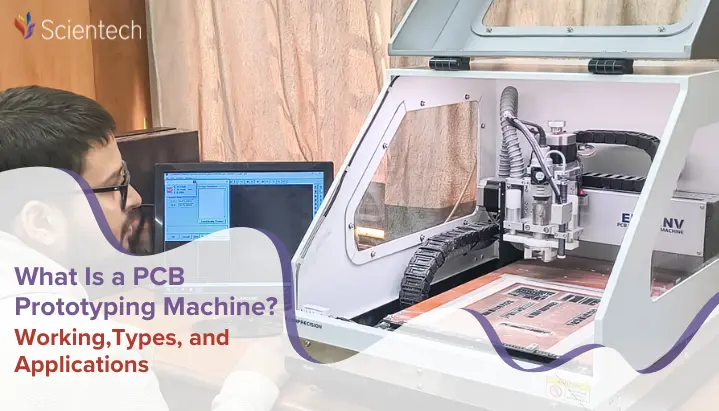
A pcb prototyping machine is a specialized machine that is used to make a functional prototype printed circuit board directly off digital design files. These machines are speed-optimized, precision-oriented, and low-volume production unlike mass-production PCB manufacturing that depends on chemical etching and massive production processes.
Also known as a PCB Machine or PCB Rapid Prototyping Machine, it enables a designer and engineers to create PCB layouts (Gerber files) into physical boards without contracting out. This allows faster testing, quicker design iterations, and better quality control at early stages of development.
PCB prototyping machines are commonly found in:
- Electronics R&D Labs
- Hardware startups
- Educational institutions
- Industrial design and testing environments
Related Blogs:
- From Idea to Prototype: How Students Build Real Projects with PCB Prototyping and 3D Printing
- Transforming Labs with Workbenches: Bringing Industrial Discipline to Education
- Data Logging and Remote Monitoring: Driving Efficiency Across Research and Industry
Why Is PCB Prototyping So Important?
PCB prototyping is necessary for the following reasons:
- Prototyping the circuit gives engineers an opportunity to test and to prove the circuit design to be effective prior to mass production. These issues can be identified early using a pcb prototyping machine, helping save time and money by avoiding design, layout, or thermal problems.
- A pcb rapid prototyping machine allows design iterations to be reduced from weeks to hours. Making boards in-house using a pcb machine allows the teams to have more control, reduce costs, and have more assurance that the completed PCB would work well in the real world.
- A small fault in design may cause signal problems, overheat or failure of the entire device. Prototyping enables the engineers to detect and correct these issues early in advance before the expensive mass production process commences. A pcb rapid prototyping machine saves significant iteration time, making innovation faster and less risky.
- Increased demand for PCB in modern electronics because of:
- High reliability
- Compact layouts
- Multi-layer routing
- Short development cycles
How Does a PCB Prototyping Machine Work?
Step-by-Step Working Process
- PCB Design Creation
Engineers design the PCB using CAD software such as Altium Designer, Eagle, or KiCad. The layout includes traces, pads, vias, and drill holes. - File Export
The design is exported as Gerber files and drill files, which serve as input instructions for the pcb prototyping machine. - Material Preparation
A copper-clad laminate (usually FR4) is placed on the machine bed. This serves as the base material for the PCB. - Board Fabrication
Depending on the technology, the pcb machine either:- Removes unwanted copper (subtractive method), or
- Deposits conductive material (additive method)
- Drilling and Finishing
Holes for through-hole components and vias are drilled automatically. The board is then cleaned and inspected. - Testing and Assembly
The prototype PCB is ready for component assembly and functional testing.
This streamlined process enables same-day PCB fabrication, which is a major advantage over traditional methods.
Key Components of a PCB Prototyping Machine
A modern pcb prototyping machine integrates multiple precision components to ensure accuracy and repeatability:
- Spindle or Print Head – Performs milling, drilling, or ink deposition
- Motion Control System – High-precision motors and linear guides
- Control Software – Converts Gerber files into machine instructions
- Tooling System – Milling bits, drills, or ink cartridges
- Vacuum or Dust Extraction – Keeps the workspace clean and safe
The integration of these components makes the pcb machine suitable for complex layouts and fine trace widths.
Types of PCB Prototyping Machines
There are several types of PCB prototyping machine, and each type fulfills a given design, precision and speed requirement. The selection of an appropriate pcb prototyping machine is dependent on the PCB complexity, required materials and development objectives.
1. PCB Milling Machines
PCB milling machines apply the subtractive milling process whereby undesirable copper is cut away on a copper-clad board by means of precision cutting tools. The reliability of this pcb machine has seen it used extensively in the creation of quick single and double-layer PCB prototypes because of low set up time and absence of chemicals.
2. PCB Drilling Machines
PCB drilling machines focus on accurately drilling holes for through-hole components and vias. Often integrated into advanced pcb prototyping systems, they ensure precise alignment and are essential for functional PCB assembly.
3. PCB Laser Prototyping Machines
Laser-based machines use high-energy laser beams to define circuit paths without physical contact. These pcb rapid prototyping machines are ideal for fine traces, high-frequency circuits, and applications where extreme precision is required.
4. Additive / Inkjet PCB Prototyping Machines
Additive PCB Machines create circuits by printing conductive ink directly onto the substrate instead of removing copper. This newer technology minimizes material waste and allows rapid design changes, making it suitable for research and experimental PCB development.
PCB Prototyping Machine vs Traditional PCB Machine
Aspect | PCB Prototyping Machine | Traditional Machine |
Turnaround Time | Hours | Days to weeks |
Production Volume | Low | Medium to high |
Cost per Board | Low for prototypes | Lower at scale |
Flexibility | Very high | Limited |
In-House Control | Full | Minimal |
For early-stage development and testing, a pcb prototyping machine clearly offers unmatched speed and flexibility.
Applications of PCB Prototyping Machines
PCB prototyping machines are used across a wide range of industries that require speed, precision, and flexibility in PCB development. A pcb prototyping machine enables engineers in electronics research and development to rapidly test their circuit designs, fix bugs, and optimize layouts and then proceed to mass production. Hardware startups use pcb rapid prototyping machines to manufacture and test prototypes quickly with low costs of development and full design control. PCB Machines are used in learning institutions and training laboratories to offer students first-hand knowledge in PCB design and electronics to help them understand the gap between theory and practice. PCB prototyping machines are used in the IoT, embedded systems, and industrial automation to develop custom control boards, sensor interfaces, and communication modules in a relatively short time to ensure a high degree of reliability in the real world.
Advantages of Using a PCB Rapid Prototyping Machine
- Speed: Same-day PCB fabrication
- Cost Efficiency: Reduced outsourcing expenses
- Design Flexibility: Easy modifications and iterations
- Confidentiality: Sensitive designs remain in-house
- Skill Development: Hands-on learning for engineers
These benefits explain why PCB Machines are now standard tools in modern electronics labs.
How to Choose the Right PCB Prototyping Machine?
Selecting the right pcb prototyping machine is crucial for efficient, accurate, and cost-effective board development. Whether you’re setting up a lab, upgrading your equipment, or exploring pcb rapid prototyping machine options, these key factors will help you make the best choice.
- Maximum board size and thickness
- Trace width and spacing resolution
- Supported materials
- Layer capability
- Software compatibility
- Budget and maintenance costs
Choosing the right pcb machine ensures reliable performance and long-term value.
Conclusion
A pcb prototyping machine has now become a very necessary machine in the development of electronics today. It allows engineers to be innovative without having to waste time because it allows quick, precise, and in-house PCB fabrication. You can be an R&D professional, an entrepreneur, or a teacher, but the correct pcb machine will enable you to design exponentially faster.
PCB rapid prototyping machines fill the gap between concept and product, and therefore can be regarded as a foundation of consistent and effective electronic design in the busy time schedule of the modern world.
FAQs
PCB prototyping machine is an assembly that is used to rapidly convert digital designs to test circuit boards which helps the engineers to verify and refine their circuits before transitioning to mass production.
It creates small volumes of PCBs in short periods and internally, whereas the manufacturing of PCBs in large volumes takes into consideration high-volume production and longer turnaround time.
Mill 5 PCB Machines are the most popular as they are quick, dependable, affordable, and easy to use in the case of fast prototyping requirements.
Multi-layer PCB prototyping machines are available in some advanced PCB prototyping machines, although the majority of desktop models are restricted to single or double-layered PCBs.
PCB prototyping machines are used by electronics engineers, students, startups, R&D teams and educational institutions to either test circuitry, learn or to develop products.