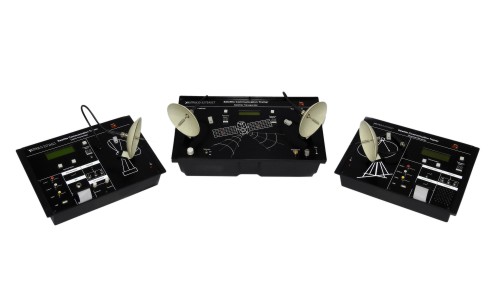
Scientech 2272A Satellite Communication platform provides an in-depth study of basic satellite communication systems. It consists of Uplink Transmitter, Satellite Link and Downlink Receiver, which can be conveniently placed in the laboratory. The Satellite can be placed at an elevated position if needed. The Satellite Transponder receives signal from Uplink Transmitter and retransmits at different frequencies to a Downlink Receiver. The Uplink and Downlink frequencies are selectable and can have a variety of signals such as Video, Audio, Voice, Tone, Data and Telemetry (Temperature and Light intensity).
The Operating manual illustrates basic theory and glossary of satellite communication terms along with Experiments related to the satellite communication system.
Features
- Simultaneous communication of three different signals
• Communicate Audio, Video, Digital data, PC data, Tone, Voice, function generator waveforms etc
• 2.4GHz Band PLL microwave operation for satellite communication
• Communication of external broad band digital signal
• Choice of different transmitting and receiving frequencies
• Built-in Speaker and Microphone for Voice and Audio link
• Remote detection of Light intensity and environment temperature
• Detachable Dish Antenna at each station for practical satellite communication system experiments
• USB port for PC communication
Understanding Satellite Communication System
A satellite communication system enables the transmission and reception of information over long distances using communication satellites. It generally includes an uplink transmitter, satellite transponder, and downlink receiver that work together to transfer different types of signals.
The Scientech 2272A helps students understand the fundamental concepts of satellite communication through practical laboratory experiments. The platform demonstrates how signals are transmitted from an uplink station, received and retransmitted by a satellite transponder, and then captured by a downlink receiver.
Key Applications
The Scientech 2272A can be used for laboratory training and demonstrations related to:
- Uplink and downlink communication
- Satellite transponder operation
- Audio and video signal transmission
- Digital and PC data communication
- Voice and tone transmission
- Microwave communication
- Temperature and light intensity telemetry
- Transmitting and receiving frequency selection
This practical approach helps students develop a better understanding of how a satellite communication system works and how different signals can be transmitted through a satellite link.
Benefits for Engineering Laboratories
The Scientech 2272A is designed to support practical education in satellite communication. Students can perform experiments, observe signal transmission and reception, and understand the role of different components used in a satellite communication system.
It is suitable for engineering colleges, universities, and technical laboratories where students need practical exposure to satellite communication principles and microwave-based communication technologies.
Why Choose Scientech 2272A for Satellite Communication?
The Scientech 2272A is designed to provide practical and hands-on learning of satellite communication concepts. It combines essential components of a satellite communication system in a laboratory-friendly platform, helping students understand both theoretical concepts and practical signal transmission.
- Practical Satellite Communication Training: Provides hands-on experience with uplink, satellite link, and downlink operations.
- Multiple Signal Types: Supports audio, video, voice, tone, digital data, PC data, and telemetry signals.
- 2.4 GHz Microwave Operation: Uses a 2.4 GHz PLL microwave system for practical satellite communication experiments.
- Selectable Frequencies: Allows users to work with different transmitting and receiving frequencies.
- Built-in Voice and Audio Support: Includes a speaker and microphone for voice and audio communication experiments.
- Telemetry Experiments: Enables remote detection of light intensity and environmental temperature.
- Detachable Dish Antennas: Provides practical exposure to antenna-based signal transmission and reception.
- PC Connectivity: Includes a USB port for PC communication and data-related experiments.
- Laboratory-Friendly Design: Components can be conveniently placed in a laboratory for demonstrations and experiments.
- Comprehensive Learning: Helps engineering students understand the working principles, components, and applications of a satellite communication system.
Frequently Asked Questions
1. What is satellite communication?
Satellite communication is a method of transmitting voice, video, data, and other signals over long distances using an artificial satellite. A typical satellite communication system includes an uplink transmitter, satellite transponder, and downlink receiver.
2. How does satellite communication work?
Satellite communication works by sending a signal from an earth-based uplink station to a satellite. The satellite transponder receives the signal, processes or amplifies it, and retransmits it at a different frequency to a receiving station on Earth.
3. What is the satellite communication frequency range?
The satellite communication frequency range depends on the application and frequency band being used. Common bands include L-band, S-band, C-band, X-band, Ku-band, and Ka-band, with each band covering a different frequency range and serving different communication requirements.
4. What are the main components of a satellite communication system?
The main components of a satellite communication system include an uplink transmitter, satellite transponder, and downlink receiver. Antennas are also used to transmit signals to and receive signals from the satellite.
5. What signals can be transmitted through satellite communication?
Satellite communication can transmit different types of signals, including audio, video, voice, digital data, PC data, tone, and telemetry information. The Scientech 2272A demonstrates several of these signal types for practical laboratory learning.